Customer support has always been an important part of building a successful business. Customers expect quick answers, helpful solutions, and a smooth experience whenever they interact with a company. However, as businesses grow, managing customer questions and support requests can become increasingly difficult.
This is where Artificial Intelligence (AI) is transforming customer support.
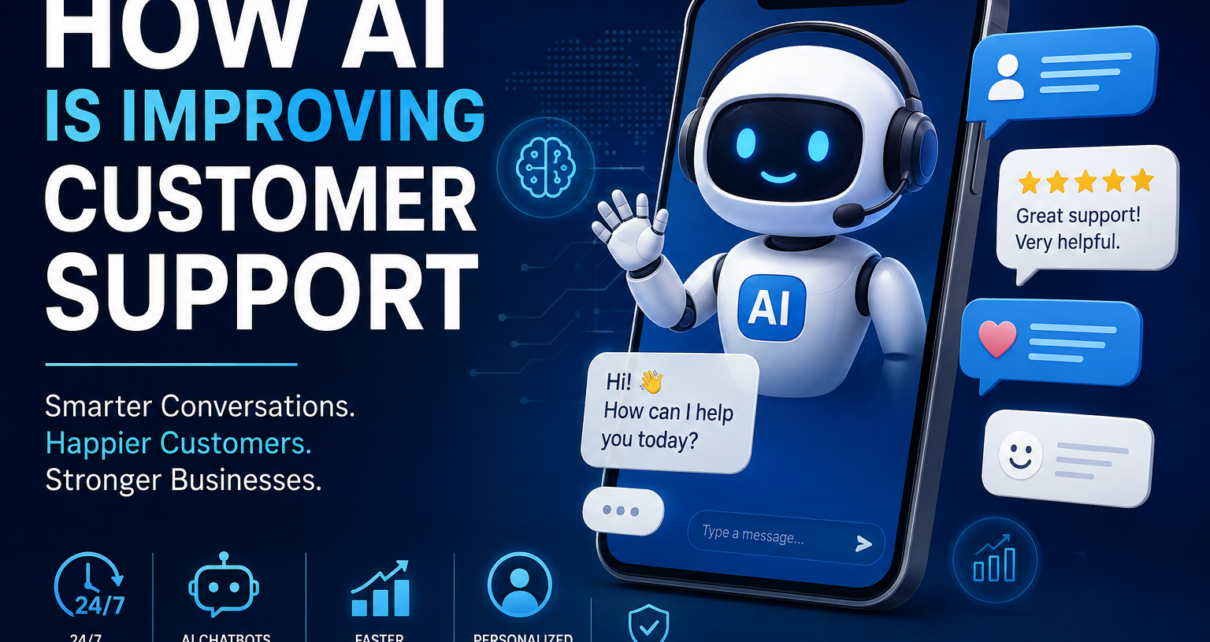
AI-powered customer support tools can help businesses answer common questions, automate repetitive tasks, analyze customer conversations, provide personalized assistance, and help support teams resolve issues more efficiently. From AI chatbots and virtual assistants to sentiment analysis and automated ticket routing, artificial intelligence is changing how companies communicate with their customers.
Unlike traditional customer service systems that rely heavily on human agents, AI can operate continuously and handle large numbers of customer interactions at the same time. This makes AI especially valuable for businesses that want to improve response times without dramatically increasing support costs.
But AI is not simply replacing customer service representatives. In many organizations, the biggest advantage comes from combining AI automation with human expertise. AI can take care of repetitive and predictable tasks while human agents focus on complex problems that require empathy, creativity, and judgment.
In this article, we will explore how AI is improving customer support, the major benefits of AI in customer service, practical use cases, challenges businesses should consider, and what the future of AI-powered customer support may look like.
What Is AI-Powered Customer Support?
AI-powered customer support refers to the use of artificial intelligence technologies to assist customers and support teams throughout the customer service process.
These technologies can understand customer questions, analyze conversations, identify patterns, retrieve information, and sometimes take action automatically.
Common AI customer support technologies include:
- AI chatbots
- Virtual customer service assistants
- Generative AI
- Natural language processing (NLP)
- Machine learning
- Sentiment analysis
- Automated ticket classification
- AI-powered knowledge bases
- Speech recognition
- Conversation analytics
- Predictive customer service tools
For example, instead of waiting for a support agent to respond to a simple question such as “How can I reset my password?”, an AI chatbot can immediately provide instructions.
For more complicated issues, AI can collect information about the problem and transfer the conversation to a human agent with relevant context.
This creates a more efficient support process while allowing human employees to spend more time solving complicated customer problems.
How AI Is Improving Customer Support
AI is improving customer support in several important ways. From faster responses to personalized experiences, businesses can use artificial intelligence at almost every stage of the customer service journey.
1. AI Provides 24/7 Customer Support
One of the biggest advantages of AI customer support is availability.
Human customer service teams usually operate according to specific working hours. Even businesses with large support departments may not be able to provide immediate assistance to every customer.
AI-powered support systems can operate 24 hours a day, seven days a week.
Customers can ask questions at midnight, during weekends, or on holidays and still receive an immediate response.
For global companies, this is particularly useful because customers may be located across different time zones.
AI can handle basic requests outside normal business hours and escalate complex problems when necessary.
Examples of 24/7 AI support include:
- Answering frequently asked questions
- Providing order information
- Explaining product features
- Helping customers navigate a website
- Troubleshooting common problems
- Checking account information
- Providing basic technical support
24/7 availability can improve customer satisfaction because customers do not always have to wait until the next business day to get help.
2. AI Reduces Customer Response Times
Long waiting times are one of the most frustrating aspects of customer service.
Customers increasingly expect businesses to respond quickly, especially when they are experiencing a technical problem, payment issue, or delivery problem.
AI can dramatically reduce response times by answering common questions instantly.
For example, if hundreds of customers ask about shipping times, an AI assistant can respond to each request simultaneously instead of forcing customers to wait for an available agent.
This allows businesses to provide faster support without requiring a proportional increase in their customer service workforce.
Faster support can lead to:
- Higher customer satisfaction
- Fewer abandoned conversations
- Lower support backlogs
- Better customer retention
- More efficient support teams
Speed is not the only factor that determines customer satisfaction, but it is an important part of a positive customer experience.
3. AI Chatbots Handle Repetitive Questions
Customer support agents often spend significant amounts of time answering the same questions repeatedly.
Examples include:
- “Where is my order?”
- “What are your business hours?”
- “How do I change my password?”
- “What payment methods do you accept?”
- “How can I cancel my subscription?”
- “Where can I find my invoice?”
- “How long does delivery take?”
These questions may be simple, but answering them manually consumes valuable employee time.
AI chatbots can automate many of these repetitive interactions.
Instead of requiring a support representative to answer every basic question, the chatbot can provide the appropriate information immediately.
Human agents can then focus on more complicated customer issues.
This creates a human-AI customer support model where AI handles routine work and employees handle situations that require human judgment.
4. AI Helps Support Agents Work More Efficiently
AI is not only useful for communicating directly with customers. It can also become a powerful assistant for customer service representatives.
Modern AI tools can help agents by:
- Summarizing customer conversations
- Suggesting responses
- Finding relevant information
- Searching internal knowledge bases
- Identifying customer sentiment
- Translating conversations
- Generating follow-up emails
- Summarizing previous support tickets
- Recommending possible solutions
For example, an agent may receive a complicated technical support ticket containing several paragraphs of information.
Instead of manually reading the entire conversation, an AI system can create a short summary containing the customer’s problem, previous troubleshooting steps, and requested resolution.
The agent can then quickly understand the situation and begin working on a solution.
This can significantly improve agent productivity.
5. AI Provides Personalized Customer Experiences
Customers increasingly expect businesses to understand their individual needs.
Generic responses may not always provide a satisfactory experience.
AI can analyze customer information, previous conversations, purchase history, preferences, and behavior to help businesses deliver more personalized support.
For example, an online retailer could use AI to understand that a customer is asking about a product they purchased recently.
Instead of providing generic information, the AI system can potentially provide assistance related to that specific purchase, depending on the company’s systems and permissions.
Personalization can make customer interactions feel more relevant and useful.
AI-powered personalization can include:
- Personalized product recommendations
- Customized troubleshooting
- Relevant account information
- Context-aware responses
- Personalized follow-ups
- Customer-specific offers
However, businesses must handle customer data responsibly and transparently when implementing these capabilities.
6. AI Improves Ticket Management
Large customer support teams may receive thousands of support tickets every day.
Manually reviewing, categorizing, prioritizing, and assigning every ticket can be time-consuming.
AI can automate much of this process.
An AI system can analyze incoming customer requests and determine:
- What the issue is
- How urgent it may be
- Which department should handle it
- Whether it can be resolved automatically
- Which agent may be best suited to handle it
For example, a payment-related problem could automatically be routed to the billing department, while a technical issue could be sent to technical support.
AI-powered ticket routing helps reduce delays and ensures that customer requests reach the right team more quickly.
7. AI Can Detect Customer Sentiment
Understanding what customers are saying is important, but understanding how customers feel can be equally valuable.
AI-powered sentiment analysis can examine customer messages and identify signals associated with emotions such as:
- Satisfaction
- Frustration
- Anger
- Confusion
- Urgency
- Disappointment
For example, a customer writing “I have contacted support three times and nobody has solved my problem” may indicate a high level of frustration.
An AI system can flag the conversation for priority handling.
This gives support teams an opportunity to intervene before the situation becomes a larger customer experience problem.
Sentiment analysis can also help businesses identify broader trends.
If many customers express frustration about the same product feature, the company may discover an opportunity to improve the product.
8. AI Makes Self-Service More Powerful
Many customers prefer solving simple problems themselves instead of contacting customer support.
Traditional knowledge bases and FAQ pages can help, but customers sometimes struggle to find the information they need.
AI can make self-service more conversational.
Instead of searching through dozens of articles, a customer can ask:
“How do I connect my account to the mobile app?”
An AI-powered support assistant can understand the question and provide a relevant answer based on the company’s approved knowledge sources.
This can make customer self-service faster and easier.
AI-powered self-service can help customers:
- Find product documentation
- Troubleshoot common problems
- Understand account settings
- Locate policies
- Learn how to use products
- Find billing information
- Resolve simple technical issues
When customers can solve simple problems independently, support teams receive fewer repetitive tickets.
9. AI Helps Businesses Predict Customer Problems
One of the most interesting applications of AI in customer service is predictive support.
Traditional customer support is often reactive.
A customer experiences a problem and contacts the company.
AI can help businesses move toward a more proactive model.
By analyzing historical data, product usage patterns, system information, and customer behavior, AI systems may identify signals that indicate a potential problem.
For example, a software company could identify unusual behavior suggesting that a customer may be experiencing difficulty with a particular feature.
The company could then provide a helpful tutorial or notification before the customer submits a support ticket.
Predictive customer support can help businesses solve problems before they become major frustrations.
10. AI Supports Multilingual Customer Service
Businesses operating internationally often need to support customers who speak different languages.
Hiring dedicated support teams for every language can be expensive and difficult to scale.
AI-powered translation and language processing can help businesses communicate with customers across multiple languages.
AI can assist with:
- Translating customer messages
- Translating support responses
- Understanding different languages
- Creating multilingual knowledge bases
- Providing multilingual chatbot support
This can help businesses expand their customer service capabilities without building completely separate support operations for every market.
However, human review may still be important for sensitive, technical, legal, or highly nuanced communications.
11. AI Improves Call Center Operations
AI is also changing traditional call centers.
Speech recognition technology can convert conversations into text, while AI can analyze those conversations to identify important information.
AI-powered call center systems may help with:
- Automatic call transcription
- Conversation summaries
- Agent assistance
- Customer sentiment analysis
- Quality monitoring
- Automated call categorization
- Real-time information retrieval
For example, an AI assistant could listen to a customer service conversation and help an agent quickly find relevant information while the call is taking place.
After the call, AI can generate a summary and potentially identify follow-up actions.
This reduces administrative work and allows agents to focus more heavily on the customer.
12. AI Helps Identify Knowledge Gaps
A company’s customer support conversations contain valuable information.
AI can analyze thousands of conversations to discover recurring questions that are not adequately covered by the company’s documentation.
For example, if customers repeatedly ask about a particular product feature that is missing from the knowledge base, AI analytics can identify the pattern.
The company can then create a new FAQ article, tutorial, video, or help-center page.
This creates a continuous improvement cycle:
Customer questions → AI analysis → Knowledge gap identified → New content created → Better self-service
Over time, this can reduce repetitive support requests and improve the overall customer experience.
13. AI Helps Improve Customer Retention
Customer support has a direct relationship with customer retention.
When customers experience unresolved problems, slow responses, or poor communication, they may decide to move to a competitor.
AI can help companies identify customers who may be at risk.
Signals could include:
- Repeated support requests
- Negative sentiment
- Frequent complaints
- Unresolved tickets
- Declining engagement
- Repeated requests for cancellation
AI can bring these signals to the attention of customer service or customer success teams.
A human employee can then take appropriate action, such as contacting the customer, resolving the issue, or providing additional assistance.
AI therefore becomes a tool for improving customer relationships rather than simply answering questions.
Benefits of AI in Customer Support
The adoption of artificial intelligence can provide several important benefits for businesses.
Faster Response Times
AI can answer many common questions instantly, reducing customer waiting times.
Lower Support Costs
Automation can reduce the amount of repetitive work handled manually.
Higher Agent Productivity
Support representatives can spend more time on complex issues.
24/7 Availability
AI systems can provide support outside traditional business hours.
Better Scalability
Businesses can handle increasing support volumes without increasing staffing at the same rate.
More Personalized Experiences
AI can use customer context to make interactions more relevant.
Better Customer Insights
AI can identify patterns and trends across large volumes of customer conversations.
Improved Consistency
AI can provide standardized responses for common questions, provided the underlying information is accurate and well maintained.
AI vs. Human Customer Support: Which Is Better?
The question is not necessarily whether AI or humans are better.
The strongest customer support strategies often combine both.
AI is particularly good at:
- Repetitive tasks
- Fast responses
- Data analysis
- Information retrieval
- Ticket classification
- Basic troubleshooting
- Handling large volumes of requests
Humans are particularly good at:
- Empathy
- Complex problem solving
- Negotiation
- Sensitive situations
- Creative thinking
- Emotional conversations
- Exceptional customer recovery
For example, an AI chatbot may successfully help a customer reset a password.
But if a customer has experienced a serious billing problem for several weeks, a human representative may be better equipped to understand the situation and provide an appropriate resolution.
The goal should therefore be AI-assisted customer service, rather than blindly replacing human support.
Challenges of Using AI for Customer Support
Despite its benefits, AI customer support also has challenges.
1. AI Can Make Mistakes
AI systems are not perfect.
They may misunderstand questions, provide outdated information, or generate incorrect responses.
Businesses should use reliable knowledge sources, monitoring, testing, and human escalation processes.
2. Lack of Human Empathy
Customers dealing with sensitive problems may prefer speaking with a human.
Businesses should make it easy for customers to reach a human representative when necessary.
3. Data Privacy
AI customer support systems may process sensitive customer information.
Companies need appropriate privacy, security, access controls, and data governance practices.
4. Implementation Costs
Advanced AI systems can require investment in software, integration, training, infrastructure, and ongoing maintenance.
5. Customer Trust
Some customers may be uncomfortable interacting with AI, particularly if they do not know whether they are speaking to a human or automated system.
Transparency can help build trust.
How Businesses Can Successfully Implement AI Customer Support
Businesses should avoid implementing AI simply because it is a popular technology trend.
Instead, companies should start with specific customer support problems.
Step 1: Identify Repetitive Tasks
Find questions and processes that consume significant employee time.
Step 2: Start With a Focused Use Case
A company might begin with an AI chatbot for FAQs rather than attempting to automate its entire customer service operation.
Step 3: Build a Reliable Knowledge Base
AI is only as useful as the information it can access.
Companies should maintain accurate, updated, and well-organized support documentation.
Step 4: Create Human Escalation
Customers should have a clear path to a human representative when AI cannot resolve the issue.
Step 5: Monitor AI Performance
Track metrics such as:
- Resolution rate
- Customer satisfaction
- Response time
- Escalation rate
- Accuracy
- Ticket volume
- Agent productivity
Step 6: Continuously Improve
Analyze unsuccessful conversations and use those insights to improve AI responses and support content.
Key AI Customer Support Use Cases
Businesses across industries can apply AI to customer service in different ways.
| AI Use Case | Customer Support Benefit |
|---|---|
| AI Chatbots | Instant answers to common questions |
| Ticket Classification | Faster issue routing |
| Sentiment Analysis | Identifies frustrated customers |
| Automated Summaries | Saves agent time |
| AI Knowledge Search | Faster information retrieval |
| Predictive Support | Helps identify potential issues |
| Translation | Supports global customers |
| Voice AI | Automates selected phone interactions |
| Personalized Recommendations | More relevant customer experiences |
| Conversation Analytics | Identifies trends and support problems |
Important Customer Support Metrics to Track
Businesses should measure the impact of AI instead of assuming it is improving customer service.
Important metrics include:
First Response Time
How long customers wait before receiving an initial response.
Average Resolution Time
How long it takes to resolve customer issues.
First Contact Resolution
The percentage of problems resolved during the initial interaction.
Customer Satisfaction Score
Measures how satisfied customers are with their support experience.
Customer Effort Score
Measures how easy it was for customers to resolve their problem.
AI Resolution Rate
Measures how many customer requests AI can successfully resolve without human intervention.
Escalation Rate
Measures how often AI conversations need to be transferred to human agents.
These metrics can help companies determine whether AI is actually improving customer support.
The Future of AI in Customer Support
The future of customer support is likely to become increasingly intelligent, personalized, and proactive.
AI systems will continue to improve their ability to understand customer intent, maintain conversation context, retrieve information, and assist human agents.
Businesses may increasingly use AI agents that can perform complete support workflows rather than simply answer questions.
For example, instead of telling a customer how to update an account, an AI system may eventually be able to guide the customer through the process or perform authorized actions on their behalf.
Another important development will be the integration of AI across multiple customer service channels.
A customer might begin a conversation through a website chatbot, continue it through a mobile application, and then speak to a human agent by phone without having to explain the entire situation again.
AI could maintain the relevant context across these interactions.
The result could be a more connected and seamless customer experience.
Will AI Replace Customer Service Agents?
One of the biggest concerns surrounding AI customer support is whether automation will eliminate customer service jobs.
While AI will automate many repetitive tasks, the future of customer support is more likely to involve collaboration between humans and AI.
As AI handles routine questions, customer service professionals may increasingly focus on higher-value activities such as:
- Complex problem solving
- Relationship management
- Customer retention
- Escalation handling
- Strategic customer success
- Emotional support
- Quality assurance
In this model, AI becomes an assistant that helps customer service representatives work faster and more effectively.
The role of the customer service professional may change, but human interaction will remain valuable for many types of customer problems.
Best Practices for AI-Powered Customer Support
Businesses should follow several best practices when adopting AI.
Keep Humans in the Loop
AI should have clear escalation paths for complicated or sensitive situations.
Be Transparent
Customers should understand when they are interacting with an AI system.
Use High-Quality Data
AI systems require accurate information to provide reliable support.
Protect Customer Data
Security and privacy should be fundamental parts of the implementation.
Test Before Scaling
Businesses should test AI with real-world scenarios before deploying it widely.
Monitor Customer Feedback
Customer feedback can reveal problems that automated metrics may miss.
Keep Knowledge Current
Outdated information can result in poor AI responses.
Measure Business Results
AI should improve measurable outcomes rather than simply add another technology layer.
Frequently Asked Questions About AI in Customer Support
What is AI in customer support?
AI in customer support involves using artificial intelligence technologies such as chatbots, natural language processing, machine learning, and generative AI to assist customers and support teams.
How does AI improve customer service?
AI can improve customer service by providing faster responses, offering 24/7 assistance, automating repetitive tasks, personalizing interactions, analyzing customer sentiment, and helping human agents resolve problems more efficiently.
Can AI completely replace customer service agents?
AI can automate many routine customer service tasks, but it is unlikely to replace human support completely. Complex, sensitive, and highly personalized situations often require human judgment and empathy.
What are AI chatbots used for?
AI chatbots can answer frequently asked questions, provide basic troubleshooting, help customers find information, collect support details, and route complicated requests to human representatives.
Is AI customer support available 24/7?
Yes. AI-powered customer support systems can operate continuously, allowing customers to receive assistance outside normal business hours.
Does AI reduce customer support costs?
AI can potentially reduce support costs by automating repetitive tasks and helping human agents handle more customer requests efficiently. Actual savings depend on implementation, support volume, technology costs, and the types of tasks being automated.
How does AI personalize customer support?
AI can analyze available customer context, previous interactions, preferences, and other authorized information to provide more relevant responses and recommendations.
What are the risks of AI in customer service?
Major risks include inaccurate responses, privacy concerns, security issues, lack of empathy, outdated information, excessive automation, and poor escalation processes.
Is AI good for small businesses?
Yes. Small businesses can use AI customer support tools to automate common questions, provide after-hours assistance, reduce repetitive work, and give small support teams more time to focus on complex customer needs.
Conclusion
Artificial intelligence is changing customer support from a reactive service function into a faster, more intelligent, and increasingly proactive part of the customer experience.
From AI chatbots and automated ticket routing to sentiment analysis, predictive support, personalized communication, and agent assistance, businesses have numerous opportunities to use AI to improve customer service.
The biggest advantage of AI is not simply automation. It is the ability to combine automation, data analysis, and human expertise.
AI can answer simple questions instantly. It can analyze thousands of conversations. It can identify recurring problems and help agents find information faster. Meanwhile, human employees can focus on situations where empathy, judgment, and creativity are essential.
Businesses that implement AI thoughtfully can potentially deliver faster responses, improve agent productivity, reduce repetitive workloads, and create more personalized customer experiences.
However, successful AI customer support requires more than installing a chatbot. Companies need accurate information, strong data protection, human escalation, continuous monitoring, and a clear understanding of what customers actually need.
The future of customer service is therefore unlikely to be AI versus humans. Instead, it will be AI working alongside humans.
Businesses that find the right balance between automation and human interaction will be better positioned to deliver customer support that is not only faster, but also more useful, personal, and trustworthy.
AI is not simply changing how businesses answer customer questions—it is changing what customers expect from customer support itself.