Artificial intelligence has changed the way people write.
From blog posts and website copy to emails, product descriptions, social media captions, reports, and creative stories, AI writing tools can help users move from an empty page to a usable first draft much faster.
But choosing the best AI writing tool is not as simple as picking the most popular platform. Different tools are designed for different purposes. Some are excellent at generating long-form content, while others are better for grammar and editing. Some focus heavily on marketing and SEO, while others are designed specifically for fiction writers or business teams.
In 2026, the AI writing landscape is more competitive than ever. General-purpose assistants such as ChatGPT and Claude compete with specialized platforms such as Grammarly, Jasper, Writesonic, Copy.ai, Rytr, and Sudowrite.
The good news is that you don’t necessarily need to choose only one.
A blogger might use ChatGPT or Claude to develop ideas, Writesonic for SEO-focused content, and Grammarly for final editing. A novelist may prefer Sudowrite, while a marketing department may benefit more from Jasper or Copy.ai.
This guide compares the best AI writing tools in 2026, their strengths, weaknesses, ideal users, and the types of writing tasks they handle best.
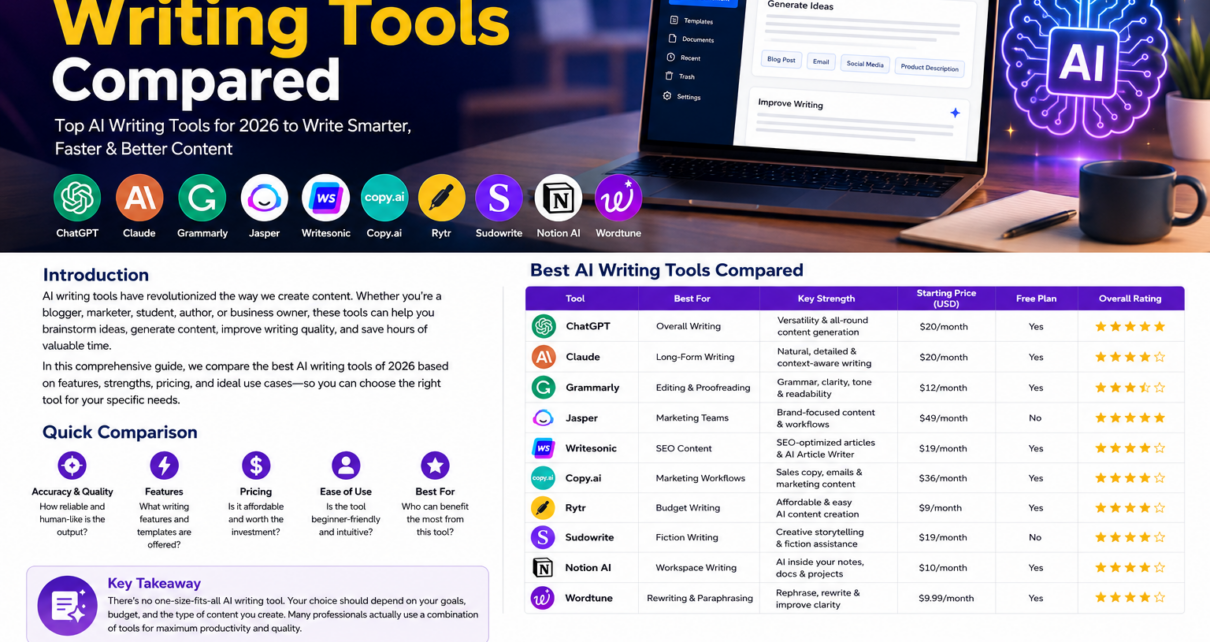
Best AI Writing Tools Compared
| AI Writing Tool | Best For | Main Strength | Ideal User |
|---|---|---|---|
| ChatGPT | Overall writing | Versatile writing and editing | Almost everyone |
| Claude | Long-form writing | Natural, detailed prose | Writers & researchers |
| Grammarly | Editing | Grammar, clarity and tone | Professionals & students |
| Jasper | Marketing | Brand-focused content | Marketing teams |
| Writesonic | SEO content | SEO and article creation | Bloggers & marketers |
| Copy.ai | Marketing workflows | Marketing and GTM content | Businesses |
| Rytr | Budget writing | Affordable content creation | Beginners |
| Sudowrite | Fiction | Creative storytelling | Authors |
| Notion AI | Workspace writing | Writing inside a knowledge workspace | Teams |
| Wordtune | Rewriting | Rephrasing and clarity | Professionals & students |
1. ChatGPT – Best Overall AI Writing Tool
When it comes to versatility, ChatGPT is one of the strongest choices for AI-assisted writing.
It can help with brainstorming, outlining, drafting, rewriting, summarizing, translating, editing, and adapting content for different audiences. OpenAI specifically recommends a writing workflow built around planning, drafting, revising, and packaging content for its intended format.
ChatGPT is particularly useful because it isn’t limited to a single type of writing.
You can use it to create:
- Blog posts
- Website content
- Emails
- Product descriptions
- Social media posts
- Business reports
- Ad copy
- Scripts
- FAQs
- Headlines
- Content outlines
- Meta descriptions
- Creative writing
Its Canvas and writing features also make it useful for longer documents and iterative editing. Canvas allows writers to work on a document, highlight sections, request targeted revisions, change length or reading level, and polish the final draft.
Pros
- Extremely versatile
- Excellent for brainstorming
- Useful for long-form writing
- Strong rewriting capabilities
- Can adapt tone and audience
- Supports many writing formats
- Useful for research-assisted writing
Cons
- Requires good prompts for consistently strong results
- AI-generated facts still need verification
- Generic prompts can produce generic content
- Not exclusively designed for SEO content
Best for
Bloggers, marketers, business owners, students, freelancers, and virtually anyone who needs an AI writing assistant.
Verdict
Best overall AI writing tool for 2026.
2. Claude – Best AI Writing Tool for Long-Form Content
Claude is another excellent option for writers who prioritize natural language, detailed reasoning, and long-form content.
It can be particularly useful when you want to work with substantial amounts of source material or develop a document gradually rather than generate a short piece of copy from a simple prompt.
Claude works well for:
- Articles
- Reports
- Essays
- Research summaries
- Business documents
- Scripts
- Brainstorming
- Editing
- Long-form drafts
One of its biggest advantages is its ability to maintain context while working through complex writing projects.
For professional writers, this can make Claude useful as a writing partner rather than simply a text generator.
Pros
- Strong long-form writing
- Natural-sounding prose
- Good at restructuring documents
- Useful for analysis and brainstorming
- Good at working with detailed instructions
Cons
- Not primarily an SEO platform
- Marketing-specific workflows are less specialized than dedicated platforms
- Users still need to fact-check generated information
Best for
Authors, researchers, consultants, students, and professionals working on long documents.
Verdict
A strong choice when writing quality and long-form content matter most.
3. Grammarly – Best AI Writing Tool for Editing
Grammarly has evolved far beyond traditional spell-checking.
Its AI-powered features can help users compose, rewrite, brainstorm, improve clarity, adjust tone, and polish existing content. Grammarly describes its generative AI as supporting composition, rewriting, ideation, and replies while adapting suggestions to context and personal voice.
Its strength is not necessarily generating a 3,000-word article from scratch. Instead, Grammarly shines when you already have something written and want to make it clearer, more professional, concise, or polished.
It can help identify:
- Grammar errors
- Spelling mistakes
- Punctuation problems
- Wordiness
- Unclear sentences
- Tone problems
- Repetitive language
- Awkward phrasing
Grammarly also offers paragraph-level rewrites and AI-powered writing agents, including tools focused on proofreading, paraphrasing, and reader reactions.
Pros
- Excellent grammar checking
- Strong editing capabilities
- Tone suggestions
- Easy to use
- Works across many writing environments
- Useful for professional communication
Cons
- Not the best standalone tool for long-form content generation
- Advanced features require paid access
- Some AI suggestions still require human judgment
Best for
Students, professionals, bloggers, business owners, and anyone who wants to improve existing writing.
Verdict
Best AI writing assistant for editing and polishing.
4. Jasper – Best AI Writing Tool for Marketing Teams
Jasper is designed primarily around marketing and business content.
Rather than functioning only as a general chatbot, Jasper focuses on marketing workflows, brand consistency, and content creation.
This makes it especially attractive to businesses that need to produce a large amount of marketing content while maintaining a consistent voice.
Typical use cases include:
- Blog content
- Advertising copy
- Social media content
- Landing pages
- Email campaigns
- Product marketing
- Brand messaging
The biggest advantage of a specialized marketing platform is workflow.
Instead of starting from a blank chat window every time, marketing teams can work within repeatable content processes.
Pros
- Marketing-focused
- Useful for brand consistency
- Helpful for marketing teams
- Supports multiple content formats
- Good for campaign-focused workflows
Cons
- Can be expensive for individual users
- Overkill for simple writing tasks
- General AI assistants may offer more flexibility
Best for
Marketing departments, agencies, content teams, and businesses with established brand guidelines.
Verdict
One of the best AI writing tools for professional marketing teams.
5. Writesonic – Best AI Writing Tool for SEO Content
If your primary goal is creating online content, Writesonic deserves serious consideration.
Writesonic’s AI Article Writer is designed specifically around long-form article creation. Its newer article-writing capabilities include options such as tone customization, internal linking, source citations, FAQs, calls to action, and SEO-oriented workflows.
That makes it particularly relevant for:
- SEO agencies
- Bloggers
- Affiliate marketers
- Website owners
- Content marketers
- Digital marketing agencies
For SEO writers, the advantage is having multiple content-related tasks within one platform.
However, no AI writing platform should replace actual SEO strategy.
AI can help produce content, but writers still need to evaluate search intent, competition, topical coverage, originality, internal links, user experience, and factual accuracy.
Pros
- Strong focus on SEO content
- Designed for long-form articles
- Useful content workflows
- Internal linking capabilities
- Helpful for marketers producing content at scale
Cons
- May be more than casual users need
- SEO tools still require human strategy
- Generated content should be reviewed before publication
Best for
SEO professionals, bloggers, affiliate marketers, agencies, and content teams.
Verdict
One of the best AI writing tools for SEO-focused content production.
6. Copy.ai – Best for Marketing Workflows
Copy.ai is another platform built around business and marketing content.
It can help marketers generate and transform copy for different channels, making it useful when a business needs more than simple blog generation.
Potential use cases include:
- Sales copy
- Email content
- Website copy
- Social media content
- Product descriptions
- Marketing campaigns
- Business communications
One of the major advantages of specialized marketing AI tools is repeatability. A company can develop workflows that make content production more systematic.
Pros
- Marketing-focused
- Useful for business content
- Good for repetitive content tasks
- Helpful for teams
- Supports multiple marketing use cases
Cons
- Less useful if you only need occasional writing
- Specialized features may take time to learn
- General-purpose AI assistants can be more flexible
Best for
Marketing teams, sales teams, startups, agencies, and businesses creating content at scale.
Verdict
A strong choice for businesses looking to integrate AI into marketing workflows.
7. Rytr – Best Budget AI Writing Tool
Rytr is aimed at users who want straightforward AI writing assistance without the complexity of a large enterprise platform.
According to Rytr, the platform supports more than 40 use cases covering areas such as content creation, editing, marketing, creative writing, and professional communication.
This makes it useful for beginners.
You can use Rytr for:
- Blog ideas
- Emails
- Social posts
- Product descriptions
- Ad copy
- Website content
- Rewriting
- Expanding short content
Its simplicity is one of its biggest strengths.
Pros
- Beginner-friendly
- Multiple use cases
- Useful templates
- Affordable positioning
- Good for short-form copy
Cons
- Less sophisticated than some premium platforms
- Long-form output may require more editing
- Advanced SEO users may want specialized tools
Best for
Students, freelancers, small businesses, and beginners.
Verdict
One of the best affordable AI writing tools for everyday content creation.
8. Sudowrite – Best AI Writing Tool for Fiction
Not every writer needs AI for SEO or marketing.
Novelists and creative writers have very different requirements.
Sudowrite is designed specifically for fiction and storytelling. Instead of concentrating primarily on marketing templates, it provides tools intended to help authors develop stories, characters, scenes, and narrative ideas.
It can be useful for:
- Novel writing
- Short stories
- Character development
- Scene development
- Creative brainstorming
- Story descriptions
- Fiction editing
Pros
- Built specifically for creative writers
- Helpful for overcoming writer’s block
- Useful for story development
- Designed around narrative writing
Cons
- Not ideal for business writing
- Not primarily an SEO platform
- Fiction writers still need to maintain their own voice
Best for
Novelists, short-story writers, screenwriters, and creative writers.
Verdict
One of the best specialized AI writing tools for fiction.
9. Notion AI – Best for Writing Inside a Workspace
Notion AI is particularly useful for people who already use Notion to manage documents, projects, notes, and team information.
Instead of separating writing from your workspace, Notion brings AI assistance directly into the environment where your information is already stored.
Its writing features can help with:
- Editing
- Rewriting
- Summarizing
- Brainstorming
- Content creation
- Tone adjustment
- Grammar improvement
Notion also emphasizes writing that follows a user’s or team’s style guidelines, which can be useful for maintaining consistency across business content.
Pros
- Integrated with a productivity workspace
- Useful for teams
- Good for documentation
- Helpful for editing and rewriting
- Supports style consistency
Cons
- Most valuable if you already use Notion
- Not a dedicated SEO writing platform
- May not be the best standalone AI writer
Best for
Startups, teams, project managers, content teams, and Notion users.
Verdict
Best AI writing tool for users who want AI integrated into their workspace.
10. Wordtune – Best for Rewriting and Paraphrasing
Sometimes the problem isn’t creating content.
You already know what you want to say—you just need to say it better.
That’s where rewriting-focused tools such as Wordtune can be useful.
These tools are particularly helpful for:
- Rephrasing sentences
- Improving clarity
- Simplifying complex writing
- Changing tone
- Making text more concise
- Finding alternative wording
This makes them useful for students, professionals, bloggers, and non-native English writers.
Pros
- Excellent for rewriting
- Easy to use
- Helpful for clarity
- Good for alternative phrasing
Cons
- Not designed primarily for large-scale content creation
- Less suitable for complete marketing workflows
- Best used alongside other writing tools
Best for
People who already have a draft but want better wording.
Verdict
A useful AI writing assistant for rewriting and improving existing text.
Best AI Writing Tools by Use Case
Choosing one overall winner doesn’t make sense for every writer.
Here’s a simpler breakdown.
Best Overall: ChatGPT
Choose ChatGPT if you need one flexible AI writing assistant that can handle many different tasks.
Best for Long-Form Writing: Claude
Choose Claude when your priority is detailed, natural long-form writing and working with substantial context.
Best for Editing: Grammarly
Choose Grammarly if you already write your own content and want help improving grammar, clarity, tone, and readability.
Best for SEO Content: Writesonic
Choose Writesonic if your primary goal is producing SEO-focused online content.
Best for Marketing Teams: Jasper
Choose Jasper if your company needs brand-focused marketing content and repeatable workflows.
Best for Marketing Workflows: Copy.ai
Choose Copy.ai if your team wants to incorporate AI into broader marketing and sales processes.
Best Budget Option: Rytr
Choose Rytr if you want simple AI writing assistance at a lower cost.
Best for Fiction: Sudowrite
Choose Sudowrite if you’re a novelist or creative writer.
Best for Teams Using Notion: Notion AI
Choose Notion AI if your writing and documentation already live inside Notion.
Best for Rewriting: Wordtune
Choose Wordtune when your main goal is improving or rephrasing existing text.
AI Writing Tools Comparison: Which One Should You Choose?
The right tool depends on what you’re trying to accomplish.
For Bloggers
Bloggers should prioritize tools that can help with research, outlining, drafting, editing, and SEO.
Recommended: ChatGPT, Claude, Writesonic, and Grammarly.
A useful workflow is to use one tool for research and outlining, another for drafting if necessary, and an editing tool for the final review.
For SEO Professionals
SEO professionals need more than an AI text generator.
The tool should support content planning, search intent, topical coverage, internal linking, and optimization.
Recommended: Writesonic, ChatGPT, and Grammarly.
However, remember that AI-generated content is not automatically SEO-friendly. Search engines reward useful content that satisfies users, not simply content generated by a particular software platform.
For Copywriters
Copywriters often need multiple variations of the same message.
They may need:
- Headlines
- Ad copy
- Product descriptions
- Email subject lines
- Landing page copy
- Calls to action
Recommended: Jasper, Copy.ai, ChatGPT, and Rytr.
For Businesses
Businesses should prioritize consistency, collaboration, brand voice, and workflow integration.
Recommended: Jasper, Copy.ai, Notion AI, and Grammarly.
For Students
Students can use AI writing tools for brainstorming, outlining, grammar improvement, summarization, and feedback.
Recommended: ChatGPT, Claude, Grammarly, and Wordtune.
Students should always follow their school’s or university’s AI policies and use AI in ways that support learning rather than replacing their own work.
For Authors
Fiction writers have different requirements from marketing professionals.
Recommended: Sudowrite and Claude.
The best approach is to use AI as a creative partner while keeping your own characters, voice, themes, and narrative decisions at the center of the process.
How to Choose the Best AI Writing Tool
Before subscribing to an AI writing platform, consider these seven factors.
1. Your Primary Writing Task
First, identify what you write most often.
If you create blog posts, choose a tool optimized for long-form content.
If you write emails, an editing assistant may be more useful.
If you create advertisements, a marketing-focused platform may provide better workflows.
2. Content Quality
AI can generate thousands of words quickly, but quantity isn’t the same as quality.
Evaluate:
- Accuracy
- Readability
- Originality
- Structure
- Tone
- Relevance
- Factual reliability
Always read AI-generated content before publishing it.
3. Ease of Use
A tool with hundreds of features isn’t necessarily better.
If you’re a beginner, a simple interface may be more valuable than an advanced enterprise platform.
4. Brand Voice
Businesses should look for tools that can help maintain a consistent writing style.
This is especially important when several people are producing content for the same company.
5. SEO Features
If you’re creating content for search engines, consider whether the platform offers features such as:
- Keyword assistance
- Content outlines
- Internal linking
- Search-focused workflows
- Content optimization
- Research support
But don’t let software replace actual SEO strategy.
6. Editing Capabilities
The best AI writing workflow doesn’t end when the first draft is generated.
Look for tools that can help you:
- Rewrite sentences
- Shorten paragraphs
- Improve clarity
- Change tone
- Fix grammar
- Remove repetition
- Improve structure
7. Price and Usage Limits
AI writing platforms use different pricing structures.
Before subscribing, check:
- Monthly limits
- Word limits
- User limits
- Model access
- Advanced features
- Export options
- Collaboration features
A cheaper tool can be better value if you only need occasional writing assistance.
How to Use AI Writing Tools Effectively
The quality of AI-generated content depends heavily on the instructions you provide.
Instead of saying:
“Write a blog about digital marketing.”
Give the AI more information.
For example:
“Write a 2,000-word SEO article for small business owners. Explain five digital marketing strategies in simple language. Include an introduction, H2 and H3 headings, practical examples, a comparison table, FAQs, and a conclusion. Avoid exaggerated claims and keep the tone professional but approachable.”
The second prompt provides:
- Audience
- Topic
- Length
- Structure
- Tone
- SEO requirements
- Content requirements
- Quality expectations
The result will usually be much more useful.
The Best AI Writing Workflow
Instead of asking an AI tool to produce an entire article in one step, use a structured workflow.
Step 1: Research
Collect reliable information and understand the topic.
Step 2: Create an Outline
Build a logical structure before drafting.
Step 3: Write the First Draft
Use AI to accelerate the initial writing process.
Step 4: Add Original Insights
Include your own experience, examples, data, opinions, and expertise.
Step 5: Fact-Check
Verify statistics, claims, dates, product information, and quotations.
Step 6: Edit
Improve readability, tone, grammar, and flow.
Step 7: Optimize for Search
Review the title, headings, keywords, internal links, meta description, and search intent.
Step 8: Human Review
Read the complete article as a real reader would.
This approach is much better than publishing raw AI output.
Are AI Writing Tools Worth It?
For most writers, yes.
The biggest advantage isn’t that AI eliminates writing.
Instead, it reduces the amount of time spent on repetitive writing tasks.
AI can help you overcome the blank-page problem, generate alternatives, organize information, and improve rough drafts.
OpenAI’s own writing guidance recommends treating AI output as a draft that should be reviewed rather than as a final authority.
That principle applies to almost every AI writing platform.
The best results usually come from human expertise + AI assistance, rather than AI alone.
Advantages of AI Writing Tools
Faster Content Creation
AI can create initial drafts much faster than starting from an empty page.
Better Brainstorming
AI can generate headlines, angles, questions, examples, and content ideas.
Easier Editing
Writing assistants can identify grammar problems, unclear sentences, repetition, and unnecessary words.
Consistent Content
Businesses can use AI to maintain similar formats and messaging across multiple channels.
Reduced Writer’s Block
Having several possible openings or outlines can make it easier to start writing.
Disadvantages of AI Writing Tools
AI writing isn’t perfect.
Generic Content
Poorly prompted AI can produce predictable and repetitive writing.
Factual Errors
AI can sometimes produce incorrect information with confidence.
Lack of Experience
AI doesn’t replace firsthand experience, professional expertise, or genuine opinions.
Overuse
Publishing large amounts of unedited AI content can damage quality and credibility.
Voice Problems
If every article sounds machine-generated, your brand may lose personality.
That’s why human editing remains essential.
Final Verdict: Which AI Writing Tool Is Best?
There is no single AI writing tool that wins every category.
The best AI writing tool depends on your specific writing goals.
If you want one flexible tool that can handle almost anything, ChatGPT is the strongest overall choice.
If you’re primarily working on long-form documents, Claude is worth considering.
If you need grammar and editing assistance, choose Grammarly.
For SEO-focused article creation, Writesonic is a strong option.
For marketing teams, Jasper and Copy.ai deserve consideration.
For affordable everyday AI writing, Rytr is a practical choice.
For fiction, Sudowrite stands out.
And if your team already works inside Notion, Notion AI can make writing and documentation more convenient.
The smartest strategy isn’t necessarily to find one tool that does everything. Instead, build a writing workflow around the tools that solve your biggest problems.
For example:
Research → ChatGPT/Claude → Draft → Writesonic → Edit → Grammarly → Human Review → Publish
The goal of AI writing isn’t to remove the writer from the process.
The goal is to help writers think faster, write better, edit more efficiently, and spend more time on the ideas that actually matter.
As AI writing technology continues to evolve, the writers who benefit most will be those who learn how to combine these tools with strong judgment, original expertise, and a distinctive human voice.
Frequently Asked Questions
What is the best AI writing tool in 2026?
For most users, ChatGPT is the best overall AI writing tool because of its versatility. It can brainstorm, draft, rewrite, summarize, translate, and edit content across many formats.
However, the best choice depends on your needs. Grammarly is stronger for editing, Writesonic is useful for SEO content, Jasper is focused on marketing, and Sudowrite is designed for fiction.
What is the best free AI writing tool?
The answer depends on the features and usage limits available in each platform’s current free plan. ChatGPT, Grammarly, and Rytr all provide ways to begin using AI writing assistance without immediately committing to a premium subscription.
Can AI writing tools write SEO articles?
Yes. AI tools can help with SEO article outlines, drafts, headings, FAQs, meta descriptions, and content optimization.
However, SEO success requires more than AI-generated text. You still need search-intent analysis, accurate information, useful content, internal linking, strong user experience, and original expertise.
Can AI replace human writers?
AI can automate parts of the writing process, but it does not eliminate the need for human writers.
Human writers provide judgment, expertise, firsthand experience, creativity, fact-checking, brand perspective, and editorial decisions.
Which AI writing tool is best for bloggers?
ChatGPT and Writesonic are strong choices for bloggers. ChatGPT offers broad flexibility, while Writesonic has a stronger emphasis on SEO-oriented article workflows.
Which AI writing tool is best for grammar?
Grammarly is one of the strongest choices for grammar, clarity, tone, and sentence-level editing. Its current AI features extend beyond traditional proofreading into rewriting and other writing assistance.
Which AI writing tool is best for fiction?
Sudowrite is one of the most specialized options for fiction writers because its features are designed around storytelling rather than marketing or business communication.
Are AI writing tools good for businesses?
Yes. Businesses can use AI writing tools for marketing, emails, reports, documentation, social media, customer communication, and internal content.
For larger organizations, brand consistency, privacy, collaboration, and workflow integration should be considered when selecting a platform.