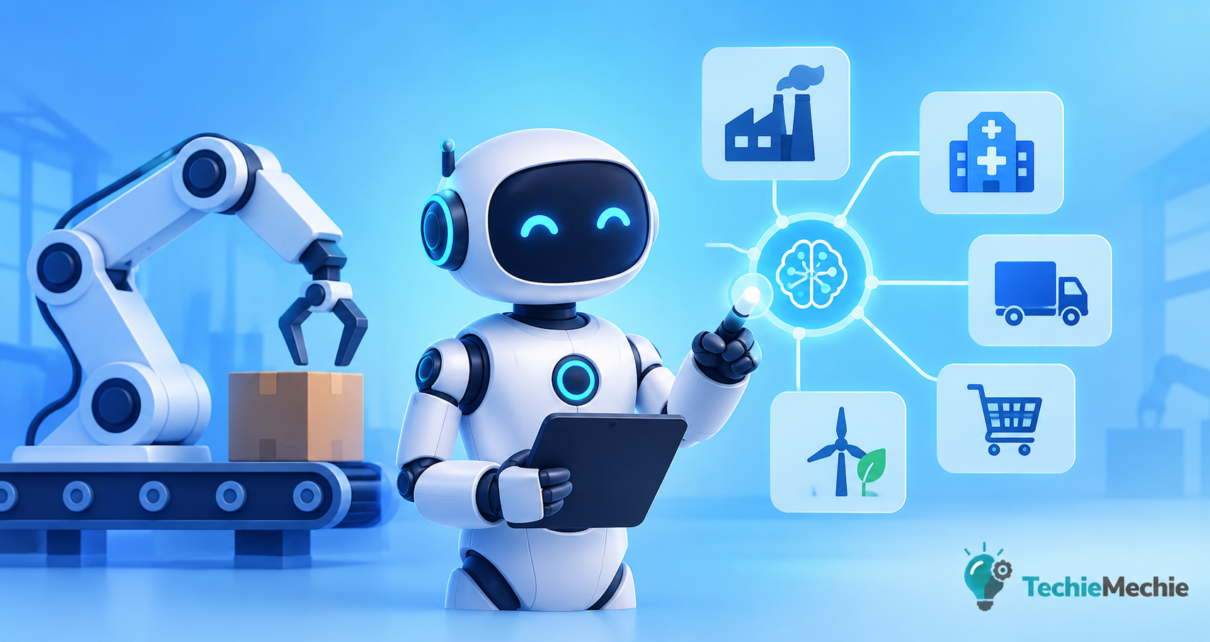
Artificial intelligence is no longer limited to chatbots, software, and digital assistants. In 2026, AI is increasingly moving into the physical world, where it can see, understand, make decisions, and control machines.
This combination of robotics and artificial intelligence is creating a new generation of intelligent machines that can work in factories, warehouses, hospitals, farms, stores, construction sites, and even homes.
The change is bigger than simply making robots faster. Traditional robots usually perform tasks that engineers carefully program in advance. AI-powered robots can increasingly understand their surroundings, respond to changes, learn from data, and work alongside people.
The International Federation of Robotics (IFR) reported that 542,000 industrial robots were installed worldwide in 2024, more than twice the number installed a decade earlier. The total number of industrial robots operating worldwide reached approximately 4.66 million. (IFR International Federation of Robotics)
At the same time, AI is giving these machines new capabilities.
So, what does this mean for businesses, workers, and everyday life?
Let’s explore how robotics and AI in 2026 are changing industries and what the future may look like.
What Is AI Robotics?
AI robotics combines artificial intelligence, robotics, sensors, computer vision, machine learning, and automation.
A traditional robot may follow a fixed sequence:
Pick up object → move to position → place object → repeat.
An AI-powered robot can work differently:
Identify the object → understand its position → decide how to pick it up → adjust its movement → complete the task.
This difference is important.
AI allows robots to deal with situations that are not completely predictable.
For example, a warehouse robot may encounter boxes in different sizes and positions. Instead of requiring every situation to be programmed manually, AI can help the robot recognize the boxes and determine an appropriate action.
This is part of a broader movement toward physical AI or embodied AI—AI systems that can interact with the physical world.
Recent developments in robotics are increasingly focused on combining AI models with cameras, sensors, actuators, simulation, and powerful computing systems.
Why Robotics and AI Are Growing So Quickly in 2026
Several trends are pushing intelligent robotics forward.
1. Better AI models
Modern AI models are becoming better at understanding images, language, video, and complex instructions.
This means robots can potentially receive instructions in natural language rather than requiring every movement to be manually programmed.
2. Improved computer vision
Cameras and vision systems allow robots to recognize objects, people, obstacles, and environments.
Computer vision is particularly important for manufacturing, logistics, agriculture, healthcare, and autonomous machines.
3. More powerful chips
AI requires significant computing power.
Modern GPUs, AI accelerators, edge processors, and specialized robotics hardware allow more AI processing to happen directly on or near the robot.
4. Better sensors
Robots are becoming more aware of their surroundings through cameras, lidar, force sensors, touch sensors, microphones, and other technologies.
5. Falling hardware costs
As robotics components become more widely produced, companies can deploy automation across more tasks.
6. Labor shortages
Many industries face shortages of workers for repetitive, dangerous, physically demanding, or difficult-to-fill jobs.
The IFR identifies staff shortages as an important driver of professional service robot adoption. (IFR International Federation of Robotics)
1. AI and Robotics in Manufacturing
Manufacturing remains one of the biggest markets for robotics.
Factories have used robots for decades, especially for welding, painting, assembly, packaging, and material handling.
But AI is changing how these robots operate.
Instead of performing only highly repetitive tasks, intelligent robots can increasingly support more flexible production environments.
AI-powered manufacturing robots can help with:
- Quality inspection
- Defect detection
- Assembly
- Welding
- Packaging
- Sorting
- Predictive maintenance
- Material handling
- Machine monitoring
- Production optimization
For example, an AI vision system can inspect thousands of products and identify small defects that human inspectors may miss or detect inconsistently.
AI can also analyze machine data and identify signs of potential equipment failure.
This can help manufacturers move from reactive maintenance to predictive maintenance.
The scale of industrial robotics is already significant. According to IFR data, 542,000 industrial robots were installed globally in 2024, while Asia accounted for 74% of new deployments. (IFR International Federation of Robotics)
2. Smart Warehouses and Logistics
The logistics industry is another major area where AI robotics is making a difference.
Modern warehouses can contain thousands or millions of products.
Moving those products manually can be expensive and time-consuming.
AI-powered mobile robots can transport products around warehouses, while robotic arms can pick, sort, pack, and move items.
Intelligent warehouse robots can:
- Move inventory
- Sort packages
- Pick products
- Load and unload goods
- Navigate warehouses
- Optimize routes
- Assist human workers
- Track inventory
Professional service robotics is already heavily concentrated in transportation and logistics. IFR reported that more than half of professional service robots sold in 2024 were for transportation and logistics applications. (IFR International Federation of Robotics)
The next step is making these systems more intelligent.
Instead of simply following predetermined routes, robots can increasingly use AI to understand changing environments and make decisions.
3. AI Robots in Healthcare
Healthcare is another industry where robotics and AI have significant potential.
Medical robots are being used for specialized tasks ranging from surgery to rehabilitation and hospital logistics.
AI can help robots process medical images, assist with precision movements, transport supplies, and support healthcare professionals.
Potential applications include:
- Surgical assistance
- Rehabilitation
- Patient monitoring
- Hospital delivery robots
- Laboratory automation
- Medication handling
- Elder-care assistance
- Medical imaging
The demand for healthcare robotics is also influenced by aging populations and healthcare workforce shortages.
According to IFR data, nearly 16,700 medical robots were sold in 2024, with medical robotics showing particularly strong growth. (IFR International Federation of Robotics)
Importantly, AI robots are not necessarily designed to replace doctors and nurses.
In many cases, their more realistic role is to assist healthcare workers and automate repetitive tasks.
4. Agriculture Gets Smarter With AI Robots
Agriculture presents a particularly interesting challenge for robotics.
Factories are controlled environments.
Farms are not.
Weather changes. Plants grow differently. Soil conditions vary. Fields can contain mud, rocks, weeds, insects, and uneven terrain.
AI can help robots operate in these unpredictable environments.
AI-powered agricultural robots can be used for:
- Crop monitoring
- Weed detection
- Precision spraying
- Harvesting
- Fruit picking
- Soil analysis
- Autonomous tractors
- Plant health monitoring
- Crop counting
Computer vision can identify individual plants and determine whether they need water, fertilizer, or treatment.
This can help farmers move toward precision agriculture, where resources are applied more accurately instead of treating an entire field in the same way.
The result could be lower resource consumption and potentially higher productivity.
5. Construction Robots
Construction has traditionally been difficult to automate because every building site is different.
However, robotics and AI are beginning to change that.
Robots can potentially assist with:
- Bricklaying
- Concrete work
- Drilling
- Demolition
- Surveying
- Material transportation
- Site inspection
- 3D printing
- Safety monitoring
AI-powered drones and robotic systems can also collect information about construction sites.
This data can be compared with digital building models to identify progress, errors, or potential safety issues.
In the future, construction may become increasingly connected to AI-powered digital twins, robotics, sensors, and automated machinery.
6. Retail and Hospitality
Robots are also entering retail, restaurants, hotels, and other customer-facing environments.
Some robots can transport goods, clean floors, deliver items, or assist customers.
AI makes these robots more useful because they can potentially understand natural language and interact with people.
Imagine asking a service robot:
“Where can I find the electronics section?”
Instead of following a fixed route, the robot could understand the question and guide the customer.
Hotels can also use robots for room-service delivery or transportation of supplies.
The technology is still developing, but AI could make service robots more natural and adaptable.
7. Autonomous Vehicles and Delivery Robots
AI and robotics are closely connected to autonomous transportation.
Self-driving cars, delivery robots, drones, autonomous trucks, and industrial vehicles all depend on similar technologies:
- Computer vision
- Sensors
- Machine learning
- Navigation
- Real-time decision-making
- Edge computing
AI enables these machines to understand their environment and react to changing conditions.
For example, an autonomous delivery robot needs to recognize pedestrians, roads, obstacles, traffic signals, and other vehicles.
That requires much more than simple automation.
It requires machine perception and decision-making.
8. Humanoid Robots: The Biggest Robotics Trend?
Perhaps the most talked-about robotics development in 2026 is the rise of humanoid robots.
Humanoid robots are designed to have a human-like body structure, typically including two arms, two legs, a torso, and a head containing sensors.
Why build robots that look like humans?
One major reason is that our world is designed for humans.
Stairs, doors, shelves, tools, vehicles, and workplaces were generally created around the human body.
A humanoid robot could potentially operate in these existing environments without requiring companies to completely redesign them.
However, humanoid robots still face major challenges.
They need to become:
- More reliable
- More affordable
- More energy efficient
- Safer
- Better at manipulating objects
- More capable in unpredictable environments
Current industry activity shows that specialized industrial robots remain extremely important, even as humanoids attract attention. The Financial Times recently reported that China’s major robotics progress is occurring heavily in purpose-built industrial robots rather than humanoids alone. (Financial Times)
This distinction is important.
The future of robotics will not necessarily be humanoid-only.
Different jobs require different machines.
AI Robotics vs Traditional Robotics
The easiest way to understand the change is to compare traditional automation with AI-powered robotics.
| Traditional Robotics | AI Robotics |
| Follows predefined instructions | Can make decisions based on inputs |
| Works best in predictable environments | Can handle more variation |
| Limited adaptability | More adaptable |
| Mostly rule-based | Uses AI and machine learning |
| Requires detailed programming | Can use higher-level instructions |
| Limited perception | Advanced computer vision and sensors |
| Repeats specific tasks | Can potentially perform multiple related tasks |
This does not mean traditional robotics is becoming obsolete.
In many factories, traditional robots remain faster, cheaper, and more reliable for highly repetitive tasks.
AI becomes especially valuable when the environment or task is more complex.
The Rise of Physical AI
One of the most important concepts to understand in 2026 is physical AI.
Traditional AI mainly operates in the digital world.
For example:
- Chatbots generate text.
- AI image tools generate pictures.
- AI coding tools generate software.
Physical AI takes those capabilities into the real world.
A physical AI system can:
See → Understand → Decide → Act → Learn
This creates a connection between AI software and robotic hardware.
Companies are increasingly developing AI models specifically for robotics, simulation, perception, and physical-world interaction. Recent industry reporting describes this shift as the move toward AI systems capable of learning and acting through machines rather than simply producing digital outputs. (Business Insider)
How AI Is Changing the Way Robots Learn
Traditional robots generally need engineers to program specific movements.
AI introduces a different approach.
Robots can be trained using:
- Demonstrations
- Simulated environments
- Video data
- Sensor data
- Reinforcement learning
- Synthetic data
- Human feedback
For example, instead of manually programming every movement required to pick up an object, engineers may train a robotic system using demonstrations and simulation.
The robot can then learn patterns that help it perform similar tasks.
This could eventually make robot programming much easier.
Instead of saying:
“Program the robot to perform 300 individual movements.”
A worker might eventually say:
“Pick up these packages and place them on the conveyor.”
The AI system could determine the required actions.
AI + Robots + Human Workers
One of the biggest questions surrounding robotics is simple:
Will robots replace human workers?
The answer is more complicated than yes or no.
Robots are likely to automate some tasks.
But many jobs consist of multiple tasks, and not all of them are easy to automate.
For example, a warehouse worker may:
- Move products
- Solve unexpected problems
- Communicate with colleagues
- Handle damaged items
- Operate equipment
- Make decisions
A robot may be excellent at moving standardized boxes but less capable of handling unusual situations.
This means the future workplace could increasingly involve human-robot collaboration.
Workers may supervise robotic systems, maintain machines, analyze data, train AI models, or perform tasks that require judgment and creativity.
Interestingly, IFR research has highlighted that robotization can create opportunities for employment and skill development in adopting plants and firms. (IFR International Federation of Robotics)
New Jobs Created by Robotics and AI
As intelligent machines become more common, new roles are likely to grow.
Examples include:
- Robotics engineer
- Robotics technician
- AI engineer
- Computer vision engineer
- Robot fleet manager
- Automation specialist
- AI safety specialist
- Robotics data specialist
- Simulation engineer
- Human-robot interaction designer
There will also be demand for traditional workers who understand how to work alongside automated systems.
This means AI and robotics skills could become increasingly valuable across many industries.
Challenges Facing AI Robotics in 2026
Despite rapid progress, intelligent robots are not perfect.
Several challenges remain.
1. Cost
Advanced robots require expensive hardware, sensors, computing systems, maintenance, and integration.
For many businesses, the return on investment still needs to be proven.
2. Safety
Robots operating around humans must be extremely reliable.
A mistake in software can have physical consequences.
3. Reliability
A robot may work perfectly in a controlled environment but struggle when conditions change.
4. Data
AI systems require large amounts of useful training data.
Collecting high-quality physical-world data can be difficult.
5. Energy consumption
Advanced AI processing and robotic movement require electricity.
This becomes particularly important for mobile robots and humanoids.
6. Cybersecurity
Connected robots can become potential cybersecurity targets.
Companies need to protect robotic systems, networks, software, and operational data.
7. Workforce transition
Businesses must invest in employee training as automation changes job responsibilities.
Why India Could Be an Important Robotics Market
India is becoming increasingly important in the global robotics landscape.
According to IFR’s World Robotics 2025 data, India installed a record 9,100 industrial robots in 2024, an increase of 7% from the previous year. Automotive manufacturing accounted for 45% of installations, and India ranked sixth globally for annual industrial robot installations. (IFR International Federation of Robotics)
India’s manufacturing expansion, automotive sector, electronics production, logistics industry, agriculture, healthcare needs, and growing technology ecosystem could create significant opportunities for robotics.
For Indian businesses, the opportunity is not limited to humanoid robots.
There is potential for:
- Factory automation
- Warehouse robots
- Agricultural robots
- Healthcare robotics
- Autonomous delivery
- Industrial inspection
- AI-powered quality control
- Robotics-as-a-Service
As hardware becomes more affordable and AI becomes more capable, robotics could become accessible to more small and medium-sized businesses.
Robotics-as-a-Service Could Lower the Barrier
Buying robots outright can require significant capital.
That’s why Robotics-as-a-Service (RaaS) is becoming an interesting business model.
Instead of purchasing a robot, a company can potentially pay for robotic capabilities as a service.
This can include:
- Hardware
- Software
- Maintenance
- Updates
- Support
- Fleet management
The model could make robotics easier for smaller businesses to adopt.
IFR reported strong growth in RaaS within professional service robotics in 2024, showing increasing interest in service-based robotics deployment. (IFR International Federation of Robotics)
What Will AI Robots Look Like in the Future?
The future of robotics is unlikely to consist of one universal robot.
Instead, we may see several categories.
Specialized robots
Designed for one specific job.
Examples:
- Welding robots
- Surgical robots
- Agricultural robots
- Warehouse robots
Mobile robots
Designed to move through warehouses, factories, hospitals, or public spaces.
Collaborative robots
Designed to safely work alongside humans.
Humanoid robots
Designed to perform multiple tasks in environments created for humans.
Autonomous machines
Vehicles, drones, agricultural equipment, and other machines capable of operating with limited human intervention.
Together, these technologies could create a much more automated physical world.
The Future of Intelligent Machines
The most important change may not be that robots are becoming stronger.
It is that robots are becoming more intelligent.
A robot that can only repeat one movement is useful.
A robot that can understand its environment, follow instructions, adapt to changes, and cooperate with people is much more powerful.
That is the direction robotics is moving toward.
However, businesses should avoid assuming that every task needs an AI-powered humanoid robot.
In many cases, the best solution will be a simple specialized machine.
The real question should be:
What task needs to be automated, and what technology can perform it safely, reliably, and economically?
How Businesses Can Prepare for AI Robotics
Companies interested in robotics should start with practical problems rather than technology hype.
Step 1: Identify repetitive tasks
Look for tasks that are:
- Repetitive
- Physically demanding
- Dangerous
- Time-consuming
- Highly standardized
Step 2: Calculate the business case
Consider:
- Robot cost
- Integration cost
- Maintenance
- Labor savings
- Productivity improvements
- Downtime
- Expected ROI
Step 3: Start small
A pilot project can help a company understand the technology before deploying hundreds of robots.
Step 4: Train employees
Employees should understand how to operate, maintain, supervise, and work with robotic systems.
Step 5: Build an AI-ready data infrastructure
AI robotics depends heavily on data.
Companies should invest in sensors, connectivity, cloud or edge computing, data management, and cybersecurity.
Conclusion: Robotics and AI Are Moving Into the Physical World
Robotics and AI in 2026 represent a major shift in how machines interact with the world.
Robots are no longer simply programmable machines that repeat the same movement.
With AI, they can increasingly see, understand, learn, navigate, and make decisions.
From manufacturing and logistics to healthcare, agriculture, construction, and retail, intelligent machines are becoming part of real-world operations.
The rise of physical AI could eventually make robots more flexible and useful than previous generations of automation.
But the future will not simply be about humans versus robots.
The bigger opportunity is humans working with intelligent machines.
Companies that learn how to combine human judgment with robotic speed, AI decision-making, and automation could gain significant advantages in productivity, safety, and efficiency.
The robotics revolution is already underway—and 2026 may be remembered as an important stage in the transition from traditional automation to intelligent machines.
Frequently Asked Questions
Physical AI refers to AI systems that interact with the physical world through robots, autonomous vehicles, drones, machines, and other intelligent devices.
Humanoid robots have significant potential because they can operate in human-designed environments. However, specialized robots are likely to remain more practical and economical for many specific tasks.
AI robots will automate some tasks, particularly repetitive or dangerous ones. However, many jobs will continue to require human judgment, creativity, communication, and problem-solving. Human-robot collaboration is likely to become increasingly important.
Major applications include manufacturing, logistics, healthcare, agriculture, construction, automotive, retail, hospitality, and transportation.
AI enables robots to better understand their surroundings, recognize objects, interpret instructions, make decisions, and adapt to changing environments.
AI robotics combines robotics hardware with artificial intelligence, machine learning, computer vision, sensors, and autonomous decision-making. It allows robots to perform tasks with greater flexibility and adaptability.