Introduction: Is AI Recommending Your Brand?
Search is changing.
For years, businesses competed for Google rankings, backlinks, featured snippets, and organic traffic. Those things still matter, but another layer of search has become increasingly important: AI-generated answers.
Today, potential customers can ask ChatGPT, Gemini, Perplexity, Claude, Google AI, or other AI systems questions such as:
- “What are the best accounting software platforms for small businesses?”
- “Which SEO agency should I hire?”
- “What are the best AI writing tools?”
- “Which CRM is best for a startup?”
- “What are the top VPN services?”
- “What alternatives are there to [competitor]?”
Instead of receiving a traditional list of blue links, users may receive a synthesized answer containing recommendations, comparisons, brands, sources, and citations.
That creates a new marketing question:
Does AI mention your brand when your customers ask questions related to your products or services?
This is where AI visibility tools come in.
AI visibility platforms help businesses monitor how frequently they are mentioned, recommended, or cited in AI-generated answers. Depending on the platform, they can also track competitors, analyze citations, monitor prompts, measure share of voice, identify content gaps, and provide recommendations for improving visibility.
We reviewed the approaches taken by several current AI visibility guides, including Arobis, Position Digital, and ScopeSite, and combined those insights with the broader 2026 AI search landscape.
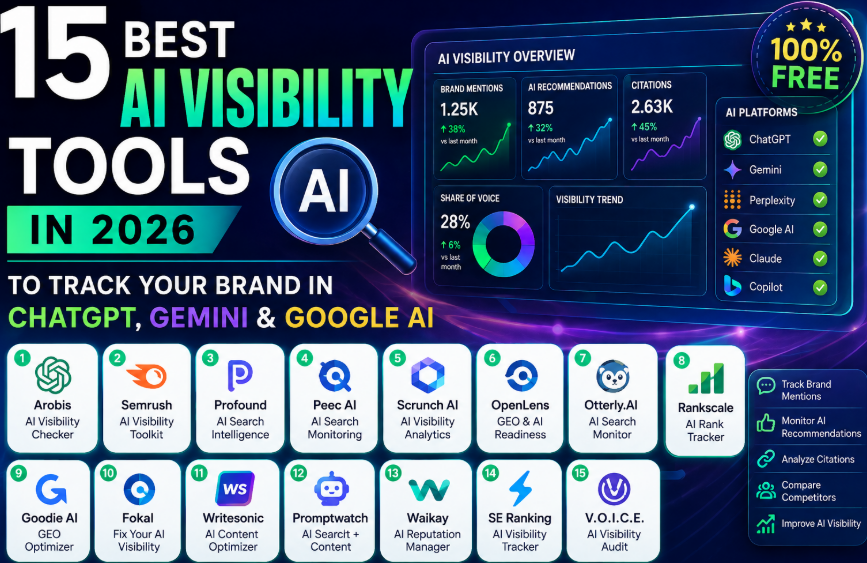
In this guide, we’ll look at the 15 best AI visibility tools in 2026, who each tool is best for, what it does well, potential limitations, and how to choose the right platform.
What Is AI Visibility?
AI visibility is the extent to which a brand, website, product, or company appears in AI-generated search results and recommendations.
Traditional SEO generally asks:
“Where does my website rank in Google?”
AI visibility asks:
“Does AI mention, recommend, or cite my brand when users ask relevant questions?”
These are related but different measurements.
For example, a company could rank highly for “best project management software” on Google but still fail to appear when someone asks ChatGPT:
“What are the best project management tools for a remote team?”
AI visibility tools attempt to measure this new layer of discoverability.
Depending on the platform, they can measure:
- Brand mentions
- AI recommendations
- Citations
- Citation sources
- Sentiment
- Share of voice
- Competitor visibility
- Prompt performance
- AI search rankings
- Visibility by topic
- Visibility by country
- Historical changes
- AI traffic and referrals
- Content opportunities
The exact metrics vary significantly from tool to tool.
Why AI Visibility Matters in 2026
AI search is becoming an increasingly important part of the discovery process.
Users are not only searching Google anymore. They are asking AI assistants to research products, compare companies, summarize industries, recommend services, and help them make purchasing decisions.
This changes the traditional search funnel.
Instead of:
Google → Website → Research → Purchase
the journey can become:
AI assistant → Recommendations → Shortlist → Website → Purchase
If your brand isn’t included in the AI-generated shortlist, you may lose an opportunity before the potential customer ever reaches your website.
Arobis describes this shift as moving beyond traditional rankings toward monitoring recommendations, citations, mentions, competitive visibility, and AI search share of voice.
However, there is an important caveat.
AI visibility isn’t a replacement for SEO.
Your traditional SEO strategy still matters because search engines, websites, third-party sources, reviews, structured information, and other web content can influence the information available to AI systems.
The smartest approach in 2026 is to treat AI visibility as an additional layer of your SEO and digital marketing strategy.
How We Evaluated the Best AI Visibility Tools
There is no single “best” AI visibility tool for every company.
A startup may need a simple free checker.
An SEO agency may need multi-client reporting.
An enterprise brand may need sophisticated competitive monitoring.
A content team may care more about actionable recommendations than dashboards.
For this comparison, the most important criteria include:
1. AI Platform Coverage
Does the tool monitor platforms such as:
- ChatGPT
- Google AI
- Gemini
- Perplexity
- Claude
- Microsoft Copilot
- Grok
- DeepSeek
- Meta AI
More coverage isn’t automatically better, but it can be valuable for larger brands.
2. Prompt Tracking
Can you create and monitor the questions your customers are likely to ask?
3. Citation Tracking
Can the platform tell you which websites and pages AI systems cite?
4. Competitor Analysis
Can you compare your visibility against competitors?
5. Historical Monitoring
Can you see whether your visibility is improving or declining?
6. Actionability
Does the platform simply tell you what happened, or does it help you understand what to improve?
7. Pricing
Is there a useful free plan, affordable entry-level plan, or enterprise offering?
8. Reporting
Can you create reports for clients, managers, or executives?
These criteria overlap with the evaluation frameworks used by current AI visibility guides.
15 Best AI Visibility Tools in 2026
1. Arobis AI Visibility Checker — Best Free Starting Point
If you’re completely new to AI visibility, Arobis AI Visibility Checker is one of the easiest places to start.
The tool is designed around a straightforward question:
Does AI know your brand?
According to Arobis, its checker evaluates brand discoverability across platforms including ChatGPT, Gemini, Claude, and Perplexity.
Key Features
- AI visibility analysis
- Brand discoverability insights
- Competitor comparisons
- AI recommendation monitoring
- Multi-engine analysis
- Simple reporting
Best For
- Startups
- Small businesses
- SaaS companies
- Founders
- Marketers
- Agencies
- Beginners
Pros
- Easy to understand
- Free starting point
- Low barrier to entry
- Useful for initial research
Cons
- Not designed for large-scale enterprise monitoring
- Less historical depth than enterprise platforms
Verdict
If you have never checked whether AI recommends your company, start with a simple visibility audit before paying for a sophisticated platform.
2. Semrush — Best for SEO + AI Visibility
If your organization already uses SEO software, Semrush is a compelling option because AI visibility can be incorporated into a broader search marketing workflow.
Position Digital highlights Semrush as its top pick for integrated SEO and GEO, citing its combination of traditional SEO data and AI visibility tracking.
Its AI visibility functionality can track things such as:
- Mentions
- Citations
- Sentiment
- Share of voice
- Competitors
- Prompts
- AI search performance
The platform also combines AI visibility with keyword research, backlink analysis, technical SEO, content optimization, and site auditing.
Best For
Established SEO teams and businesses that don’t want separate platforms for traditional SEO and AI visibility.
Pros
- Strong SEO ecosystem
- AI visibility and traditional SEO in one platform
- Competitive analysis
- Broad data infrastructure
- Suitable for larger marketing teams
Cons
- Can be expensive for small businesses
- Large feature set can create a learning curve
- May be unnecessary if you only need basic AI monitoring
Verdict
Best choice for businesses wanting to connect traditional SEO with AI search visibility.
3. Profound — Best for Enterprise AI Search Intelligence
Profound is one of the more enterprise-focused names in the AI visibility category.
It is designed for organizations that need deeper monitoring of how their brands appear across generative search environments.
Its feature set includes:
- AI visibility monitoring
- Brand mentions
- AI recommendations
- Competitive analysis
- Citation analysis
- Executive reporting
Arobis positions Profound as an enterprise solution rather than a beginner-focused free tool.
ScopeSite’s 2026 analysis also highlights its broad AI platform coverage, including ChatGPT, Perplexity, AI Overviews, Gemini, Copilot, Meta AI, Grok, DeepSeek, and Claude.
Best For
- Enterprise brands
- Large SaaS companies
- Global organizations
- Corporate marketing teams
Pros
- Broad platform coverage
- Enterprise-focused reporting
- Competitive monitoring
- Strong AI search intelligence
Cons
- Not designed primarily for beginners
- Enterprise-oriented pricing
- Free-tier limitations may not be enough for ongoing monitoring
Verdict
Choose Profound when AI search has become a serious strategic channel rather than an experiment.
4. Peec AI — Best for Prompt and Citation Tracking
Peec AI focuses heavily on AI search monitoring and prompt-based analysis.
Instead of checking your visibility once, you can build a repeatable system around the prompts that matter to your business.
The platform can help monitor:
- Search prompts
- Brand visibility
- Competitors
- Citations
- AI search performance
- Historical trends
Arobis specifically highlights Peec AI’s prompt monitoring and competitive benchmarking capabilities.
Best For
- GEO teams
- Marketing teams
- Agencies
- Brands running ongoing AI search campaigns
Pros
- Strong prompt tracking
- Competitive analysis
- Citation reporting
- Historical visibility data
Cons
- More useful for active GEO programs than occasional audits
- Paid plans can become expensive for larger-scale monitoring
Verdict
A strong choice if you want to turn AI visibility into an ongoing measurement process.
5. Scrunch AI — Best for Agencies and Actionable Insights
Scrunch AI takes a more analytics-oriented approach.
Rather than simply telling you whether your company appeared in an AI answer, the platform focuses on understanding how AI systems perceive and surface your brand.
Key areas include:
- AI search analytics
- Brand monitoring
- Competitive visibility
- Share of voice
- Recommendations
- Multi-brand management
Arobis identifies Scrunch as particularly useful for agencies and larger marketing organizations.
Best For
Agencies and companies managing multiple brands or products.
Pros
- Strong reporting
- Competitive insights
- Multi-brand capabilities
- Action-oriented analytics
Cons
- Better suited to larger teams
- No traditional free plan
Verdict
If you’re managing AI visibility for multiple clients, Scrunch is worth considering.
6. OpenLens — Best Free GEO Readiness Platform
OpenLens is particularly interesting for businesses that want to combine visibility tracking with technical and content audits.
Position Digital highlights its free plan, which includes multiple projects, seats, monthly credits, tracking, and AI indexing capabilities.
The platform also includes:
- AI Indexing
- Site Readiness
- Content Audit
- AI visibility scoring
- Share of voice
- Topic performance
- Google Search Console integration
- Google Analytics integration
Its free tier supports ChatGPT, Perplexity, and Google AI, according to Position Digital’s review.
Best For
- SEO agencies
- Small marketing teams
- GEO beginners
- Businesses wanting technical AI-readiness analysis
Pros
- Generous free plan
- Technical audits
- AI indexing checks
- Content auditing
- Multi-project support
Cons
- Newer platform
- Prompt-level citation analysis is limited
Verdict
One of the strongest options if you want free AI visibility monitoring plus GEO readiness analysis.
7. Otterly.AI — Best for Affordable AI Monitoring
Otterly.AI is designed specifically around AI search and brand monitoring.
Its functionality can include:
- Brand monitoring
- Prompt tracking
- Citation tracking
- AI keyword research
- Sentiment monitoring
- Country-specific tracking
- Automated reports
ScopeSite notes that Otterly offers a 14-day trial with a limited number of prompts, making it more accurate to describe it as a trial-based tool rather than a permanently free platform.
Best For
- Small businesses
- SEO consultants
- Agencies
- Teams testing AI visibility monitoring
Pros
- Affordable entry point
- Automated reporting
- Geographic monitoring
- Strong monitoring functionality
Cons
- Free access is limited
- Some AI platform coverage may require paid options
Verdict
A good choice if you want to move from occasional AI visibility checks toward automated monitoring.
8. Rankscale — Best for Affordable AI Rank Tracking
Rankscale focuses on measuring AI search performance and visibility.
It is particularly useful for users who want a relatively accessible entry point into AI rank tracking.
Features can include:
- AI rankings
- Brand visibility
- Competitor monitoring
- Prompt tracking
- Reporting
- Performance analysis
Position Digital lists Rankscale among its lower-cost options, with an entry price substantially below many enterprise-focused platforms.
Best For
- Freelancers
- Startups
- Small agencies
- SEO professionals
Pros
- Lower entry cost
- Useful ranking analytics
- Accessible for smaller teams
Cons
- Less enterprise-oriented than platforms such as Profound
- Feature depth varies by plan
Verdict
If budget is important, Rankscale deserves consideration.
9. Goodie AI — Best for Turning Visibility Data Into Optimization
Goodie AI focuses on the broader Generative Engine Optimization workflow.
The basic concept is simple:
Don’t just measure your visibility. Use the data to improve it.
The platform can help marketers understand how AI systems interpret their content and where optimization opportunities exist.
Best For
- Content teams
- GEO professionals
- SaaS marketers
- SEO teams
Useful Capabilities
- AI visibility monitoring
- Generative search analysis
- Competitive insights
- Content optimization
- GEO recommendations
Verdict
Goodie is worth considering if your goal is not simply reporting but building an optimization process around AI search.
10. Fokal — Best for Finding Visibility Problems
Fokal takes an interesting approach by focusing on identifying problems and potential fixes.
Arobis includes Fokal among its recommended AI visibility platforms and describes it as a tool focused on fixing AI visibility rather than simply measuring it.
That distinction is important.
A visibility report saying:
“Your brand isn’t appearing.”
isn’t particularly useful unless it leads to:
“Here’s what you should change.”
Best For
- Marketers
- Founders
- Content teams
- Businesses looking for actionable GEO recommendations
Verdict
Consider Fokal if you care more about optimization opportunities than dashboards alone.
11. Writesonic — Best for AI-Friendly Content Optimization
Writesonic is better known as an AI content platform, but its GEO capabilities make it relevant to AI visibility.
Its positioning is different from a pure monitoring tool.
Instead of focusing only on:
“Where is my brand appearing?”
it also focuses on:
“How can I create and optimize content for AI search?”
Best For
- Content marketers
- Bloggers
- SEO teams
- Agencies
- Businesses producing large amounts of content
Pros
- Content creation and optimization
- GEO recommendations
- Broader AI content ecosystem
Cons
- Not a pure AI visibility tracker
- Users looking only for monitoring may prefer a specialized tool
Verdict
A useful option if content production and AI visibility are part of the same workflow.
12. Promptwatch — Best for AI Search + Content Execution
Promptwatch goes beyond traditional visibility reporting.
Position Digital highlights features such as prompt discovery, content gap analysis, an AI Content Agent, off-site mentions, actions, and CMS publishing capabilities.
This creates a more complete workflow:
Track → Analyze → Find Gap → Create Content → Publish → Monitor
Best For
Brands and agencies that want to connect AI search insights directly to content execution.
Key Features
- Prompt monitoring
- Content gap analysis
- AI search data
- Content Agent
- Off-site mentions
- Action recommendations
- CMS publishing
- API/MCP capabilities
Verdict
If you’re looking for something closer to a GEO operating system rather than a simple rank tracker, Promptwatch is an interesting choice.
13. Waikay — Best for AI Reputation Management
AI visibility isn’t only about being mentioned.
It’s also about how your brand is described.
For example, AI might mention your company but associate it with outdated pricing, inaccurate product information, poor reviews, or an incorrect positioning statement.
Waikay focuses on AI reputation and knowledge analysis.
Position Digital highlights features including AI knowledge audits and topic-gap reports.
Best For
- Brands concerned about reputation
- Companies with complex product portfolios
- Marketing teams
- Reputation management professionals
Verdict
Consider Waikay when brand perception inside AI-generated answers matters as much as raw visibility.
14. SE Ranking — Best for SEO Teams Adding AI Visibility
SE Ranking combines traditional SEO functionality with AI visibility features.
Position Digital lists capabilities such as:
- AI mentions
- Citation tracking
- AI competitor research
- Insights
- GA4 integration
- Traditional SEO tools
This makes it attractive for teams that don’t want their AI search strategy separated from their existing SEO workflow.
Best For
- SEO agencies
- In-house SEO teams
- SMBs
- Businesses already using SEO reporting workflows
Verdict
A good middle ground for teams wanting both traditional SEO and emerging AI search capabilities.
15. ScopeSite V.O.I.C.E. — Best for a Detailed Free Audit
ScopeSite takes a different approach from ongoing AI rank tracking.
Its V.O.I.C.E. tool is positioned as a detailed free AI visibility and website-readiness audit.
ScopeSite says its scan examines multiple technical and authority-related factors, including browser rendering, PageSpeed information, domain authority/backlink data, and AI-generated analysis.
Best For
- Small businesses
- Local businesses
- Website owners
- Beginners
- One-time AI readiness audits
Pros
- Free initial scan
- Technical analysis
- Website readiness assessment
- Action plan
Cons
- More audit-oriented than continuous monitoring
- Not a substitute for long-term visibility tracking
Verdict
A useful starting point if you want to understand whether technical problems could be limiting your AI discoverability.
AI Visibility Tools Comparison Table
| Tool | Best For | Free Option | Main Strength |
|---|---|---|---|
| Arobis | Beginners | Yes | Simple AI visibility check |
| Semrush | SEO + GEO | Limited/paid | Integrated search platform |
| Profound | Enterprise | Limited | Enterprise AI intelligence |
| Peec AI | Prompt tracking | Limited | Citation & prompt analysis |
| Scrunch AI | Agencies | No | Reporting & analytics |
| OpenLens | Free GEO audits | Yes | AI readiness |
| Otterly.AI | SMBs | Trial | Automated monitoring |
| Rankscale | Budget tracking | Limited | Affordable AI tracking |
| Goodie AI | GEO optimization | Limited | Optimization workflow |
| Fokal | Actionable insights | Yes | Visibility improvement |
| Writesonic | Content teams | Limited | Content + GEO |
| Promptwatch | Content execution | Limited | End-to-end GEO workflow |
| Waikay | Reputation | Limited | AI knowledge analysis |
| SE Ranking | SEO teams | Limited | SEO + AI visibility |
| V.O.I.C.E. | Free audits | Yes | Technical AI-readiness audit |
Free vs. Paid AI Visibility Tools: Which Should You Choose?
This is one of the most important questions.
You don’t necessarily need to pay hundreds of dollars every month to begin measuring AI visibility.
In fact, ScopeSite makes an important distinction: free tools can tell you whether you have a problem, while paid platforms are more useful for ongoing monitoring, competitive research, and measuring changes over time.
Free Tools Are Best When:
- You’re just getting started
- You own a small business
- You want a baseline
- You’re testing GEO
- You don’t have a large marketing budget
- You only need occasional checks
Paid Tools Are Better When:
- You need daily or weekly monitoring
- You’re managing multiple brands
- You need competitor tracking
- You want historical trends
- You need client reports
- You need detailed citation analysis
- You’re running a serious GEO campaign
The important thing is not to buy software simply because “AI search” is trending.
First determine what information you actually need.
What Do AI Visibility Tools Actually Measure?
AI visibility software can measure several different things.
Brand Mentions
Does the AI mention your company?
This is the simplest metric.
But a mention isn’t necessarily a recommendation.
AI Recommendations
Does the AI actively recommend your brand?
This can be more commercially meaningful.
For example:
“The best email marketing platforms include A, B, C, and D.”
If your company appears in that list, it has achieved recommendation visibility.
Citations
Which websites does AI use as supporting sources?
This is one of the most valuable data points because it can reveal what types of sources influence AI-generated answers.
You might discover that competitors are repeatedly cited by:
- Industry publications
- Review websites
- Directories
- News sites
- Comparison articles
- Reddit discussions
- Partner websites
That information can influence your broader content and digital PR strategy.
Share of Voice
AI share of voice attempts to answer:
“How much of the relevant AI conversation belongs to my brand compared with competitors?”
For example:
| Brand | AI Share of Voice |
|---|---|
| Brand A | 32% |
| Brand B | 25% |
| Brand C | 18% |
| Your Brand | 11% |
This gives marketers a competitive benchmark.
The Biggest Problem With AI Visibility Tracking
There is an important limitation that marketers should understand.
AI responses are not perfectly stable.
The same prompt can generate different answers at different times.
Position Digital specifically highlights personalization and volatility as major challenges. AI responses can vary based on factors such as location, context, user history, and constantly changing model behavior.
ScopeSite makes a similar point: visibility tools simulate prompts, rather than giving marketers a perfect window into what every real user is seeing.
This means an AI visibility score should not be treated like a traditional Google ranking.
Instead, think of it as a directional performance indicator.
If your visibility is consistently increasing across a large set of relevant prompts, that’s useful.
If you’re measuring only one prompt once, don’t overinterpret the result.
How to Use AI Visibility Tools Properly
Buying an AI visibility tool isn’t enough.
You need a process.
Step 1: Build a Prompt Library
Start by collecting questions your potential customers might ask.
For example, an SEO agency might track:
- Best SEO agencies for startups
- Best SEO agency in [city]
- Affordable SEO companies
- Enterprise SEO agencies
- Technical SEO agencies
- SEO consultants for SaaS
- SEO companies with eCommerce experience
Don’t only track your brand name.
Track commercial questions where your brand should appear.
Step 2: Add Competitors
Identify five to ten competitors.
Then compare:
- Mentions
- Recommendations
- Citations
- Position
- Sentiment
- Share of voice
This can reveal gaps much faster than looking at your brand alone.
Step 3: Identify Citation Sources
If competitors are repeatedly cited by the same websites, investigate those sources.
Ask:
- Why is this page being cited?
- Is it more comprehensive?
- Is it more authoritative?
- Is it updated more frequently?
- Does it contain original data?
- Does it answer the question more directly?
Don’t simply copy the competitor.
Find the underlying reason.
Step 4: Improve Your Website
AI visibility isn’t just a content problem.
Technical accessibility matters too.
Review:
- Crawlability
- Indexability
- Rendering
- Page speed
- Structured data
- Internal linking
- Clear headings
- Author information
- Product information
- Contact information
- Organization information
Tools such as OpenLens and V.O.I.C.E. specifically emphasize technical and AI-readiness checks.
Step 5: Create Answer-Focused Content
Write content that directly answers real customer questions.
Instead of:
“Our innovative solutions help businesses succeed.”
write:
“The best CRM for a five-person startup should be affordable, easy to configure, and include pipeline management.”
AI systems need clear information.
Your content should make facts easy to identify, understand, and verify.
Step 6: Build Third-Party Authority
Your own website isn’t the only place where your brand reputation is formed.
AI systems can encounter your brand through:
- Industry publications
- Review sites
- Business directories
- News websites
- Expert articles
- Forums
- Podcasts
- Partner websites
- Social platforms
That’s why AI visibility should be treated as an ecosystem problem, not simply a website problem.
AI Visibility vs. Traditional SEO
The two disciplines overlap, but they’re not identical.
| Traditional SEO | AI Visibility / GEO |
|---|---|
| Keyword rankings | AI mentions |
| Backlinks | AI citations |
| Organic traffic | AI referrals |
| SERP position | Recommendation position |
| Featured snippets | AI-generated answers |
| Search volume | Prompt demand |
| Domain authority | Source credibility |
| Technical SEO | AI retrieval readiness |
| CTR | AI-driven discovery |
The winning strategy isn’t to abandon SEO.
It’s to combine them.
SEO gets your information discoverable. GEO/AI visibility helps you understand whether AI systems are using and recommending that information.
How to Choose the Best AI Visibility Tool
Ask yourself these seven questions.
1. What is my budget?
If you’re starting from zero, begin with a free checker.
2. Do I need continuous monitoring?
If yes, choose a platform with historical tracking.
3. How many AI platforms matter to my audience?
Don’t pay for ten platforms if your customers primarily use two.
4. Do I need competitor analysis?
For serious marketing teams, the answer is usually yes.
5. Do I need citation analysis?
If your goal is GEO optimization, citation data can be extremely valuable.
6. Do I need reports?
Agencies should prioritize white-label or client-friendly reporting.
7. Do I need recommendations?
If you’re already comfortable with SEO and content, raw data may be enough.
If you’re new to GEO, actionable recommendations can save significant time.
Our Final Picks
After comparing the different approaches, here’s how we’d categorize the leading options.
🏆 Best Free Starting Point: Arobis AI Visibility Checker
Best for understanding whether AI systems recognize and recommend your brand.
🏢 Best Enterprise Platform: Profound
Best for large organizations requiring sophisticated AI search intelligence.
🔎 Best SEO + AI Combination: Semrush
Best for established SEO teams that want AI visibility integrated with traditional SEO.
📊 Best for Prompt Tracking: Peec AI
Best for marketers running structured GEO campaigns.
🆓 Best Free GEO Platform: OpenLens
Best for teams wanting free visibility tracking combined with AI-readiness analysis.
💼 Best for Agencies: Scrunch AI
Best for multi-brand monitoring and reporting.
💰 Best Budget-Friendly Tracker: Rankscale
Best for smaller teams and professionals looking for affordable AI rank tracking.
✍️ Best for Content Optimization: Promptwatch
Best for teams that want to move from AI visibility data to content execution.
🛠️ Best for a Free Technical Audit: V.O.I.C.E.
Best for businesses wanting a detailed starting-point audit of AI readiness.
Frequently Asked Questions About AI Visibility Tools
What is an AI visibility tool?
An AI visibility tool monitors how frequently a brand appears in AI-generated answers from platforms such as ChatGPT, Gemini, Perplexity, Claude, and Google AI.
Depending on the platform, it can also track citations, competitors, sentiment, prompts, share of voice, and historical performance.
Are AI visibility tools the same as SEO tools?
No.
Traditional SEO tools primarily measure search-engine performance such as rankings, backlinks, keywords, and organic traffic.
AI visibility tools focus on how brands appear in AI-generated responses.
Some modern platforms combine both capabilities.
What is GEO?
GEO stands for Generative Engine Optimization.
It refers to strategies designed to improve a brand’s visibility in generative AI and AI-powered search experiences.
GEO is closely related to terms such as AEO, AI SEO, and AI search optimization.
Can AI visibility tools guarantee that my brand will appear in ChatGPT?
No.
No legitimate tool can guarantee AI recommendations.
AI-generated answers can change, and different users may receive different results.
Visibility tools should therefore be treated as measurement and optimization systems rather than guarantees of rankings.
Are free AI visibility tools worth using?
Yes.
Free tools can be extremely useful for establishing a baseline.
They can help you discover whether AI systems mention your business and identify obvious technical or content problems.
For ongoing monitoring, however, paid tools generally provide deeper historical, competitive, and citation data.
How often should I check AI visibility?
For a small business, a monthly review may be enough.
For an agency or enterprise marketing team, weekly or daily monitoring may make more sense.
The frequency should depend on how quickly your industry, competitors, content, and AI search environment change.
Should I stop traditional SEO and focus only on GEO?
No.
Traditional SEO remains important.
AI systems rely on information available across the web, and strong technical SEO, useful content, authoritative sources, and brand reputation can all contribute to broader discoverability.
The best strategy is to combine SEO with AI visibility monitoring.
Conclusion: AI Visibility Is Becoming the New Search Metric
The definition of search visibility is expanding.
For years, marketers asked:
“Where do we rank?”
Increasingly, another question deserves attention:
“Does AI recommend us?”
That’s the central reason AI visibility tools are becoming important.
The market is still young, and the tools are evolving rapidly. Some focus on simple visibility checks. Others specialize in prompt tracking, citations, competitor analysis, reputation, content optimization, technical readiness, or enterprise reporting.
There is no universal winner.
For beginners, Arobis, OpenLens, and V.O.I.C.E. provide useful starting points for exploring AI visibility without immediately committing to a large software budget. For established SEO teams, Semrush and SE Ranking offer a bridge between traditional SEO and AI search. For enterprise organizations, Profound and Scrunch provide more sophisticated monitoring and reporting. And for teams focused on turning insights into action, platforms such as Peec AI, Promptwatch, Goodie AI, and Fokal deserve attention.
Most importantly, don’t obsess over a single AI visibility score.