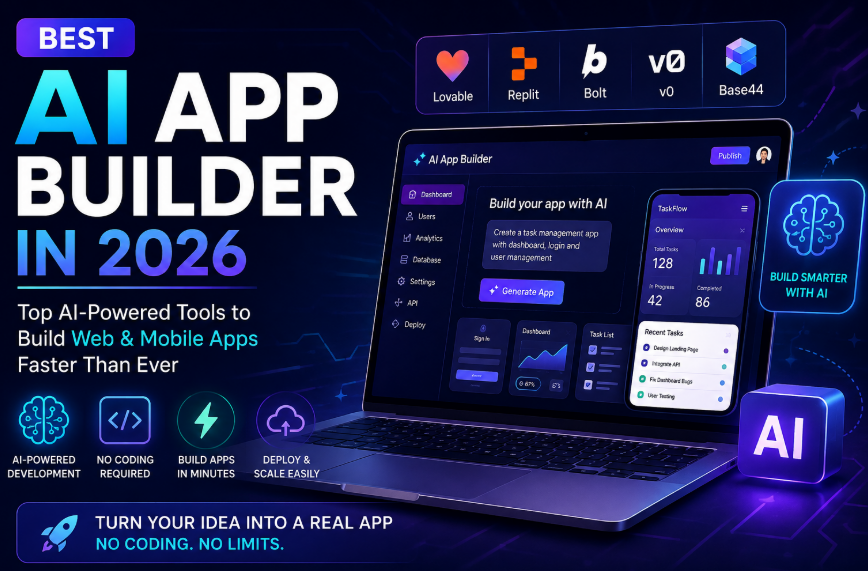
Building an application traditionally required programming knowledge, a development team, weeks or months of work, and a significant budget. AI is changing that process.
Today, AI app builders can turn a plain-language idea into a working application. Instead of starting with code, developers, entrepreneurs, marketers, and even beginners can describe what they want and let AI generate much of the interface, functionality, database structure, and supporting code.
But with so many platforms available, an important question remains: What is the best AI app builder in 2026?
There is no single answer for everyone. Some platforms are designed for non-technical founders, while others are better for developers who want complete control over the generated code. Some excel at rapid prototypes, while others are better suited to production applications.
In this guide, we compare the leading AI app builders, their strengths and weaknesses, ideal use cases, and the factors you should consider before choosing one.
What Is an AI App Builder?
An AI app builder is a software development platform that uses artificial intelligence to help users create applications from natural-language instructions.
Instead of manually writing every component, you can describe your idea with a prompt such as:
“Build a customer management dashboard where users can sign up, add customers, track sales, and view monthly revenue.”
The AI can then generate parts of the application and allow you to refine it through additional instructions.
Depending on the platform, an AI app builder may help create:
- User interfaces
- Databases
- Authentication
- Dashboards
- Forms
- APIs
- Business logic
- Payment integrations
- Responsive layouts
- SEO elements
- Deployment configurations
This approach is often called prompt-to-app development or vibe coding.
However, AI-generated applications still require testing and human review, especially when handling payments, personal information, authentication, or business-critical processes.
Best AI App Builders in 2026
Here are some of the leading options worth considering:
| AI App Builder | Best For | Main Strength |
|---|---|---|
| Lovable | Non-technical founders | Full-stack web apps from natural language |
| Replit Agent | Developers and beginners | AI development environment and deployment |
| Bolt | Rapid prototypes | Fast browser-based app creation |
| v0 by Vercel | Product and engineering teams | High-quality React/Next.js interfaces |
| Base44 | Beginners | All-in-one AI application creation |
| Softr | Business apps | Apps built around existing business data |
| Bubble | No-code applications | Mature visual development platform |
The best option depends heavily on what you want to build.
1. Lovable – Best Overall AI App Builder for Beginners
Lovable has become one of the most prominent prompt-to-app platforms. It is particularly attractive to founders, marketers, designers, and other users who want to create functional web applications without spending most of their time writing code.
Lovable focuses on letting users describe an application in natural language and then iteratively improve the result.
A recent 2026 comparison from Lovable itself positions the platform as particularly suitable for non-technical founders building full applications, with support for backend functionality, authentication, and deployment.
Key Features
- Natural-language app generation
- Full-stack web application development
- Database integrations
- Authentication
- Responsive interfaces
- Rapid iteration
- Deployment capabilities
Pros
- Beginner-friendly
- Fast prototyping
- Good-looking interfaces
- Useful for MVP development
- Natural-language workflow
Cons
- Complex applications may still require technical knowledge
- AI-generated code needs testing
- Costs can increase with heavy usage
Best For
Lovable is a strong choice for founders and non-technical users who want to turn an idea into a working web application quickly.
2. Replit Agent – Best AI App Builder for Developers and Learners
Replit Agent takes a slightly different approach.
Rather than hiding the development environment completely, Replit gives users access to a browser-based coding environment alongside its AI agent.
You can describe what you want to build, and Replit Agent can generate and modify the application. Replit says users can start with an app or website idea and refine it through conversation, without requiring coding experience.
Replit also provides a useful environment for people who want to learn while building because users can inspect the generated code.
Key Features
- AI Agent
- Browser-based development environment
- Code editing
- Database functionality
- Deployment
- Multiple programming languages
- AI-assisted debugging
Replit has also introduced an SEO Agent that can scan published applications and identify discoverability issues, while its newer defaults include semantic HTML, metadata, Open Graph previews, robots.txt, and sitemap generation.
Pros
- Flexible development environment
- Good for learning
- Code remains visible
- Strong AI-assisted development
- Suitable for more complex projects
Cons
- Can feel complicated for absolute beginners
- AI-generated code still needs review
- Advanced usage can become more expensive
Best For
Replit Agent is ideal if you want AI assistance but also want access to the underlying code and development environment.
3. Bolt – Best for Rapid Prototyping
Bolt is designed around speed.
You can provide an application idea and quickly generate a working browser-based project. This makes it particularly useful when you need to test an idea, create a proof of concept, or demonstrate a product to a client.
Its 2026 evolution has expanded beyond simple frontend generation, with Bolt Cloud adding native hosting, databases, authentication, and SEO configuration according to a recent industry comparison.
Key Features
- Prompt-based development
- Fast prototyping
- Browser-based workflow
- Web application creation
- Hosting options
- Database capabilities
- Authentication
Pros
- Very fast
- Easy to experiment with
- Excellent for prototypes
- Accessible to beginners
- Useful for client demonstrations
Cons
- Production requirements should be evaluated carefully
- Complex applications may need manual development
- Pricing and usage can change
Best For
Choose Bolt when your priority is getting an idea into a working prototype quickly.
4. v0 by Vercel – Best for Modern Web Interfaces
v0 by Vercel is especially interesting for product teams and developers working with modern web technologies.
Rather than simply focusing on completely hiding development, v0 is particularly strong at generating polished user interfaces and React/Next.js-oriented code.
The platform is often a good fit when designers and developers want to move quickly from an idea or design concept to an implementation.
Key Features
- AI-generated UI
- React-based development
- Next.js compatibility
- Component generation
- Rapid design iteration
- Developer-friendly workflow
Pros
- Strong UI generation
- Excellent for modern web products
- Developer-friendly
- Useful for prototypes and production interfaces
Cons
- Backend development may require additional work
- Best suited to users comfortable with modern web development
- Not necessarily the simplest choice for complete beginners
Best For
v0 is a strong choice for developers and product teams that need high-quality web interfaces and React/Next.js code.
5. Base44 – Best for Simple All-in-One App Creation
Base44 is another AI-powered platform aimed at making application development accessible to people without traditional programming skills.
Its appeal comes from the idea of describing the application you want and allowing AI to handle much of the technical implementation.
Key Features
- Natural-language development
- Application generation
- Database functionality
- Authentication
- Business logic
- Rapid prototyping
Pros
- Beginner-friendly concept
- Fast application creation
- Useful for business prototypes
- Less traditional coding required
Cons
- Complex requirements may still require technical expertise
- Platform limitations should be reviewed before committing to a production project
- Generated applications should be thoroughly tested
Best For
Base44 can be a good option for beginners who want an all-in-one approach to application development.
6. Softr – Best for Business Applications
If your application depends heavily on existing business data, Softr deserves consideration.
Softr is particularly useful for creating client portals, internal tools, dashboards, directories, and other business applications.
It can connect with services such as spreadsheets and databases, making it useful for teams that don’t necessarily need to build an application completely from scratch.
Best Use Cases
- Customer portals
- Internal dashboards
- Business directories
- CRM-style tools
- Inventory management
- Employee portals
Best For
Softr is a good choice when your app needs to work with existing business data rather than requiring a completely custom software stack.
7. Bubble – Best Mature No-Code Option
Bubble is not exclusively an AI app builder, but it remains important when discussing no-code application development.
Its visual development environment lets users create applications without traditional programming.
AI capabilities can make the development process faster, while Bubble’s mature ecosystem provides a broader environment for building business applications.
Best Use Cases
- SaaS applications
- Marketplaces
- Internal tools
- Customer portals
- Business workflows
- MVPs
Best For
Bubble is worth considering if you want a mature no-code platform with extensive visual development capabilities.
AI App Builder Comparison
| Platform | Beginner Friendly | Full-Stack | UI Quality | Code Access | Best Use |
| Lovable | ⭐⭐⭐⭐⭐ | ⭐⭐⭐⭐⭐ | ⭐⭐⭐⭐⭐ | ⭐⭐⭐⭐ | Full-stack MVPs |
| Replit Agent | ⭐⭐⭐⭐ | ⭐⭐⭐⭐⭐ | ⭐⭐⭐⭐ | ⭐⭐⭐⭐⭐ | Development + learning |
| Bolt | ⭐⭐⭐⭐⭐ | ⭐⭐⭐⭐ | ⭐⭐⭐⭐ | ⭐⭐⭐⭐ | Rapid prototypes |
| v0 | ⭐⭐⭐ | ⭐⭐⭐ | ⭐⭐⭐⭐⭐ | ⭐⭐⭐⭐⭐ | Modern web UI |
| Base44 | ⭐⭐⭐⭐⭐ | ⭐⭐⭐⭐ | ⭐⭐⭐⭐ | ⭐⭐⭐ | Simple business apps |
| Softr | ⭐⭐⭐⭐⭐ | ⭐⭐⭐ | ⭐⭐⭐⭐ | ⭐⭐⭐ | Business portals |
| Bubble | ⭐⭐⭐⭐ | ⭐⭐⭐⭐ | ⭐⭐⭐⭐ | ⭐⭐ | No-code SaaS |
Ratings are editorial comparisons rather than official scores. Features and pricing can change, so check each platform’s current documentation before making a purchasing decision.
What Can You Build With an AI App Builder?
AI app builders are useful for a surprisingly wide range of projects.
1. SaaS Applications
You can create early versions of:
- Project management software
- CRM systems
- Analytics dashboards
- Scheduling tools
- Marketing platforms
- Customer portals
2. Internal Business Tools
Companies can use AI builders to create:
- Employee dashboards
- Inventory systems
- Reporting tools
- Approval workflows
- Data-entry applications
3. Customer Portals
Businesses can build portals where customers can:
- Log in
- View account information
- Submit requests
- Track orders
- Download documents
- Communicate with support
4. AI-Powered Applications
You can also build applications around AI APIs, including:
- AI writing assistants
- Chatbots
- Document summarization tools
- Content generators
- Recommendation systems
- Data analysis tools
5. MVPs
Perhaps the biggest use case is the minimum viable product.
Instead of spending months building a complete product before testing an idea, founders can create a smaller version, collect feedback, and improve it.
How to Choose the Best AI App Builder
Choosing an AI app builder should depend on your project rather than popularity alone.
1. Consider Your Technical Experience
If you have little or no coding experience, prioritize platforms with:
- Natural-language prompts
- Visual editing
- Simple deployment
- Built-in databases
- Authentication
- Easy debugging
Lovable, Bolt, and Base44 may be more approachable starting points.
Developers may prefer Replit or v0 because they provide greater control over the development process.
2. Decide Whether You Need a Web or Mobile App
This is an important distinction.
Many popular AI app builders are primarily designed for web applications, even if the resulting website looks good on a smartphone.
If your goal is a native iOS or Android application, verify that the platform actually supports your required mobile framework and app-store deployment process.
Do not assume that a responsive web app is the same thing as a native mobile application.
3. Check Backend Support
A beautiful interface is not enough for a real application.
Before selecting a platform, check whether it supports:
- Databases
- Authentication
- APIs
- File storage
- User permissions
- Server-side logic
- Payments
These features become especially important when moving from a prototype to a production product.
4. Look at Code Ownership
One of the most important questions is:
Can you access and export your application’s code?
Code portability can matter if you eventually move to another development platform or hire developers.
A platform that makes it easy to export or manage your code may provide greater flexibility over the long term.
5. Check Pricing Carefully
AI app builders commonly use credits, tokens, monthly limits, or usage-based pricing.
A cheap plan may be enough for experimenting, but production applications can require considerably more usage.
Before choosing a platform, calculate:
- Monthly AI usage
- Hosting costs
- Database costs
- Team seats
- Deployment costs
- API costs
- Additional integrations
Don’t compare platforms based only on their advertised entry-level price.
Are AI App Builders Good Enough for Production?
Sometimes—but not automatically.
AI can dramatically reduce development time, but generated software still needs testing.
For a simple internal tool, an AI-generated application may be sufficient with relatively little additional work.
For a financial platform, healthcare application, e-commerce system, or application processing sensitive information, you need much more rigorous review.
Check:
- Authentication
- Authorization
- Data validation
- Security
- API permissions
- Database rules
- Error handling
- Performance
- Accessibility
- Privacy
- Backup and recovery
Academic research into prompt-to-app systems also highlights an important issue: visual quality, functional correctness, and user trust do not always improve together.
In other words, an application can look finished without actually being production-ready.
AI App Builder vs Traditional Development
| Factor | AI App Builder | Traditional Development |
| Initial development speed | Very fast | Slower |
| Coding required | Low to medium | Medium to high |
| Prototyping | Excellent | Good |
| Customization | Depends on platform | Excellent |
| Beginner accessibility | Excellent | Low |
| Code control | Varies | Excellent |
| Complex applications | Requires review | Excellent |
| Initial cost | Often lower | Usually higher |
| Development team | Smaller | Usually larger |
AI app builders do not necessarily replace professional developers.
Instead, they can change how developers work by automating repetitive tasks and accelerating the early stages of development.
Tips for Getting Better Results From AI App Builders
The quality of your prompt can significantly affect the application you receive.
Instead of saying:
“Build me a shopping app.”
Try something more specific:
“Build a responsive e-commerce web application for a small clothing store. Include customer registration and login, product categories, product search, product details, a shopping cart, checkout, order history, an admin dashboard, and a mobile-friendly layout. Use a clean modern design and create reusable components.”
Then build the application in stages.
A Better Workflow
Step 1: Define the application’s purpose.
Step 2: Describe the target users.
Step 3: List the core features.
Step 4: Define the database structure.
Step 5: Generate the first version.
Step 6: Test every major feature.
Step 7: Ask the AI to fix individual problems.
Step 8: Improve the design.
Step 9: Review security and permissions.
Step 10: Deploy only after proper testing.
This approach usually works better than asking an AI to create an extremely complicated application in one prompt.
Which AI App Builder Is Best for You?
Choose Lovable if:
- You are a beginner
- You want to build a web application quickly
- You are developing an MVP
- You prefer natural-language development
Choose Replit Agent if:
- You want access to the code
- You want to learn while building
- You need a flexible development environment
- You expect to customize the application
Choose Bolt if:
- Speed is your priority
- You need a prototype quickly
- You want to experiment with application ideas
Choose v0 if:
- You are a developer or product team
- UI quality is a major priority
- You work with React or Next.js
Choose Base44 if:
- You want a simple all-in-one experience
- You are not a programmer
- You are building a business-oriented application
Choose Softr if:
- Your application depends on existing business data
- You need portals or dashboards
- You want a low-code workflow
Choose Bubble if:
- You want a mature no-code platform
- You are building a more complex business application
- You prefer visual development
Frequently Asked Questions
What is the best AI app builder in 2026?
For many non-technical users, Lovable is one of the strongest choices for building full-stack web applications from natural-language prompts. Replit Agent is a strong alternative for users who want more direct access to the development environment, while v0 is particularly useful for modern web UI development.
Can I build an app without coding?
Yes. AI app builders can generate significant portions of an application from natural-language instructions. However, complex applications still benefit from someone who understands software development, testing, security, and deployment.
Can AI build a complete app?
AI can build substantial parts of a working application, including interfaces, backend functionality, databases, and authentication depending on the platform. However, “generated” does not necessarily mean “production-ready.” Testing and human review remain important.
Are AI app builders free?
Many AI app builders offer free tiers or trials, but limits vary. AI usage, deployment, databases, collaborators, and advanced features may require paid plans.
Can AI app builders create mobile apps?
Some platforms can create mobile-friendly web applications, while others support native or cross-platform mobile development. Always verify the exact iOS and Android capabilities before selecting a tool.
Is Lovable better than Replit?
It depends on your goals. Lovable is particularly attractive for users who want a streamlined prompt-to-app experience, while Replit provides a more complete development environment with visible code and AI assistance.
Are AI-built apps secure?
Not automatically. Security depends on the generated implementation, platform, configuration, integrations, and ongoing maintenance. Applications handling sensitive data should receive professional security review and testing.
Final Verdict: What Is the Best AI App Builder?
The best AI app builder in 2026 depends on what you want to build and how much technical control you need.
For beginners and non-technical founders, Lovable is one of the strongest choices for quickly creating full-stack web applications.
For developers who want an AI-powered coding environment, Replit Agent offers a more transparent and flexible workflow.
For rapid prototyping, Bolt is worth considering, while v0 is particularly compelling for teams focused on modern React and Next.js interfaces.
The most important lesson is that AI app builders are not simply about generating code. The real advantage is shortening the distance between an idea and a testable product.
If you have an app idea, start small. Build the core feature, test it with real users, identify problems, and then expand. AI can make that process much faster—but thoughtful product planning and human review still matter.