Artificial intelligence is moving beyond text.
Earlier AI systems were often designed to handle one type of information at a time. A language model could understand text, an image model could analyze pictures, and speech AI could convert audio into words. Today, a new generation of AI can work with text, images, audio, video, and other types of information together.
This technology is known as multimodal AI.
Instead of asking AI to understand only a sentence or a photograph, multimodal AI can combine different forms of information to understand a situation more like humans do.
For example, you could upload a photo of a broken machine, describe the problem in text, and provide a short recording of the unusual sound it makes. A multimodal AI system can potentially analyze all three inputs together and help identify what might be wrong.
That ability is changing how people use AI for work, education, software development, content creation, customer service, healthcare, marketing, and many other industries.
In this guide, we’ll explain what multimodal AI is, how it works, why it matters, real-world applications, benefits, limitations, and what the future could look like.
What Is Multimodal AI?
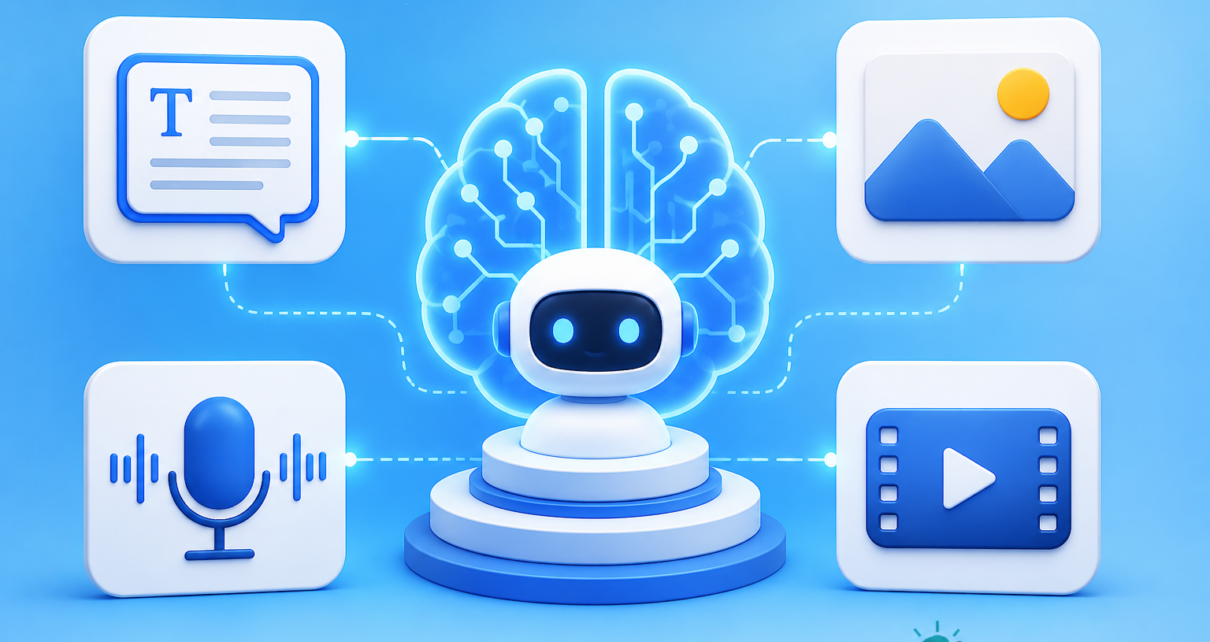
Multimodal AI is artificial intelligence that can understand, process, and generate information across multiple types of data, or “modalities.”
A modality simply means a particular type of information.
Common AI modalities include:
- Text – articles, emails, documents, conversations, code
- Images – photographs, diagrams, screenshots, charts
- Audio – speech, music, sounds, recordings
- Video – movies, tutorials, security footage, demonstrations
- Documents – PDFs, presentations, spreadsheets and scanned files
- Other data – depending on the system, this can include sensor or structured data
Traditional AI systems often specialized in one modality.
For example:
Text → language model
Image → computer vision model
Audio → speech recognition model
Video → video analysis model
Multimodal AI attempts to bring these capabilities together.
The key idea is simple:
Instead of understanding information separately, AI can connect information from different modalities.
How Does Multimodal AI Work?
At a high level, multimodal AI works by converting different types of information into representations that an AI model can process and relate to one another.
Imagine giving an AI system:
Text: “What is happening in this picture?”
Image: A photograph of a person riding a bicycle.
The system needs to understand both the question and the image before generating an answer.
A simplified workflow looks like this:
Text + Image + Audio + Video → AI processing → Combined understanding → Response or generation
Let’s break this down.
1. AI Receives Different Types of Input
The first step is collecting the information.
You might provide:
- A written question
- A photograph
- A voice recording
- A video clip
- A document
The AI system identifies what kind of information it has received.
2. Each Modality Is Processed
Different data types have different structures.
Text is made of words and tokens.
Images contain pixels.
Audio contains sound waves.
Video contains sequences of images, often combined with audio.
AI models use specialized techniques to transform these inputs into representations that can be analyzed.
For example, an image model might identify objects, shapes, colors, and relationships within an image.
A speech system may identify spoken words and sounds.
A language model can process the meaning and context of text.
3. The Information Is Connected
This is one of the most important parts of multimodal AI.
The system needs to understand how different pieces of information relate to each other.
Suppose you upload a screenshot of a programming error and ask:
“Why is my application showing this error?”
The AI needs to:
- Read the screenshot.
- Identify the error message.
- Understand the surrounding interface or code.
- Interpret your question.
- Connect the visual information with your text.
- Generate an explanation.
This combination is what makes multimodal AI powerful.
4. AI Generates an Output
The final step is producing a response.
Depending on the system, the output could be:
- Text
- An image
- Speech
- A video
- Code
- A summary
- A structured answer
- A recommendation
For example, you could upload a lecture recording and receive a written summary.
Or you could provide a written description and generate an image.
This creates a two-way relationship between different AI modalities.
Text AI: The Foundation of Modern AI
Text remains one of the most important modalities in artificial intelligence.
Large language models can process natural language and perform tasks such as:
- Answering questions
- Writing articles
- Summarizing documents
- Translating languages
- Generating code
- Extracting information
- Creating marketing copy
- Analyzing conversations
But text alone cannot fully describe everything humans experience.
Consider a medical image, a musical performance, or a security camera recording.
Words can describe these things, but the original visual or audio information may contain details that are difficult to express through text alone.
This is where multimodal AI becomes especially useful.
Image AI: Understanding the Visual World
Computer vision has existed for years, but modern AI models have significantly expanded what machines can do with images.
Image-capable AI can potentially:
- Identify objects
- Read text from images
- Understand charts
- Analyze screenshots
- Describe photographs
- Examine diagrams
- Compare images
- Answer questions about visual content
- Generate new images
For example, instead of typing:
“What does this chart show?”
you can upload the chart and ask the AI directly.
The system can combine the visual information with your natural-language question.
This makes AI much easier to use.
Audio AI: Giving AI the Ability to Hear
Audio adds another important dimension.
Speech recognition systems can convert spoken language into text, while newer AI systems can process audio more directly.
Audio AI can be used for:
- Transcription
- Voice assistants
- Meeting summaries
- Interviews
- Podcasts
- Language learning
- Customer service
- Voice-controlled applications
- Audio analysis
Imagine recording a 60-minute business meeting.
Instead of manually reviewing the entire recording, an AI system could potentially identify:
- Main discussion points
- Important decisions
- Questions
- Action items
- Speakers
- Follow-up tasks
The combination of audio and language understanding makes these workflows much more useful.
Video AI: Understanding Time and Motion
Video is more complicated than a single image because it contains information that changes over time.
A video can include:
- Images
- Motion
- Speech
- Background sounds
- Text
- Objects
- People
- Events
Multimodal AI can combine these signals to understand what is happening across a video.
For example, imagine uploading a product demonstration.
An AI system could potentially answer:
“At what point does the presenter show how to install the product?”
To answer that question, the AI may need to understand both the spoken explanation and the visual action happening on screen.
This is one reason video AI is becoming increasingly important.
A Simple Example of Multimodal AI
Let’s say you are a software developer.
You have a problem with your application.
Instead of writing a long explanation, you provide the AI with:
Screenshot: Your application’s error screen.
Text: “This error appears when I click the login button.”
Audio: A recording explaining what you tried.
Code: The relevant section of your application.
A multimodal AI system can potentially examine these inputs together.
It might identify the error from the screenshot, understand your explanation, inspect the code, and suggest a solution.
This is significantly different from an AI that only receives a text description.
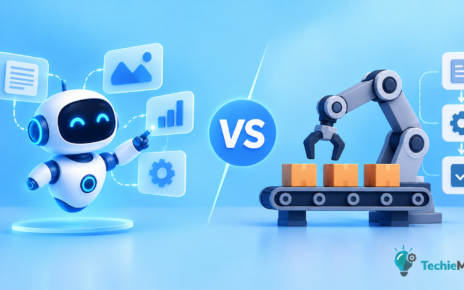
Multimodal AI vs Traditional AI
The difference becomes easier to understand with an example.
Traditional single-modality AI
You type:
“A dog is sitting on a beach.”
The AI works with your text.
Multimodal AI
You upload:
- A photograph of the beach
- A short video
- Your voice asking a question
- Additional text instructions
The AI can combine these inputs to produce a more context-aware response.
This doesn’t mean multimodal AI understands the world exactly like a human.
However, it gives AI access to a much richer set of information.
Why Is Multimodal AI Important?
Humans naturally combine information from different senses.
When we meet someone, for example, we don’t process only their words.
We may also observe:
- Facial expressions
- Body language
- Tone of voice
- Environment
- Movement
Multimodal AI moves AI systems closer to this type of combined information processing.
This can make AI applications more useful because real-world problems rarely exist in only one format.
A business might have customer information in emails, call recordings, screenshots, PDFs, videos, and databases.
Multimodal AI can help bring these sources together.
Real-World Applications of Multimodal AI
Multimodal AI is not just a research concept. Its potential applications are expanding rapidly.
1. Education
Imagine an AI tutor that can:
- Read a student’s question
- Analyze their handwritten homework
- Listen to their explanation
- Identify mistakes
- Generate visual examples
This could make digital learning much more interactive.
A student studying mathematics could upload a photograph of a handwritten equation and ask why the answer is incorrect.
The AI could analyze the equation and explain the mistake step by step.
2. Healthcare
Multimodal AI could help combine different types of medical information, such as:
- Medical images
- Clinical notes
- Patient records
- Laboratory results
- Voice information
This could support healthcare professionals by helping them organize and analyze complex information.
However, healthcare is a high-stakes area. AI-generated information should not automatically be treated as a medical diagnosis or a replacement for qualified professionals.
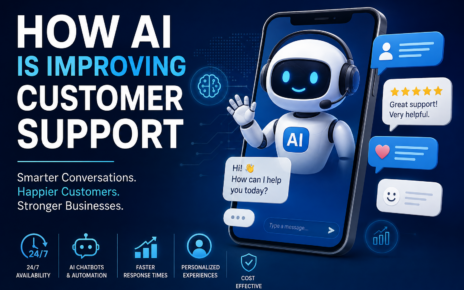
3. Customer Support
Customer service is another strong use case.
A customer could upload a photograph of a damaged product and explain the problem using voice.
Instead of asking the customer to describe everything manually, AI could potentially analyze the image and audio together.
This could help companies:
- Identify common problems
- Route support requests
- Create summaries
- Suggest troubleshooting steps
- Improve response times
4. Marketing
Marketing teams work with multiple types of content every day.
They create:
- Blog posts
- Social media posts
- Images
- Advertisements
- Videos
- Podcasts
Multimodal AI can help connect these workflows.
For example, a company could provide a product video and ask AI to create:
- A blog outline
- Social media captions
- A video summary
- Advertising ideas
- Image concepts
This can reduce repetitive content work.
5. Software Development
Developers are increasingly using AI for programming.
Multimodal capabilities can make developer tools even more useful.
For example, a developer could upload:
- A UI screenshot
- Source code
- A design mockup
- An error message
- A screen recording
The AI could then help identify differences between the design and implementation.
This is particularly useful for debugging user interfaces and understanding visual problems.
6. Accessibility
Multimodal AI could also improve accessibility.
For example, AI can potentially:
- Describe images for visually impaired users
- Convert speech into text
- Translate spoken language
- Generate captions
- Explain visual charts
- Help users interact with software through voice
The combination of modalities can make digital information available to more people.
Multimodal AI in Content Creation
Content creators are among the biggest potential beneficiaries of multimodal AI.
Imagine creating a YouTube video.
Traditionally, the workflow might look like:
Research → Script → Recording → Editing → Thumbnail → Social Posts
Multimodal AI can help connect these steps.
For example:
Topic → Script → Voice → Video → Thumbnail → Social Content
A creator could start with a written idea and use AI tools to develop different forms of content around it.
The important change is not simply that AI can generate content.
It is that AI can increasingly move information between formats.
Multimodal AI for Businesses
Businesses produce enormous amounts of unstructured information.
Consider a typical organization.
It might have:
- Emails
- PDFs
- Customer calls
- Product photos
- Training videos
- Presentations
- Spreadsheets
- Screenshots
- Internal documents
Previously, organizations often handled these sources separately.
Multimodal AI can potentially provide a common intelligence layer across them.
For example, a company could ask:
“Analyze these customer complaints, product photos, and support call recordings. What are the most common product problems?”
That’s a much richer question than simply searching through text.
Benefits of Multimodal AI
Better Context
Combining modalities can give AI more information about a problem.
More Natural Interaction
People can communicate using text, speech, images, or a combination of them.
Higher Productivity
AI can automate tasks that previously required several separate tools.
Better Accessibility
People can interact with information using different formats.
More Powerful Applications
Developers can build applications that understand real-world environments more effectively.
What Are the Challenges of Multimodal AI?
Despite its potential, multimodal AI is not perfect.
Accuracy
AI can misunderstand images, audio, video, or text.
A model might identify an object incorrectly or misunderstand what someone said.
Hallucinations
AI systems can generate information that sounds convincing but is incorrect.
This remains an important challenge.
Cost
Processing high-resolution images, long videos, and audio can require significant computing resources.
Privacy
Multimodal applications may process highly sensitive information, including:
- Faces
- Voices
- Personal documents
- Private conversations
- Photos
- Videos
Organizations need strong privacy and security practices.
Bias
AI models can reproduce biases present in their training data.
This can become particularly important when AI is used for decision-making.
Multimodal AI and Generative AI: What’s the Difference?
These terms are closely related, but they are not identical.
Generative AI refers to AI systems capable of generating new content.
That content might include:
- Text
- Images
- Audio
- Video
- Code
Multimodal AI refers to systems that can work with multiple modalities.
A system can therefore be both generative and multimodal.
For example, an AI assistant could accept text and images as input and generate text as its response.
Another system could accept text and generate both an image and audio.
The concepts overlap, but they describe different capabilities.
How Developers Can Build Multimodal AI Applications
Developers don’t necessarily need to build a large AI model from scratch.
Modern AI platforms provide APIs that can allow applications to work with different modalities.
A simplified architecture might look like:
User → Application → Multimodal AI Model → Response
For a more advanced application:
Text + Image + Audio + Video → AI Model → Reasoning → Application Logic → Output
Developers can build applications such as:
- AI customer support
- Document analysis tools
- Voice assistants
- Visual search
- Video analysis
- AI tutoring systems
- Content creation platforms
- Developer assistants
The biggest opportunity is often not building another generic chatbot, but solving a specific business or user problem with multimodal capabilities.
The Future of Multimodal AI
The future of AI is likely to become increasingly multimodal.
Instead of interacting with computers primarily through keyboards and screens, people may increasingly communicate through combinations of:
Voice + Text + Images + Video + Gestures
Imagine an AI assistant that can see what you’re seeing, hear what you’re saying, understand your documents, and respond through voice or visuals.
For example, while traveling, you could point your phone at a building and ask:
“What is this place, and what should I know before visiting?”
The AI could potentially analyze the image, understand your voice, use additional information available to it, and respond conversationally.
Similarly, a mechanic could point a camera at an engine while asking questions about an unusual sound.
A student could show an AI tutor their homework while explaining where they are confused.
A designer could upload a mockup and ask for code.
These experiences are possible because AI is becoming better at connecting different types of information.
Will Multimodal AI Replace Humans?
It is unlikely that multimodal AI will simply replace humans across the board.
Instead, the more realistic future is human-AI collaboration.
AI can process large amounts of information quickly, but humans remain important for:
- Judgment
- Creativity
- Context
- Ethics
- Responsibility
- Decision-making
The most valuable systems will likely combine AI’s ability to process information with human expertise.
Why Multimodal AI Matters for the Future of Technology
The biggest change brought by multimodal AI may not be a single new feature.
It is a change in how humans interact with technology.
For decades, computers largely required us to adapt to their interfaces.
We learned:
- Keyboard commands
- Menus
- Buttons
- Forms
- Software workflows
Multimodal AI creates the possibility of a more natural relationship.
We can increasingly give computers information in the way humans naturally communicate:
Show it. Say it. Write it. Record it.
And AI can combine those inputs to understand what we want.
Frequently Asked Questions About Multimodal AI
What is multimodal AI in simple words?
Multimodal AI is AI that can understand and work with different types of information, such as text, images, audio, and video.
How is multimodal AI different from normal AI?
Traditional AI systems may specialize in one type of information. Multimodal AI combines multiple types of information to create a richer understanding of a task.
Can multimodal AI understand images and text together?
Yes. Multimodal AI systems can be designed to process images and text together, allowing users to ask questions about visual content using natural language.
Can multimodal AI process video?
Yes. Some multimodal AI systems can analyze video, including visual information, speech, sounds, and events occurring over time.
Is ChatGPT multimodal?
Modern versions of ChatGPT can support multiple input and output modalities depending on the model and features available to the user.
Is multimodal AI the future?
Multimodal AI is expected to play an important role in the future of AI because real-world information naturally exists across text, images, audio, video, and other formats.
Final Thoughts
Multimodal AI represents an important evolution in artificial intelligence.
Instead of treating text, images, audio, and video as completely separate forms of information, multimodal systems can connect them.
That creates new possibilities for education, healthcare, software development, customer service, marketing, accessibility, entertainment, and everyday productivity.
The most exciting part is that multimodal AI makes technology more natural to interact with.
You don’t always need to explain everything in words.
You can show AI a picture, speak your question, upload a document, provide a video, or combine several types of information at once.
As AI models continue to improve, the ability to understand and generate multiple modalities could become a standard part of how we interact with computers.
The future of AI isn’t just about machines that can read or write. It’s about AI that can increasingly see, hear, understand, create, and connect information across different forms.
And that’s what makes multimodal AI one of the most important developments to watch in the next generation of technology.