No, not fully. AI is automating specific marketing tasks (first drafts, reporting, routine optimization), not marketing jobs. 91% of marketing teams already use AI in their work, yet demand for marketers who can direct, edit, and strategize with these tools is rising, not falling. The real risk isn’t AI but the marketers who don’t learn to use it.
Search “will AI replace digital marketers,” and you’ll get a wall of confident answers pointing in both directions. Here’s what’s actually true, based on current adoption data rather than speculation, and how it connects to the tools covered in our full AI marketing tools guide.
How many marketers are already using AI?
A lot more than the “will it happen” framing suggests it’s already happened. 91% of marketing teams use AI to assist with their work, and 88% of marketers report using AI tools daily. This isn’t an early-adopter niche anymore; it’s closer to the default way marketing work gets done in 2026.
That number alone reframes the question. You’re not deciding whether to compete against AI; you’re deciding whether to be one of the marketers who uses it well.
What tasks is AI actually automating?
The productivity data is specific about where the gains are coming from:
- 93% of marketers say they create content faster with AI assistance, and teams using AI for content production publish roughly 47% more content per month.
- Teams using AI strategically report 44% productivity gains, according to McKinsey’s 2025 analysis.
- A large share of AI-generated marketing content is produced in under 3 hours per week per person, meaning AI is compressing production time on tasks like first drafts, reporting summaries, and routine optimization, not replacing the strategic work around them.
What this points to: AI is absorbing the mechanical parts of marketing (e.g., drafting, formatting, basic data pulls) and leaving the judgment parts (what to say, to whom, and why it matters for the business) with humans.
Which marketing skills are becoming more valuable, not less?
As AI handles more first-draft and routine work, the skills that separate marketers who thrive from marketers who stall are shifting toward direction and oversight rather than raw production:
- Prompting and tool fluency: knowing how to get a genuinely useful first draft out of tools like ChatGPT or Jasper, instead of a generic one.
- Editorial judgment: knowing what to keep, cut, and fact-check from AI output. This matters more, not less, as output volume increases.
- Strategy and positioning: AI can generate copy; it can’t decide what your brand should stand for or which audience segment actually matters this quarter.
- Measurement: Notably, only 19% of content marketers currently track AI-specific performance metrics, which means marketers who can actually prove AI-assisted work is driving results have a real, current advantage over those who can’t.
Is there a real skills gap right now?
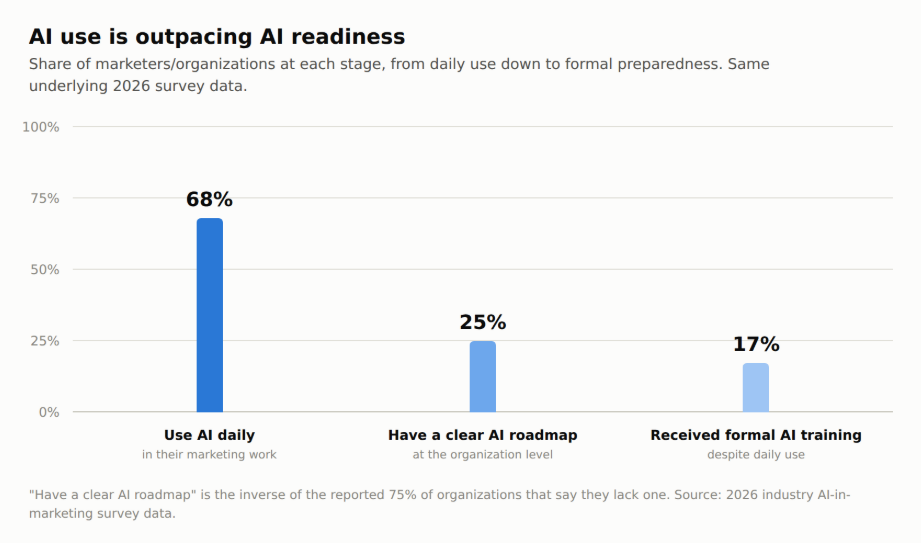
Yes, and it’s worth being honest about it: 68% of marketers use AI daily, but only 17% have received any formal training on it, according to 2026 data from Loopex Digital. Separately, 75% of organizations report they still lack a clear AI roadmap despite high day-to-day usage. That gap is exactly where risk concentrates.
It’s not at all about “AI vs. humans” in the abstract, but marketers using AI casually and without structure, versus marketers using it as a deliberate part of their workflow.
The same research found companies that invest in AI education see 43% higher project success rates, which is a meaningful gap for something as fixable as training.
The honest part: Some roles and tasks genuinely are shrinking
It would be dishonest to say nothing is changing.
Junior roles built almost entirely around repetitive production — basic social copy, templated reporting, simple graphic resizing — are the ones most exposed, because AI tools now do those specific tasks faster and at lower cost.
That’s surely a big shift, and marketers early in their careers should treat it as a signal to move up the value chain faster: toward strategy, campaign ownership, and AI-output review, rather than treating AI fluency as optional.
Which Marketing Jobs Are Relatively Safer From AI?
No marketing role is completely AI-proof. But some types of work are harder to automate because they depend heavily on context, accountability, relationships, or decisions with incomplete information.
A marketer can ask AI to generate 20 positioning options. Someone still has to determine which one fits the product, market, customer, and commercial objective. AI can analyze campaign performance. Someone still needs to decide whether the answer calls for a new audience, a different offer, a budget shift, or no change at all.
Roles that combine several of these characteristics are likely to remain more resilient, including:
- Product marketing: translating complex products into positioning, messaging, launches, and customer value propositions.
- Marketing strategy: deciding where to compete, which audiences to prioritize, and how different channels should work together.
- Brand leadership: maintaining a coherent brand identity across campaigns, markets, and customer touchpoints.
- Marketing operations: designing the systems, processes, data flows, and measurement frameworks that connect marketing activity to business outcomes.
- Growth leadership: forming hypotheses, prioritizing experiments, interpreting results, and deciding what the organization should do next.
- Customer and stakeholder-facing roles: work that depends on trust, negotiation, relationship management, and understanding organizational context.
The difference is that these roles require someone to own the decision. That makes decision ownership a more useful measure of career resilience than a specific job title.
Hasn’t marketing been through automation scares before?
Yes, and it’s worth remembering how those actually played out.
Marketing automation platforms in the 2010s were supposed to replace email marketers; they ended up creating a new specialization (marketing ops) instead of eliminating the role.
SEO tools automated keyword research that used to take days. However, SEO as a discipline didn’t shrink. It professionalized around interpreting and acting on what the tools surfaced.
The pattern each time has been the same: automation absorbs a specific mechanical task, and the humans around it move toward interpreting, directing, and applying judgment to the output.
Current AI adoption data (91% of teams using it, but only 17% formally trained on it) suggests the market is in the early, chaotic phase of that same shift, not a fundamentally different one.
The history doesn’t guarantee the same outcome this time. AI’s pace of capability growth is faster than previous automation waves. So, it’s reasonable to hold some uncertainty about that difference. But the industry consensus among marketing analysts leans toward “role transformation” rather than “role elimination.”
The New Marketing Workflow: Human, AI, Human
The emerging marketing workflow is less about handing an entire assignment to AI and more about dividing the work between humans and machines.
A simple version looks like this:
Human: Define the objective, audience, constraints, and context.
↓
AI: Research, generate options, summarize information, or perform repetitive production work.
↓
Human: Evaluate the output, apply expertise, fact-check it, and make the final decision.
↓
AI: Repurpose, personalize, format, analyze, or automate parts of execution.
↓
Human: Review performance and decide what happens next.
The valuable skill, at present,l is knowing where AI belongs in a workflow and where it doesn’t. A marketer who can design that workflow can often get more leverage from the same tools than someone who simply uses AI for individual tasks. That is also why AI fluency is becoming less of a standalone technical skill and more of a layer across marketing disciplines.
What are employers actually looking for in 2026?
Job postings and hiring signals in 2026 skew toward marketers who can demonstrate AI fluency as a skill, not toward roles that exclude AI experience.
Practically, that means being able to show (not just claim) that you can direct AI tools toward a specific brand voice, catch and correct AI errors before they ship, and measure whether AI-assisted work is actually moving a metric that matters.
The marketers struggling most in this transition tend to be the ones who either avoided AI tools entirely (and are now visibly slower than peers) or who lean on AI output without editing it critically enough (and produce work that reads as generic).
Wondering what’s the best path forward?
Take the middle ground, which is all about deliberate, editorially rigorous AI use.
How can marketers stay relevant as AI adoption grows?
The practical path is less about resisting AI tools and more about being deliberate with the ones you already have access to:
- Use a general writing assistant like ChatGPT for first drafts, but treat your edit as the actual deliverable.
- Use Grammarly AI to catch what fast AI-assisted drafting misses (tone drift, inconsistency) rather than relying on it as a crutch.
- Use HubSpot AI or similar CRM-integrated tools to move from single-campaign thinking to pipeline-level reporting. It’s the layer AI hasn’t fully absorbed yet.
- Use Notion AI to document your prompting process and campaign learnings, so your AI fluency becomes visible and repeatable, not just a personal habit.
None of this requires a big budget shift. You just need to start treating AI tools as a skill to build deliberately rather than something you dabble in.
Ready to start building AI fluency instead of just wondering about it?
Our full guide to AI tools every digital marketer should try in 2026 covers the 15 tools worth learning first, organized by what problem each one actually solves.
FAQs
Not exactly. Current data shows 91% of marketing teams already use AI without net job loss at the team level. AI is automating specific tasks like drafting and reporting, while strategy, judgment, and client relationships remain human-led.
Junior, production-heavy roles centered on repetitive tasks, such as templated social copy, basic reporting, simple design resizing, etc., are the most exposed, since AI tools now do these specific tasks faster and cheaper.
Yes, and without delay. Only 17% of marketers who use AI daily have received formal training, and companies investing in AI education report 43% higher project success rates. So, training will be a real, current advantage.
AI accelerates the production layer beneath them, not the decisions above it. Strategy, brand positioning, editorial judgment, stakeholder relationships, and measurement/attribution remain human-led skills.
Move deliberately toward strategy and AI-output review rather than pure production, document and systematize how you use AI tools, and prioritize measurement skills. It will be advantageous because most marketers still don’t track AI-specific performance.