Search Engine Optimization (SEO) has evolved dramatically in recent years, and 2026 marks a turning point. Traditional SEO is no longer just about keywords and backlinks—it now includes AI visibility, generative search optimization (GEO), and machine-understood content.
With AI-powered platforms like ChatGPT, Google AI Overviews, and Perplexity reshaping how users discover information, businesses must adapt. AI SEO tools have become essential for marketers, bloggers, agencies, and content creators who want to stay competitive.
In this in-depth guide, you’ll discover the top AI SEO tools in 2026, how they work, their features, pros & cons, and how to choose the right one for your needs.
What Are AI SEO Tools?
AI SEO tools are software platforms that use artificial intelligence, machine learning, and natural language processing (NLP) to automate and enhance SEO tasks.
These tools help with:
- Keyword research
- Content optimization
- Technical SEO audits
- Competitor analysis
- AI search visibility tracking
- Content generation
In 2026, AI SEO tools go beyond Google rankings—they also help you appear in AI-generated answers, a growing trend in search.
Why AI SEO Tools Matter in 2026
The SEO landscape is shifting due to:
1. Rise of AI Search Engines
Users increasingly rely on AI tools instead of traditional search engines.
2. Generative Engine Optimization (GEO)
SEO now includes optimizing content for AI-generated responses, not just search rankings.
3. Automation & Speed
AI tools reduce hours of manual work into minutes.
4. Data-Driven Decisions
AI tools analyze massive datasets to provide actionable insights.
👉 In short: If you’re not using AI for SEO in 2026, you’re already behind.
Categories of AI SEO Tools
Before diving into tools, understand the major categories:
| Category | Purpose |
|---|---|
| All-in-One SEO Platforms | Complete SEO + AI features |
| Content Optimization Tools | Improve blog/content rankings |
| AI Writing Tools | Generate SEO-friendly content |
| AI Visibility Tools | Track presence in AI search |
| Technical SEO Tools | Site audits & optimization |
Top AI SEO Tools in 2026
Let’s explore the best tools dominating the SEO world this year.
1. Semrush AI SEO Toolkit (Best Overall)
Best for: All-in-one SEO + AI insights
Semrush has evolved into a complete AI SEO ecosystem. Its AI Copilot provides real-time recommendations based on your data.
Key Features:
- AI-powered keyword research
- Content optimization toolkit
- Competitor analysis
- AI visibility tracking across platforms
- Predictive SEO analytics
In 2026, Semrush can even track your “Share of Voice” in AI-generated answers.
Pros:
- All-in-one solution
- Accurate data
- Advanced AI insights
Cons:
- Expensive for beginners
2. Surfer SEO (Best for Content Optimization)
Best for: On-page SEO & content scoring
Surfer SEO uses AI and NLP to analyze top-ranking pages and give real-time suggestions.
Features:
- Content editor with AI scoring
- SERP analysis
- Keyword density suggestions
- AI content generation
It ensures content is optimized for both humans and AI systems.
Pros:
- Easy to use
- Excellent content optimization
Cons:
- Limited technical SEO features
3. Ahrefs (Best for Backlinks & Research)
Best for: Keyword research & backlinks
Ahrefs integrates AI to provide deeper insights into SEO data.
Features:
- AI keyword suggestions
- Backlink analysis
- Site audit tools
- Rank tracking
It remains one of the strongest tools for data-driven SEO strategies.
Pros:
- Huge database
- Powerful analysis tools
Cons:
- Learning curve
4. Clearscope (Best for Content Quality)
Best for: High-quality content optimization
Clearscope uses NLP to analyze top content and provide optimization recommendations.
Features:
- Content grading system
- Keyword suggestions
- Readability analysis
- Competitor insights
It focuses on semantic relevance, not just keywords.
Pros:
- Improves content quality
- Great for agencies
Cons:
- High pricing
5. Frase (Best for Content Workflow Automation)
Best for: Research → Write → Optimize workflow
Frase helps you create SEO content from scratch using AI.
Features:
- AI content briefs
- SERP analysis
- AI writing assistant
- Content optimization
It’s designed to help your content get cited by AI systems.
Pros:
- End-to-end workflow
- Beginner-friendly
Cons:
- Limited technical SEO
6. SE Ranking (Best Budget Tool)
Best for: Affordable all-in-one SEO
SE Ranking combines traditional SEO with AI features.
Features:
- Keyword tracking
- Website audit
- AI visibility tracking
- Competitor analysis
Offers a strong balance of features and pricing.
Pros:
- Cost-effective
- Good for small businesses
Cons:
- Not as advanced as premium tools
7. MarketMuse (Best for Content Strategy)
Best for: Content planning & authority building
MarketMuse uses AI to build topic authority and content clusters.
Features:
- Content planning
- Topic modeling
- Competitive analysis
- AI recommendations
Ideal for long-term SEO strategy.
Writesonic (Best AI Writing + SEO Tool)
Best for: AI-generated SEO content
Writesonic combines content writing with SEO optimization.
Features:
- AI blog generation
- SEO optimization tools
- AI visibility tracking
- Content ideas
Great for bloggers and content marketers.
9. RankIQ (Best for Bloggers)
Best for: Niche bloggers
RankIQ focuses on low-competition keywords and fast content optimization.
Features:
- Keyword library
- SEO reports
- Content optimization
Beginner-friendly and effective for blogs.
10. ChatGPT (Best AI Assistant for SEO)
Best for: Content creation & ideation
AI tools like ChatGPT have become essential for SEO workflows.
Use Cases:
- Keyword research
- Blog writing
- Meta descriptions
- SEO strategy
Widely used alongside other tools for better productivity.
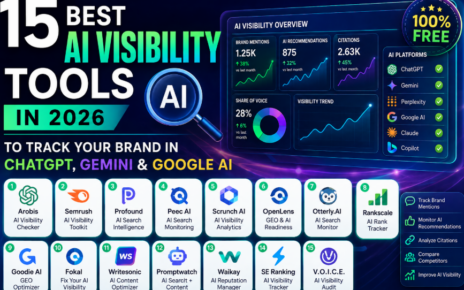
Emerging Trend: AI Visibility Tracking
A major trend in 2026 is tracking visibility in AI-generated responses.
Instead of just ranking on Google, tools now measure:
- Mentions in ChatGPT answers
- Visibility in Google AI Overviews
- Citations in AI responses
This is called Generative Engine Optimization (GEO).
How to Choose the Right AI SEO Tool
Here’s a quick guide:
✔️ For Beginners:
- RankIQ
- Writesonic
✔️ For Bloggers:
- Surfer SEO
- Frase
✔️ For Agencies:
- Semrush
- Ahrefs
- Clearscope
✔️ For Budget Users:
- SE Ranking
Pro Tips for Using AI SEO Tools
- Don’t rely 100% on AI
Always add human creativity. - Focus on search intent
AI rewards useful, relevant content. - Optimize for AI answers (GEO)
Structure content clearly. - Combine tools
Example:- Surfer (content)
- Ahrefs (research)
- ChatGPT (writing)
👉 No single tool does everything perfectly.
Limitations of AI SEO Tools
- Cannot guarantee rankings
- May generate generic content
- Require human editing
- Expensive for beginners
Future of AI SEO (2026 and Beyond)
The future of SEO will focus on:
- AI-first search engines
- Voice and conversational search
- Personalized results
- Entity-based SEO
- Trust and authority signals
SEO is evolving into AEO (Answer Engine Optimization) and GEO.
Conclusion
AI SEO tools in 2026 are no longer optional—they are essential.
From Semrush’s predictive analytics to Surfer’s content optimization and Frase’s automation, these tools help you:
- Work faster
- Rank better
- Adapt to AI-driven search
The key takeaway?
Success in SEO now depends on optimizing not just for Google, but for AI itself.