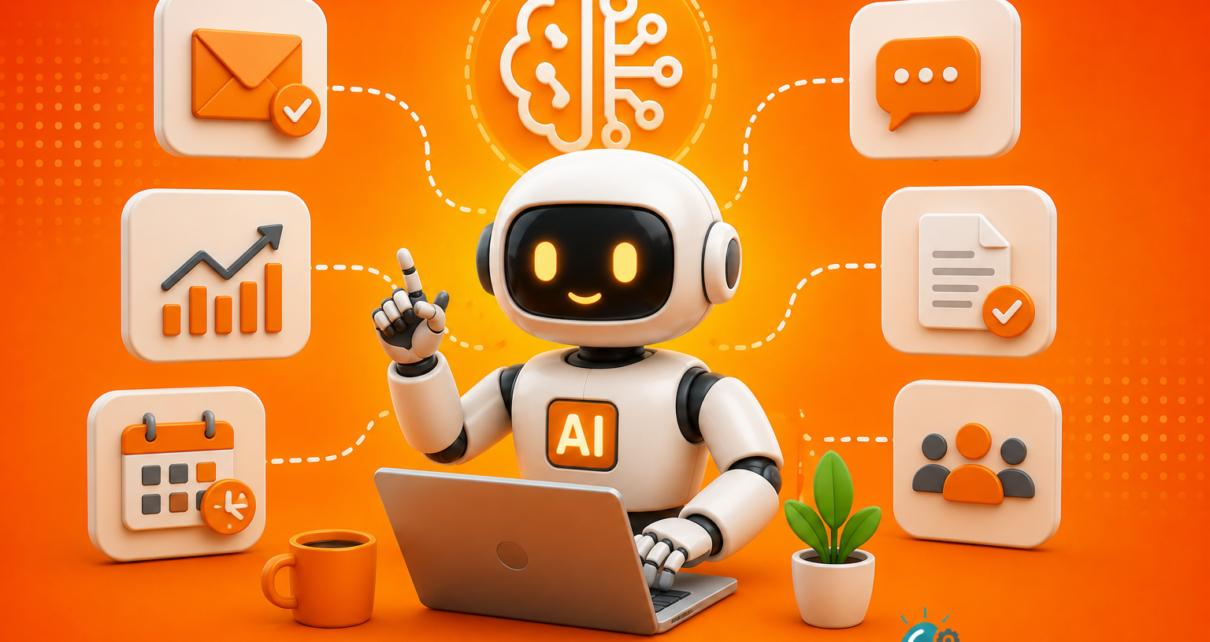
Artificial intelligence is entering a new phase in 2026. For years, generative AI was primarily used to answer questions, create content, summarize information, write code, and assist employees. Now, the focus is shifting from AI that responds to AI that acts.
This shift is being driven by AI agents—systems that can understand goals, plan multi-step tasks, use software tools, access business data, make decisions, and execute actions with varying degrees of human oversight.
Unlike traditional chatbots, AI agents are designed to participate directly in workflows. They can potentially research information, update databases, interact with applications, analyze business performance, write and test software, manage customer requests, and coordinate with other AI agents.
Industry research and recent enterprise developments indicate that organizations are moving from simple AI assistance toward delegation and execution. OpenAI, for example, describes agentic AI as changing knowledge work from short interactions toward delegated, long-horizon tasks, while Google Cloud identifies 2026 as a major year for agentic workflows and AI-powered business processes.
The result could be one of the biggest changes to workplace software since cloud computing and mobile applications.
What Are AI Agents?
An AI agent is an AI-powered system that works toward a specific objective by performing multiple actions rather than simply generating one response.
A traditional chatbot might answer:
“What were our sales last month?”
An AI agent could potentially:
- Access the company’s sales database.
- Retrieve the relevant records.
- Analyze sales performance.
- Compare results with previous months.
- Identify significant changes.
- Generate a report.
- Send the report to the appropriate manager.
The key difference is execution.
A chatbot primarily provides information. An AI agent can combine reasoning, planning, tool use, data retrieval, and action execution.
This is why AI agents are becoming increasingly important for business software. The underlying idea is moving from:
Ask → Answer
to:
Goal → Plan → Execute → Evaluate → Improve
Research published by Dreamtree similarly describes AI agents as systems that can understand a goal, use tools, interact with databases and APIs, complete multiple steps, and operate with limited human intervention.
AI Agents vs. Traditional Automation
AI agents are not simply a replacement for traditional automation.
Traditional automation works extremely well when the process is predictable.
For example:
Invoice received → Save invoice → Send notification
The rules are predefined and deterministic.
But real-world business processes are rarely perfectly predictable. An invoice may be missing information. A customer may ask an unusual question. A document may use an unexpected format.
This is where agentic AI can provide another layer of flexibility.
Traditional automation
- Rule-based
- Predictable
- Deterministic
- Excellent for repetitive tasks
- Usually follows predefined workflows
AI agents
- Context-aware
- Adaptive
- Goal-oriented
- Capable of reasoning
- Can use external tools
- Can handle multi-step workflows
- Can respond to changing conditions
The future is unlikely to be AI agents instead of automation. More realistically, businesses will combine deterministic automation with AI-based reasoning.
Why AI Agents Are Becoming Important in 2026
Several developments are accelerating the adoption of AI agents.
Modern AI models are becoming better at reasoning, coding, tool use, long-context processing, and multimodal interaction. At the same time, businesses have accumulated enormous amounts of data across CRM platforms, ERP systems, cloud applications, databases, documents, communication platforms, and internal tools.
AI agents can act as an intelligent layer connecting employees with these systems.
A simplified architecture looks like this:
Employee → AI Agent → Business Applications → Data → Actions
Instead of manually opening multiple applications, searching for information, copying data, creating reports, and sending updates, employees can increasingly delegate parts of the workflow to AI.
Google Cloud’s 2026 AI agent research describes this transition as moving from individual prompts toward complex, end-to-end workflows and “digital assembly lines.”
Anthropic’s research also found that more than half of surveyed organizations were deploying agents for multi-stage workflows, with some using them across multiple business functions.
How AI Agents Are Changing the Way We Work
The biggest change may not be that AI replaces an entire job.
Instead, AI agents can change how individual tasks inside that job are performed.
An employee who previously spent four hours preparing reports might spend 30 minutes reviewing an agent-generated report.
A developer who spent hours investigating a bug might delegate code analysis, testing, and debugging tasks to an AI coding agent.
A salesperson might ask an agent to identify inactive customers and prepare a personalized follow-up list.
A project manager could use agents to monitor deadlines, summarize meetings, identify risks, and prepare status reports.
The employee remains responsible for important decisions while AI handles more of the repetitive execution.
This creates a new workplace model:
Human sets direction → AI executes tasks → Human reviews important outcomes
1. AI Agents Are Transforming Software Development
Software development is one of the clearest examples of agentic AI.
AI coding systems are increasingly capable of working across repositories, analyzing existing code, generating changes, running tests, investigating errors, and iterating on solutions.
Consider a request:
“Add customer invoice search to the admin dashboard.”
A conventional AI coding assistant might generate a code snippet.
A more advanced coding agent could potentially:
- Inspect the project structure
- Find relevant database tables
- Understand existing APIs
- Review authentication requirements
- Modify backend code
- Create frontend components
- Add validation
- Generate tests
- Run the test suite
- Investigate failures
- Fix implementation problems
- Prepare changes for human review
This represents a significant shift from AI as coding assistant to AI as software engineering collaborator.
OpenAI’s 2026 research also reports that users are increasingly delegating longer and harder coding tasks to agents, demonstrating how agentic systems are moving beyond short AI interactions.
2. The Rise of Multi-Agent Systems
The future of AI agents may not involve one giant agent doing everything.
Instead, businesses may use multiple specialized AI agents that collaborate.
Imagine an e-commerce company with:
- Sales Agent — handles customer questions and recommendations
- Inventory Agent — monitors stock
- Pricing Agent — analyzes pricing
- Marketing Agent — evaluates campaigns
- Finance Agent — analyzes transactions
- Customer Support Agent — manages service requests
A customer order could trigger a workflow such as:
Sales Agent → Inventory Agent → Payment System → Fulfillment Agent → Customer Support Agent
Each agent performs a specialized function.
NASSCOM community material on AI agents similarly highlights networked ecosystems in which multiple specialized agents and human teams can coordinate across project and business workflows.
3. Agent-to-Agent Communication Will Matter
As organizations deploy more AI agents, interoperability becomes increasingly important.
If every agent uses a completely different communication system, connecting them becomes complicated.
Technologies such as Google’s Agent2Agent (A2A) approach are designed to facilitate communication between independent AI agents. A2A complements technologies such as the Model Context Protocol (MCP), which focuses on connecting AI applications with tools and data sources.
The long-term vision is an ecosystem where companies can connect specialized agents rather than building one enormous AI system.
That could make enterprise AI:
- More modular
- Easier to integrate
- Easier to replace
- More scalable
- More specialized
4. AI Agents Are Changing CRM
Customer relationship management is another area where AI agents can make a major difference.
Traditional CRM software stores customer information and gives employees tools for managing it.
Agentic CRM could become more proactive.
An AI agent could potentially:
- Identify inactive customers
- Prioritize leads
- Summarize customer conversations
- Draft follow-up messages
- Identify sales opportunities
- Recommend next actions
- Update customer records
- Generate sales reports
- Alert managers about unusual customer activity
Instead of asking an employee to search through customer records, the system could continuously analyze customer activity and recommend what should happen next.
The CRM becomes more than a database.
It becomes an intelligent operational system.
5. AI Agents in Customer Support
Customer support is another natural application.
Traditional workflow:
Customer → Ticket → Human Agent → Resolution
Agentic workflow:
Customer → AI Agent → Knowledge Base + CRM + Business Systems → Resolution
For straightforward requests, an agent may be able to complete the entire process.
For complicated requests, it can collect information before transferring the case to a human.
For example, instead of asking a customer to wait while an employee checks an order, an agent could retrieve:
- Order status
- Shipping information
- Payment status
- Previous support interactions
- Customer account information
It could then provide the employee with a complete context before escalation.
This reduces repetitive work and allows human support specialists to focus on complex customer problems.
6. AI Agents Are Making Business Intelligence More Intelligent
Businesses already have dashboards full of information.
The problem is often not a lack of data.
It is understanding what the data means and what should happen next.
Suppose revenue falls 12% in one region.
A traditional dashboard might show the decline.
An AI agent could potentially investigate:
- Which products declined?
- Which customers reduced purchases?
- Did website traffic change?
- Did advertising performance fall?
- Were products out of stock?
- Did pricing change?
- Did competitors launch new offers?
This creates a transition from:
Business Intelligence → Business Intelligence + AI Reasoning
AI agents can therefore become a layer between raw business data and managerial decision-making. Dreamtree’s research similarly describes agents as capable of monitoring business metrics, investigating unusual patterns, and helping explain why changes occurred.
7. AI Agents in ERP and Business Operations
Enterprise resource planning systems are another major opportunity.
Consider a manufacturing company.
An operations agent could monitor:
- Inventory
- Purchase orders
- Supplier performance
- Production schedules
- Sales forecasts
- Delivery timelines
If inventory falls below a threshold, the agent could identify the issue.
If a supplier delay creates a production risk, it could alert the appropriate team.
If demand suddenly increases, it could recommend procurement changes.
The goal is not necessarily to remove humans from operational decisions.
Instead, AI can continuously monitor complex systems while people focus on decisions requiring judgment and accountability.
8. AI Agents and Project Management
AI agents are also changing project management.
Project teams spend significant amounts of time on administrative work such as:
- Meeting notes
- Status reports
- Task tracking
- Risk monitoring
- Resource planning
- Documentation
- Project reporting
AI agents can automate or assist with many of these activities.
For example, an agent could listen to a meeting, identify decisions, extract action items, assign responsibilities, and distribute a structured summary.
NASSCOM community research highlights use cases such as automated project charter generation, billing-loss detection, AI-generated meeting minutes, and continuous domain intelligence.
This allows project managers to spend less time maintaining project information and more time managing stakeholders, risks, and strategic priorities.
9. AI Agents Will Change Software Interfaces
Traditional business software is built around screens.
Users click buttons, fill forms, open menus, search databases, and move between applications.
Agentic software can be built around goals.
Instead of:
Open CRM → Search customer → Open record → Check sales → Export report
an employee might simply say:
“Show me customers whose purchases declined by more than 20% this quarter and prepare a follow-up list.”
The agent determines how to complete the task.
This does not mean graphical interfaces will disappear.
Instead, the next generation of applications may combine:
Traditional UI + Natural Language + AI Agents + APIs
This could create a more flexible way of interacting with business software.
10. The Rise of Agent-Native Software
The emergence of AI agents is also changing how developers design applications.
Future software may need to be designed specifically for AI agents to interact with it safely.
That means developers will increasingly think about:
- Agent-friendly APIs
- Structured outputs
- Tool definitions
- Authentication
- Permission boundaries
- Audit logs
- Event-driven architecture
- Observability
- Human approval workflows
In other words, applications will not only be designed for human users.
They will also be designed for machine users.
This could become one of the most important software development trends of the late 2020s.
11. AI Agent Security Is a Major Challenge
More autonomy creates more responsibility.
An AI agent becomes more powerful when it has access to more systems.
But more access also means more risk.
Imagine an agent with access to:
- Customer records
- Financial information
- Production databases
- Cloud infrastructure
- Internal documents
- Payment systems
A poorly configured agent could potentially cause significant damage.
Therefore, organizations need to treat AI agents as a new security category—not simply as chatbots.
Important controls include:
- Least-privilege access
- Role-based permissions
- Tool restrictions
- Human approval
- Audit logging
- Continuous monitoring
- Rate limiting
- Data-loss prevention
- Agent identity management
- Secure API access
The central principle should be:
Give an AI agent only the access it needs to perform its assigned task.
12. Human Oversight Will Still Be Essential
Autonomous AI does not mean completely unsupervised AI.
Businesses should classify tasks according to risk.
Low-risk tasks
These may be suitable for high levels of automation:
- Document summarization
- Internal search
- Report generation
- Data classification
- Routine information retrieval
Medium-risk tasks
These may require human review:
- Customer communications
- Database updates
- Financial recommendations
- Operational changes
High-risk tasks
These should generally require explicit human authorization:
- Large financial transactions
- Deleting production data
- Critical infrastructure changes
- Legal decisions
- Sensitive security actions
A practical model is:
AI recommends → Human approves → System executes
As systems become more reliable, organizations may gradually automate selected low-risk workflows.
13. AI Agents Will Transform Jobs—Not Simply Eliminate Them
One of the biggest questions surrounding AI agents is whether they will replace workers.
A better way to understand the change is through task transformation.
Imagine an employee spends four hours every week preparing reports.
An AI agent reduces that workload to 30 minutes of review.
The employee can then spend more time on:
- Strategy
- Customer relationships
- Decision-making
- Creative work
- Problem-solving
- Business development
The value of AI therefore depends heavily on how companies redesign jobs around it.
Organizations that simply add a chatbot to an old workflow may achieve limited results.
Organizations that redesign workflows around AI agents could capture much greater value.
14. What Businesses Should Do Before Adopting AI Agents
Businesses should not begin with:
“Which AI agent should we buy?”
They should begin with:
“Which business process should we improve?”
A practical adoption strategy includes:
Step 1: Identify repetitive workflows
Find processes that consume significant employee time.
Step 2: Measure the existing process
Track time, cost, error rates, bottlenecks, and outcomes.
Step 3: Choose a low-risk use case
Start with a process where mistakes have limited consequences.
Step 4: Connect the necessary data
Make sure the agent has access to accurate and relevant information.
Step 5: Define permissions
Give the agent only the access required for its job.
Step 6: Add human approval
Require people to approve sensitive actions.
Step 7: Monitor performance
Measure accuracy, cost, latency, failures, and business outcomes.
Step 8: Scale gradually
Expand the agent’s responsibilities after the initial workflow becomes reliable.
This measured approach can reduce risk while allowing businesses to demonstrate measurable ROI. These adoption principles are also consistent with the implementation framework described in Dreamtree’s 2026 analysis.
What Developers Should Learn About AI Agents in 2026
Developers who want to build agentic applications should look beyond basic prompt engineering.
Important skills include:
AI APIs
Understand how to integrate foundation models into real applications.
Tool Calling
Learn how models can safely interact with external tools and systems.
Retrieval-Augmented Generation
Understand how applications can retrieve relevant information from internal knowledge sources.
Vector Databases
Learn how semantic search and retrieval systems work.
Agent Orchestration
Understand how multiple AI tasks and agents can coordinate.
API Security
Agents need controlled access to external services.
Observability
Developers need to understand what agents did, which tools they used, where they failed, and why.
Workflow Design
Perhaps most importantly, developers need to understand how to redesign business processes rather than simply attach a chatbot to existing software.
AI Agents and the Future of Web Development
Web development is also likely to change.
Future websites may increasingly understand what users are trying to accomplish instead of simply responding to clicks.
For example, an e-commerce customer might say:
“I need a laptop for software development under my budget.”
An agent could potentially:
- Understand the requirements.
- Search available products.
- Compare specifications.
- Check availability.
- Filter options.
- Explain the differences.
- Recommend suitable products.
Similarly, business websites could use agents to qualify leads, configure services, answer questions about business data, and guide customers through complex processes.
This creates a new category of agent-powered software.
The Future May Be Multi-Agent
The long-term vision could be a digital workforce made up of specialized AI agents.
For example:
Sales Agent
↓
Customer Agent
↓
Finance Agent
↓
Operations Agent
↓
Reporting Agent
Each agent performs a specific role while communicating with other agents.
This model could make enterprise AI more modular and allow businesses to combine agents from different systems.
Interoperability standards such as A2A may become increasingly important as organizations build these interconnected agent ecosystems.
What AI Agents Mean for Businesses in India
India is particularly well positioned to benefit from enterprise AI and agentic AI.
The opportunities span industries such as:
- IT services
- Banking
- E-commerce
- Customer support
- Education
- Healthcare administration
- Logistics
- Manufacturing
- Real estate
- Digital marketing
Dreamtree’s analysis cites an Autodesk AI Pulse report in which surveyed Indian organizations reported increasing AI investment and significant interest in adopting agentic AI.
For Indian companies, however, adoption should focus on measurable business outcomes rather than simply following the AI trend.
The strongest opportunities are likely to come from workflows where companies can clearly measure:
Time saved + Cost reduced + Errors prevented + Revenue improved + Customer experience enhanced
The Biggest Competitive Advantage May Not Be the AI Model
Companies often spend enormous amounts of time comparing AI models.
Model selection matters, but it is only one component of an agentic system.
A stronger competitive advantage may come from:
Data + Workflow + Integration + Security + AI Model + User Experience
A company using a slightly less powerful model with excellent data and workflow integration could potentially outperform a company using a more advanced model without the necessary infrastructure.
This is why agentic AI is becoming a software engineering and business-process challenge, not simply a model-selection challenge.
Final Thoughts: AI Agents Are Moving From Assistance to Action
AI agents represent one of the most important developments in artificial intelligence in 2026.
The industry is moving from systems that primarily generate information toward systems that can:
- Understand goals
- Plan tasks
- Use tools
- Access business systems
- Coordinate workflows
- Analyze information
- Take actions
- Work with other agents
The transformation is already visible in software development, customer service, CRM, business intelligence, project management, and enterprise operations. OpenAI’s recent enterprise research describes the broader shift as organizations moving from asking AI for assistance toward delegating work to agents.
But autonomous AI also introduces new challenges around security, permissions, reliability, governance, data quality, and human oversight.
The winners in the agentic AI era will not necessarily be companies that use the biggest AI models.
They may be the companies that know which workflows to delegate, which decisions should remain human, how to connect AI safely to business systems, and how to measure the resulting value.
The future of work is therefore unlikely to be simply humans versus AI.
It is more likely to be:
Humans directing AI agents—and AI agents handling more of the execution.
As AI evolves from an assistant into an active participant in business workflows, organizations that redesign their software and processes around intelligent agents will be better positioned for the next phase of digital transformation.