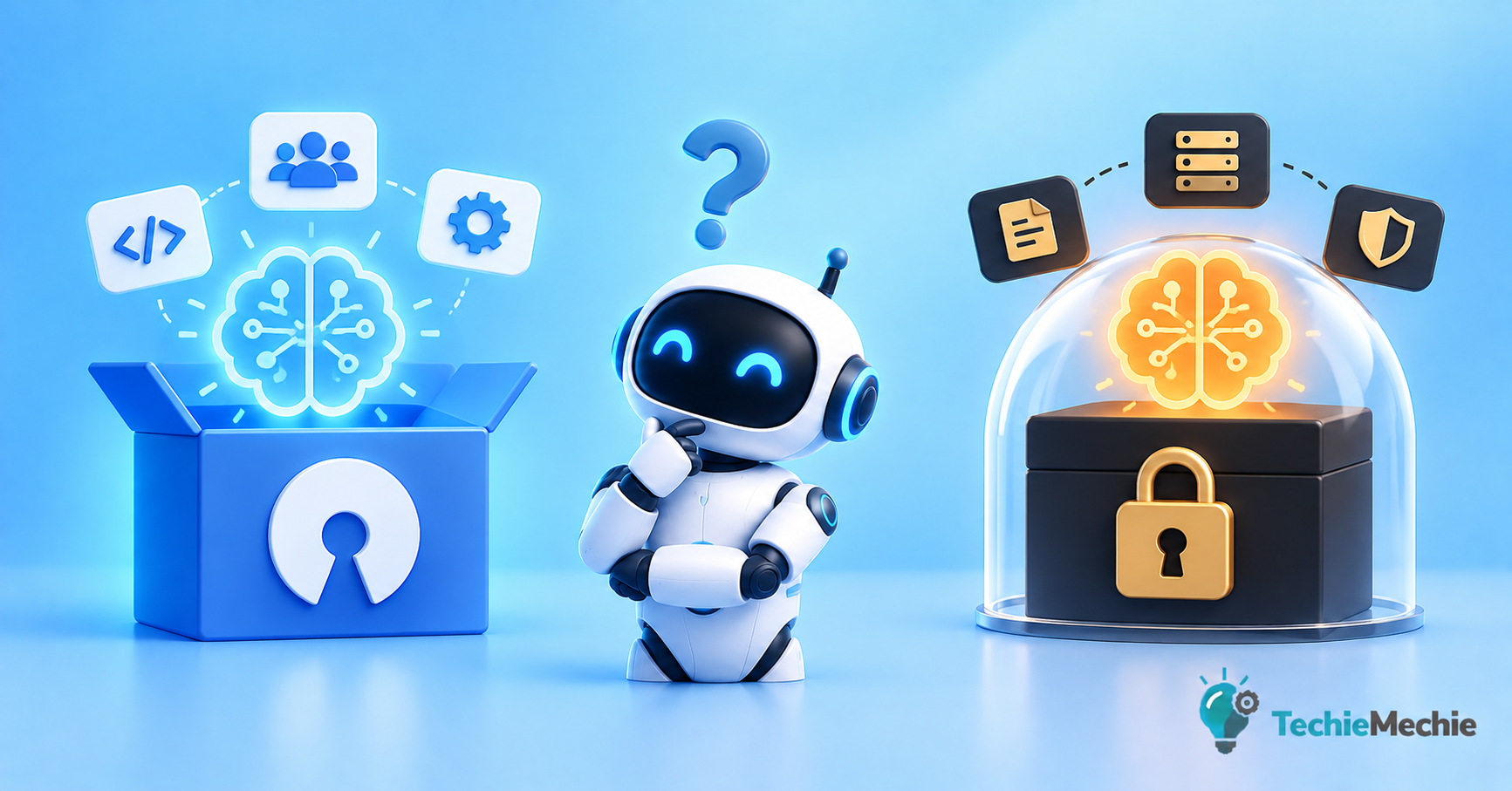
Artificial intelligence is entering a new phase in 2026. The biggest question is no longer simply which AI model is the most powerful. Businesses, developers, governments, and individual users are increasingly asking a deeper question:
Should the future of AI be open or closed?
Open-source and open-weight AI models are becoming increasingly capable, while proprietary AI companies continue to invest billions of dollars in advanced models, infrastructure, safety research, agents, and multimodal systems.
Models and ecosystems from companies such as Meta, Mistral AI, DeepSeek, Google, Alibaba, and OpenAI’s open-weight GPT-OSS are expanding the range of AI systems that developers can download, customize, or run under varying licenses. At the same time, closed systems from companies such as OpenAI, Anthropic, and Google continue to offer highly managed AI services through cloud platforms and APIs.
So, open-source AI vs. closed-source AI: which future will win?
The answer may not be a simple winner-takes-all battle. Instead, the AI industry could evolve toward a hybrid ecosystem where open models dominate some workloads while closed models remain important for frontier capabilities and managed enterprise services.
Let’s examine the differences, advantages, limitations, and future of both approaches.
What Is Open-Source AI?
Open-source AI generally refers to AI systems that provide users with meaningful freedoms to use, study, modify, and share the technology.
The Open Source Initiative (OSI) published version 1.0 of its Open Source AI Definition, which establishes criteria for what should qualify as open-source AI. For machine-learning systems, the definition goes beyond simply publishing model weights and considers components such as the model architecture, parameters, inference code, and information needed to understand and modify the system.
However, the AI industry frequently uses the term open model or open-weight model more loosely.
For example, OpenAI describes its gpt-oss models as open-weight models rather than simply calling them fully open-source AI. The weights are available under Apache 2.0, but some surrounding infrastructure and tooling can remain proprietary.
This distinction matters when comparing AI systems.
Examples of open or open-weight AI
Some notable examples include:
- Meta’s Llama family
- Mistral AI’s open models
- DeepSeek-R1
- Alibaba’s Qwen models
- Google’s Gemma models
- OpenAI’s gpt-oss models
- Various community-developed models available through platforms such as Hugging Face
DeepSeek-R1, for example, was released with its code and models under the MIT License, allowing broad use, modification and commercialization.
OpenAI’s gpt-oss-120b and gpt-oss-20b models are available under the Apache 2.0 license and are designed to run on infrastructure controlled by developers or organizations.
What Is Closed-Source AI?
Closed-source AI, often called proprietary AI, keeps important parts of the model and development process under the control of the company that created it.
Users typically interact with these models through:
- Web applications
- APIs
- Cloud platforms
- Enterprise software
- AI assistants
- Developer tools
Users may receive access to powerful capabilities without receiving the model weights, training data, complete architecture or other components needed to independently reproduce or modify the system.
Examples include proprietary AI services from companies such as OpenAI, Anthropic and Google.
The major advantage is convenience. Developers can use sophisticated models without purchasing GPUs, downloading huge model files, managing inference infrastructure or maintaining the underlying system.
Open-Source AI vs. Closed-Source AI: Key Differences
| Factor | Open/Open-Weight AI | Closed-Source AI |
| Model access | Often downloadable | Usually accessed through a service |
| Customization | Generally greater | Usually more limited |
| Self-hosting | Often possible | Usually unavailable |
| Data control | Can support local/private deployment | Depends on provider |
| Transparency | Potentially higher | Generally lower |
| Infrastructure | User manages more | Provider manages more |
| Maintenance | User responsibility | Provider responsibility |
| Licensing | Varies significantly | Provider terms apply |
| Community contribution | Often possible | Usually restricted |
| Ease of use | Can require technical expertise | Usually easier |
| Enterprise support | Varies | Often strong |
| Frontier capabilities | Rapidly improving | Often concentrated among leading labs |
The exact differences depend on the specific model and license. “Open” should therefore be treated as a spectrum rather than a binary label. Research has also highlighted the ambiguity around describing AI systems as open when important components remain unavailable.
Why Open-Source AI Is Growing So Quickly
One of the biggest developments in AI is that open models are increasingly competitive with proprietary systems on many practical workloads.
Mozilla’s 2026 State of Open Source AI report argues that the performance gap between leading open models and proprietary systems has narrowed substantially, while open models have become an important part of real-world AI usage. Mozilla also reports major reductions in model costs over recent years.
This creates several important advantages.
1. Lower AI Costs
Running an open model can reduce dependence on expensive API usage.
Organizations can deploy models on:
- Their own servers
- Private clouds
- Dedicated GPUs
- Edge devices
- Third-party inference infrastructure
However, open-source AI is not automatically free.
Organizations still have to pay for:
- GPUs
- Electricity
- Storage
- Engineering
- Monitoring
- Security
- Model updates
- Maintenance
OpenAI makes a similar point regarding gpt-oss: the model weights can be downloaded freely, but organizations remain responsible for infrastructure and operating costs.
2. More Customization
Open models provide developers with greater control over how AI behaves.
Organizations can potentially:
- Fine-tune models
- Modify inference settings
- Integrate specialized tools
- Build domain-specific assistants
- Customize system behavior
- Run models locally
This is particularly useful for industries with specialized terminology or workflows.
For example, a healthcare organization could develop a specialized internal assistant, while a manufacturing company could customize a model for technical documentation and equipment support.
3. Greater Data Control
Data privacy is one of the strongest arguments for locally deployed AI.
When a model runs on an organization’s own infrastructure, sensitive information can potentially remain inside its environment.
This can be valuable for:
- Financial institutions
- Healthcare organizations
- Government agencies
- Legal companies
- Defense organizations
- Enterprises handling confidential intellectual property
OpenAI’s documentation for gpt-oss specifically highlights self-hosting and data residency as reasons organizations may choose open-weight models.
4. Faster Community Innovation
Open models can attract developers from around the world.
Developers can experiment with:
- Fine-tuning
- Quantization
- Smaller models
- New inference techniques
- Agent frameworks
- Specialized datasets
- Local AI applications
This creates a distributed innovation model rather than concentrating development entirely inside one company.
Why Closed-Source AI Remains Powerful
Open models have made enormous progress, but proprietary AI has several structural advantages.
1. Easier to Use
With a closed AI service, developers often only need an API key.
They don’t have to:
- Download model weights
- Configure GPUs
- Manage inference servers
- Optimize memory
- Monitor hardware
- Handle model deployment
For many businesses, this convenience is worth paying for.
2. Strong Infrastructure
Large AI companies operate enormous computing infrastructures.
This allows them to provide:
- High availability
- Global deployment
- Low-latency inference
- Enterprise APIs
- Security controls
- Monitoring
- Automatic model upgrades
For companies that don’t want to operate AI infrastructure themselves, managed services can be considerably simpler.
3. Rapid Frontier Model Development
Closed AI companies can keep their newest research and models proprietary.
This provides a commercial incentive to invest heavily in:
- AI research
- Training infrastructure
- Specialized chips
- Data pipelines
- Safety research
- Multimodal systems
- AI agents
This capital-intensive approach remains a major force in the AI industry.
Research from CB Insights, for example, has documented substantially different investment patterns between open and proprietary AI companies.
Open-Source AI vs. Closed AI for Businesses
For businesses, the decision isn’t simply about model quality.
Companies should consider the complete AI total cost of ownership.
Open AI may be attractive when:
- Data must remain inside the organization.
- Customization is important.
- Large-scale inference makes API costs significant.
- The organization has AI engineering expertise.
- The company needs greater infrastructure control.
- Regulatory or geographic data requirements matter.
Closed AI may be attractive when:
- Fast deployment is important.
- The company lacks ML infrastructure expertise.
- Managed APIs are sufficient.
- The business wants automatic upgrades.
- Enterprise support is important.
- The organization doesn’t want to manage GPUs.
In many cases, businesses may use both.
For example, an organization could use a proprietary frontier model for complex reasoning while using a smaller open model for routine internal tasks.
Will Open-Source AI Replace Closed AI?
Probably not in every area.
The more realistic possibility is a hybrid AI ecosystem.
Think of the future as three layers.
Layer 1: Frontier proprietary AI
The most expensive and advanced models may continue to be developed by companies with enormous research budgets and computing infrastructure.
These models could remain primarily accessible through APIs and managed services.
Layer 2: Open and open-weight foundation models
Open models can increasingly serve developers who need:
- Customization
- Privacy
- Lower inference costs
- Local deployment
- Research access
Layer 3: Small specialized AI models
Smaller models may become extremely important for:
- Smartphones
- Laptops
- Edge devices
- Enterprise automation
- Robotics
- IoT
- Offline applications
This third category could be especially significant because smaller models can be deployed closer to where data is generated.
Recent reporting has highlighted growing interest in small language models because they can deliver useful capabilities at substantially lower computing and energy costs than large frontier systems.
Open-Source AI and AI Agents
The open-vs-closed debate becomes even more interesting with AI agents.
AI agents need access to:
- Models
- Tools
- APIs
- Databases
- Browsers
- Code execution
- Enterprise systems
Open models can allow organizations to build agents that run within controlled environments.
This could be especially important for enterprises that don’t want confidential information constantly sent to an external AI provider.
At the same time, closed AI platforms can provide integrated agent capabilities without requiring organizations to build the entire infrastructure themselves.
This means the future of AI agents may also become hybrid.
What About Developers?
For developers, the choice depends heavily on the project.
Choose an open model when you need:
- Local development
- Fine-tuning
- Customization
- Privacy
- Infrastructure control
- Offline inference
- Lower long-term inference costs
Choose a closed model when you need:
- Fast API integration
- Managed infrastructure
- Advanced capabilities without ML operations
- Enterprise support
- Rapid access to new model features
Many professional developers will likely use both approaches rather than choosing only one.
Open-Source AI vs. Closed-Source AI: The Future
The most important trend may not be that one side eliminates the other.
Instead, competition could push both ecosystems forward.
Open models can pressure proprietary providers to:
- Reduce prices
- Improve performance
- Increase flexibility
- Offer better developer tools
Closed providers can push open-model developers to:
- Improve quality
- Develop better safety systems
- Simplify deployment
- Build stronger enterprise ecosystems
This competition can benefit AI users.
Mozilla’s 2026 research suggests that open AI has already moved beyond being merely an experimental alternative, while the continued investment in proprietary systems demonstrates that closed AI remains a major part of the industry.
So, Which Future Will Win?
The evidence points toward coexistence rather than a single winner.
Open-source and open-weight AI are likely to become increasingly important for customization, privacy, self-hosting, cost optimization, and developer experimentation.
Closed-source AI is likely to remain important for frontier research, managed infrastructure, enterprise services and applications where convenience and provider-supported capabilities matter most.
The bigger transformation may be that users will increasingly choose AI models based on the job they need to accomplish, rather than automatically choosing the most famous model.
The future could therefore look less like:
Open vs. Closed
and more like:
Open + Closed + Specialized AI
Final Thoughts
The open-source AI movement is changing the economics and accessibility of artificial intelligence.
Developers no longer have to depend exclusively on a small number of AI providers. Increasingly capable open and open-weight models give organizations the ability to experiment, customize and sometimes deploy AI on infrastructure they control.
At the same time, closed AI providers continue to offer powerful advantages through managed infrastructure, sophisticated research, enterprise services and ease of use.
The important lesson for businesses and developers is simple:
Don’t choose AI based only on whether it is open or closed. Choose based on your requirements.
Consider:
- Performance
- Cost
- Privacy
- Licensing
- Customization
- Security
- Infrastructure
- Vendor lock-in
- Regulatory requirements
- Long-term scalability
As AI continues to evolve, the strongest strategy for many organizations may be a hybrid AI architecture that combines open models and proprietary models according to the specific task.
The future of AI may not belong exclusively to open-source or closed-source technology.
It may belong to organizations that know when to use each one.
Frequently Asked Questions
Is open-source AI better than closed-source AI?
Neither approach is universally better. Open AI can provide greater customization, control and self-hosting options, while closed AI can provide easier deployment, managed infrastructure and access to proprietary services.
What is the difference between open-source and open-weight AI?
Open-source AI has a broader definition involving freedoms to use, study, modify and share relevant components. Open-weight AI generally means that trained model weights are available, but other components such as training data, source code or infrastructure may not be fully open. The OSI definition provides a formal framework for evaluating open-source AI.
Is DeepSeek-R1 open source?
DeepSeek states that DeepSeek-R1’s code and models were released under the MIT License, allowing users to use and commercialize the model subject to the license terms.
Are OpenAI’s gpt-oss models open source?
OpenAI describes gpt-oss as open-weight models. The weights are available under Apache 2.0, while some surrounding infrastructure or tooling may remain proprietary.
Can businesses use open-source AI commercially?
Many open models permit commercial use, but organizations must check the specific model’s license and usage policy. Different models can have different restrictions.
Is open-source AI cheaper?
It can be cheaper for some workloads, especially at scale or when self-hosting is valuable. But infrastructure, GPUs, electricity, engineering, and maintenance can create high costs.
Will open-source AI replace ChatGPT and other proprietary AI?
There is no evidence that the AI market will necessarily converge on only one model type. Open and proprietary AI are likely to coexist, with each serving different technical and commercial requirements.