


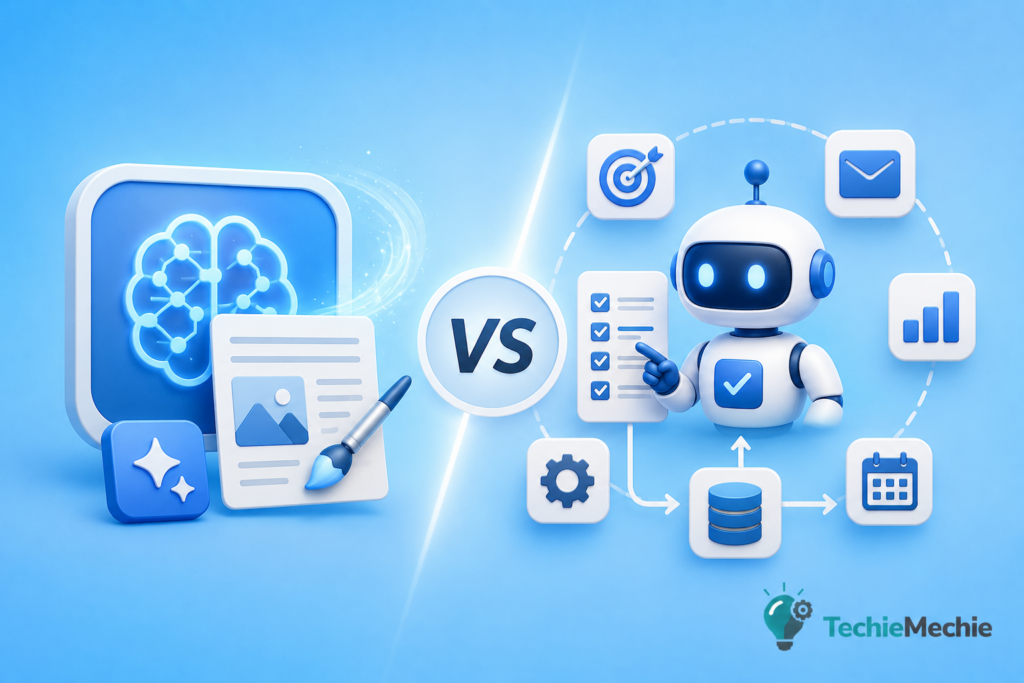
Artificial intelligence is moving into a new phase in 2026. For the past few years, Generative AI has dominated the conversation by helping people write content, create images, generate code, summarize documents, and answer questions.
Now, another term is becoming just as important: AI agents.
But what exactly is the difference between Generative AI and AI Agents? Are they competing technologies? Is one better than the other? And why are businesses increasingly interested in AI agents?
The easiest way to understand the difference is:
Generative AI creates. AI agents act.
Generative AI is mainly designed to generate content and information. AI agents go a step further by using AI models to understand goals, make decisions, use tools, and complete tasks.
In reality, however, the two technologies are closely connected. Many AI agents use Generative AI models as their “brain.”
Let’s explore the difference in simple terms.
What Is Generative AI?
Generative AI is artificial intelligence that can create new content based on a user’s instructions.
Instead of simply analyzing existing information, Generative AI can produce something new.
For example, you can ask an AI tool to:
- Write a blog post
- Create an email
- Generate computer code
- Summarize a report
- Create an image
- Write a product description
- Generate a video script
- Translate content
- Brainstorm business ideas
You provide an instruction, commonly called a prompt, and the AI generates a response.
For example:
Prompt:
“Write a 500-word blog post about the future of AI.”
Generative AI:
Creates the blog post.
That’s the basic Generative AI experience.
Popular applications of Generative AI include AI chatbots, writing assistants, image generators, coding assistants, and other creative AI tools.
What Are AI Agents?
AI agents are designed to do more than generate a response.
An AI agent is an AI-powered system that can work toward a goal by planning tasks, using tools, making decisions, and taking actions.
Imagine you tell an AI:
“Find five potential customers for our software, research their companies, add qualified prospects to our CRM, and prepare personalized outreach emails.”
A traditional Generative AI system might help you write the emails.
An AI agent could potentially handle the entire workflow.
It could:
- Search for potential companies.
- Research relevant information.
- Decide which prospects match your criteria.
- Collect the required information.
- Add prospects to a CRM.
- Draft personalized emails.
- Ask for approval before sending them.
That’s the fundamental difference.
Generative AI responds to your request.
An AI agent can work toward completing your request.
Generative AI vs AI Agents: The Simple Difference
Think about the difference between an assistant who gives you information and an assistant who actually gets the work done.
Generative AI is like saying:
“Write me an email to this customer.”
The AI creates the email.
An AI agent is more like:
“Follow up with customers who haven’t responded in seven days.”
The agent may identify those customers, review their information, prepare messages, and potentially send or schedule them according to the permissions and rules it has been given.
This doesn’t mean every AI agent can perform all of these actions automatically. Its capabilities depend on the tools, integrations, permissions, and safeguards built into the system.
A Quick Comparison
| Generative AI | AI Agents |
| Creates content | Completes tasks |
| Responds to prompts | Works toward goals |
| Generates text, images, code, etc. | Uses tools and applications |
| Usually requires user direction | Can operate with more autonomy |
| Great for individual tasks | Great for multi-step workflows |
| Produces an answer | Can produce an outcome |
The important point is that AI agents often use Generative AI as part of their architecture.
They are not necessarily replacements for each other.
How Generative AI Works
Generative AI systems are trained on large amounts of data and learn patterns that allow them to generate new content.
When you give a model a prompt, it processes the instruction and generates an appropriate response.
For example:
You:
“Give me five SEO title ideas for an AI article.”
Generative AI:
Provides five title suggestions.
You then decide what to do with those suggestions.
This makes Generative AI particularly useful for creative and knowledge-based work.
How AI Agents Work
AI agents generally involve several components working together.
A simplified AI agent workflow looks like this:
Goal → Understand → Plan → Use Tools → Take Action → Check Result → Continue
Suppose you tell an AI agent:
“Prepare a weekly sales report.”
The agent could potentially:
- Access sales data.
- Retrieve the latest numbers.
- Analyze performance.
- Compare results with the previous week.
- Identify important changes.
- Create a report.
- Send it to the appropriate people.
The agent isn’t simply generating text about sales.
It is potentially working with the underlying systems and data to complete a workflow.
Generative AI Is Often the Brain Behind an AI Agent
This is one of the most important concepts to understand.
Generative AI and AI agents aren’t always separate technologies.
An AI agent can use a Generative AI model to:
- Understand natural language.
- Interpret instructions.
- Plan tasks.
- Reason about information.
- Generate responses.
- Decide which tool may be useful.
The agent then connects that intelligence to external tools.
For example, an AI sales agent might combine:
AI model + CRM + Web search + Email + Database + Business rules
The AI model helps with reasoning and communication.
The agent system provides the ability to interact with other systems and execute tasks.
Example: Customer Support
Let’s take a simple customer-support example.
A customer asks:
“Where is my order?”
Generative AI Approach
A Generative AI chatbot might say:
“I’d be happy to help. Please provide your order number.”
It can understand the question and generate a helpful response.
But someone or another system may still need to check the order.
AI Agent Approach
An AI customer-service agent could potentially:
- Identify the customer.
- Find the order.
- Check shipping information.
- Determine the delivery status.
- Explain the delay.
- Recommend the next step.
- Create a support ticket if necessary.
The customer gets more than a generated response.
The system can potentially perform part of the actual support workflow.
Example: Software Development
The difference is also becoming clear in software development.
Generative AI
A developer might ask:
“Write a Python function that validates email addresses.”
The AI generates the code.
That’s Generative AI.
AI Coding Agent
A developer might instead ask:
“Add email validation to this application and make sure the existing tests still pass.”
A coding agent could potentially:
- Inspect the project.
- Find the relevant files.
- Understand the existing code.
- Modify the code.
- Create or update tests.
- Run the test suite.
- Identify failures.
- Make corrections.
- Prepare the changes for review.
The difference is significant.
The Generative AI model generates code.
The coding agent can potentially work through the development task.
Why AI Agents Are Becoming Important in 2026
Generative AI has already changed how people create content and access information.
AI agents are now pushing AI toward another important area:
Task automation.
Businesses don’t just want AI that can answer questions.
They increasingly want AI that can help with real work.
For example:
Marketing teams may want agents to research topics, organize campaigns, and prepare content.
Sales teams may want agents to research prospects and update CRM records.
Customer-service teams may want agents to resolve routine requests.
Developers may want coding agents to investigate bugs and implement changes.
Operations teams may want agents to manage repetitive workflows.
This is why agentic AI is becoming an important area of AI development.
What Is Agentic AI?
Agentic AI refers broadly to AI systems that can pursue objectives and take actions with some degree of autonomy.
The amount of autonomy can vary.
Some agents may need approval before every important action.
Others may be allowed to complete predefined tasks independently.
For example:
Low autonomy:
AI recommends what should be done.
Medium autonomy:
AI performs routine actions but asks for approval for important decisions.
Higher autonomy:
AI can execute an entire workflow within defined permissions and safety limits.
The goal isn’t necessarily to give AI unlimited freedom.
Instead, organizations can design agents with specific goals, permissions, boundaries, and human oversight.
Where Generative AI Is Better
Generative AI remains extremely useful.
You don’t need an autonomous agent for every task.
Generative AI is often the better option when you need:
Content Creation
- Blog posts
- Social media posts
- Emails
- Product descriptions
- Scripts
Creative Work
- Images
- Ideas
- Designs
- Headlines
- Marketing concepts
Knowledge Work
- Summaries
- Explanations
- Research assistance
- Document analysis
Coding
- Code snippets
- Explanations
- Documentation
- Debugging suggestions
If the task is mainly “create something for me,” Generative AI is often enough.
Where AI Agents Are Better
AI agents become more useful when a task involves several steps.
They are particularly suitable for:
- Workflow automation
- Research
- Sales operations
- Customer service
- Software development
- Data processing
- Business operations
- Scheduling
- CRM management
- Repetitive administrative work
If the task sounds like:
“Go and do these five things, then check the result and continue,”
you are moving closer to an agent use case.
Are AI Agents Better Than Generative AI?
No.
It isn’t really a competition.
Generative AI and AI agents solve different problems.
Think of it like this:
Generative AI = Creation
AI Agents = Action
You may use Generative AI to write a marketing campaign.
You may use an AI agent to manage parts of the marketing workflow.
And the agent may use Generative AI to create the actual campaign content.
That’s why these technologies are increasingly being combined.
Advantages of Generative AI
Generative AI provides several major benefits.
Faster Work
It can dramatically reduce the time required to create drafts, summaries, and other content.
Easy to Use
Users can interact with AI using natural language.
Creative Assistance
It can help people generate ideas and explore different possibilities.
Productivity
Employees can use AI to handle many repetitive knowledge tasks.
Flexible
The same AI model can often be used for many different types of tasks.
Advantages of AI Agents
AI agents can provide another layer of automation.
End-to-End Workflows
Agents can potentially handle multiple steps instead of just one task.
Tool Usage
Agents can interact with software, APIs, databases, and other systems.
Automation
Routine processes can potentially run with less manual intervention.
Scalability
Organizations can apply agent-based workflows to large numbers of repetitive tasks.
Continuous Decision Loops
Agents can observe results and determine what to do next within predefined boundaries.
The Risks of Generative AI
Generative AI isn’t perfect.
It can sometimes:
- Generate incorrect information.
- Produce misleading answers.
- Misunderstand context.
- Create outdated information.
- Produce inconsistent results.
Human review is still important, especially when AI-generated information affects important business decisions.
The Risks of AI Agents
AI agents introduce additional concerns because they can potentially take actions.
If an AI agent has access to important systems, an incorrect decision can have a bigger impact than an incorrect chatbot response.
Potential risks include:
- Unauthorized actions
- Incorrect decisions
- Data-access problems
- Security vulnerabilities
- Poor planning
- Incorrect tool usage
- Unexpected behavior
This is why businesses need strong controls around agent deployment.
Important safeguards can include:
- Permission management
- Human approval
- Monitoring
- Audit logs
- Testing
- Access controls
- Clear task boundaries
Human Oversight Still Matters
The rise of AI agents doesn’t mean humans disappear from the workflow.
In many cases, the best approach is human-in-the-loop AI.
For example:
AI Agent → Prepare refund → Human approval → Refund processed
Or:
AI Agent → Analyze contract → Highlight risks → Lawyer reviews
This approach allows organizations to benefit from AI automation while maintaining human control over important decisions.
Generative AI and AI Agents Will Work Together
The biggest trend to watch in 2026 isn’t necessarily Generative AI versus AI agents.
It is the combination of both.
Imagine a marketing agent.
The agent could:
- Research a topic.
- Identify keywords.
- Analyze competing content.
- Create an article outline.
- Generate the first draft using Generative AI.
- Review the content.
- Prepare metadata.
- Send it to a human editor.
Here, Generative AI creates much of the content while the agent manages the larger workflow.
This is where the real power of agentic AI becomes visible.
The Future of AI in 2026 and Beyond
The AI industry is moving from systems that simply answer questions toward systems that can increasingly complete tasks.
Generative AI made AI accessible to millions of people through natural-language interaction.
AI agents are extending that capability by connecting AI models to tools, data, applications, and workflows.
The future may look less like:
“Ask AI a question.”
And more like:
“Give AI a goal.”
That doesn’t mean every task should be automated.
Some workflows will always require human judgment, creativity, accountability, and approval.
But for repetitive, structured, and well-defined processes, AI agents could become powerful digital workers that operate alongside human teams.
Final Verdict: Generative AI vs AI Agents
So, what’s the difference between Generative AI and AI Agents in 2026?
The simplest answer is:
Generative AI creates content and information.
AI agents use AI to pursue goals, use tools, and complete tasks.
Generative AI is ideal for writing, creating, summarizing, brainstorming, coding, and other content-focused activities.
AI agents are better suited to multi-step workflows where the system needs to gather information, make decisions, interact with software, and take actions.
But the two technologies are not competitors.
Generative AI can be the brain. AI agents can be the worker that puts that intelligence into action.
As AI continues to evolve, businesses that understand how to combine Generative AI, AI agents, automation, tools, data, and human oversight will be better positioned to take advantage of the next generation of artificial intelligence.
Frequently Asked Questions
What is the difference between Generative AI and AI agents?
Generative AI primarily creates content such as text, images, code, and audio. AI agents are designed to pursue goals and complete multi-step tasks using tools and external systems.
Is ChatGPT Generative AI or an AI agent?
ChatGPT is fundamentally a Generative AI system, although modern AI assistants can also provide agent-like capabilities through tools and actions.
Can Generative AI become an AI agent?
Yes. A Generative AI model can serve as the reasoning and communication component of an AI agent when connected to tools, memory, workflows, and action capabilities.
Which is better for business?
It depends on the task. Generative AI is excellent for content and knowledge work, while AI agents are useful for multi-step workflows and automation. Many businesses can benefit from using both.
Will AI agents replace Generative AI?
No. AI agents often rely on Generative AI models. The two technologies are likely to become increasingly integrated rather than replace one another.
What is agentic AI?
Agentic AI refers to AI systems capable of pursuing goals and taking actions with some degree of autonomy, usually within defined permissions and boundaries.