


Search is changing faster in 2026 than at almost any point in web history.
For more than two decades, Google Search trained users to enter keywords, scan a list of blue links, compare websites, and click through to find an answer. Today, generative AI is transforming that model.
Instead of simply asking, “Which webpage has the information I need?”, users can increasingly ask:
“What is the best option for my situation, and why?”
AI-powered search can understand longer questions, combine information from multiple sources, summarize findings, compare alternatives, and continue the conversation through follow-up questions.
Google itself is moving aggressively in this direction. In 2026, Google’s AI Overviews and AI Mode have become major parts of Search. Google says AI Overviews now reach more than 2.5 billion monthly active users, while AI Mode has surpassed 1 billion monthly active users globally.
This raises an important question for marketers, publishers, businesses, and everyday users:
Is AI Search replacing Google Search, or is Google Search becoming AI Search?
The answer is more complicated than either/or.
What Is Traditional Google Search?
Traditional Google Search is primarily a retrieval and ranking system.
A user enters a query such as:
“best smartphones under ₹30,000”
Google analyzes the query, retrieves relevant webpages and other information, ranks results using its search systems, and presents the user with a results page.
The user then evaluates:
- Search rankings
- Titles
- Descriptions
- Reviews
- Websites
- Images
- Videos
- Featured snippets
- Shopping results
- Other search features
The final decision is usually made by the user.
This model created the modern SEO industry.
Businesses optimized webpages around keywords and search intent because appearing prominently in Google could generate valuable organic traffic.
The traditional search journey
Query → Search results → Website → Information → Decision
AI Search is changing this journey.
What Is AI Search?
AI Search uses generative AI and large language models to understand the user’s intent and produce a synthesized response.
Instead of simply returning pages to investigate, AI Search attempts to perform some of the investigation for the user.
For example, instead of searching:
“best laptop for video editing under ₹100,000”
a user could ask:
“I edit 4K videos, travel frequently, prefer Windows, and have a budget of ₹100,000. Which laptop should I buy and what compromises will I make?”
An AI-powered search system can interpret the requirements, compare products, explain trade-offs, and potentially provide links to supporting sources.
This is a major shift from keyword search to intent-based search.
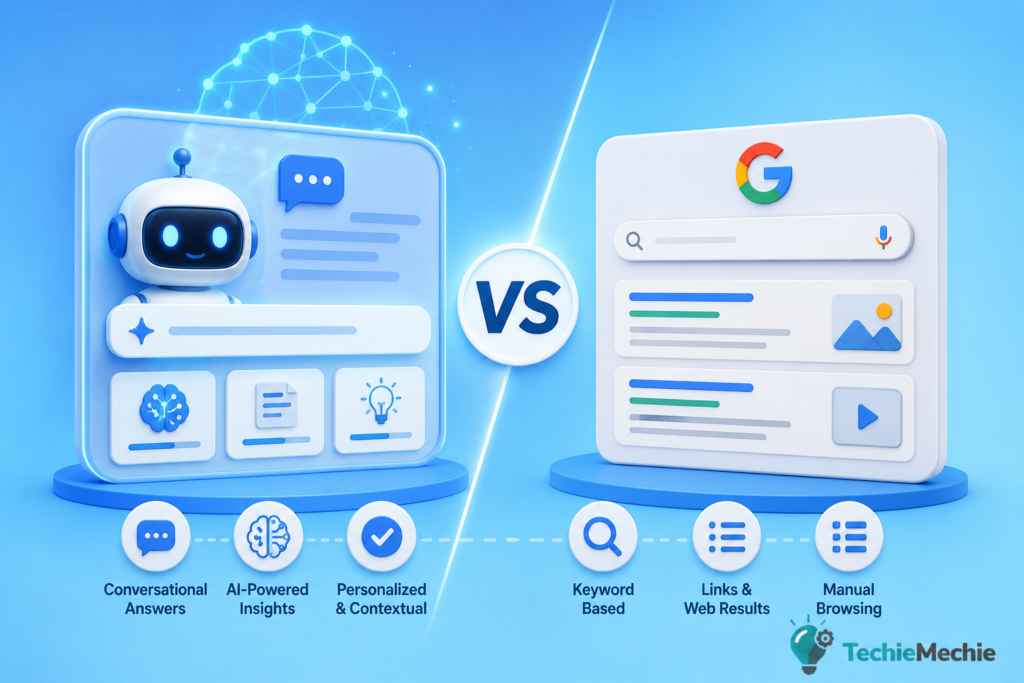
AI Search vs Google Search: Key Differences
| Feature | Traditional Google Search | AI Search |
| Main interface | Search box | Conversational interface |
| Query style | Keywords | Natural language |
| Results | Ranked links | Synthesized answers |
| User research | Mostly manual | AI-assisted |
| Follow-up questions | New searches | Ongoing conversation |
| Comparisons | User evaluates pages | AI can compare options |
| Personalization | Search history/context | Increasingly contextual |
| Content discovery | Website-centric | Answer-centric |
| SEO objective | Rank in search results | Become a trusted source/citation |
| Decision-making | Mostly human | Increasingly AI-assisted |
| Future direction | Search and browse | Search, research and action |
The important point is that these systems are not completely separate.
Google itself is turning its traditional search engine into an AI-powered search experience.
Google Search Is Becoming AI Search
One of the biggest misconceptions about the current search revolution is that AI Search means “using a chatbot instead of Google.”
In reality, Google is integrating AI directly into its search engine.
Google introduced AI Overviews and later expanded the experience with AI Mode. In 2026, Google says AI Mode queries have been growing rapidly, with queries more than doubling every quarter since launch.
AI Mode is designed for questions requiring more exploration, reasoning, comparisons, and follow-up questions.
Google’s 2026 updates also increasingly connect AI responses with webpages, original content, and sources across the web.
This means the future may not be:
Google vs AI
but rather:
Google + AI.
AI Overviews vs Traditional Search Results
AI Overviews represent one of the clearest changes in the Google Search experience.
Instead of forcing users to immediately choose from a list of webpages, Google can display an AI-generated summary before traditional results.
For informational queries, this can dramatically reduce the amount of time required to find an initial answer.
For example:
Traditional search:
Search → Open five websites → Read → Compare → Form conclusion
AI-assisted search:
Search → AI summary → Review cited sources → Ask follow-up → Make decision
Google says its AI-powered Search features are driving increased Search usage and that AI Mode has surpassed one billion monthly active users.
But this transformation also creates a major challenge for publishers.
The Zero-Click Search Problem Gets Bigger
Traditional SEO has often relied on a simple equation:
Higher rankings = more clicks = more traffic
AI Search disrupts this equation.
If a user gets a useful answer directly inside Google’s AI interface, they may not need to visit the websites that contributed information to that answer.
Recent research is already examining this behavior. A 2026 study of Google Search found that AI Overviews were associated with fewer clicks and that visits to cited sources were rare in the dataset studied. Another preregistered field experiment reported reduced publisher click-through when AI features were present.
At the same time, Google says it continues to send billions of clicks to websites each week through AI features in Search.
So the picture is still developing.
The important SEO lesson is clear:
Ranking alone is no longer the entire visibility strategy.
AI Search Changes What “Ranking” Means
In traditional SEO, marketers usually ask:
“How do I rank #1 on Google?”
In AI Search, another question becomes important:
“How do I become a source that AI systems trust, understand, and cite?”
This introduces concepts such as:
- AI SEO
- Generative Engine Optimization (GEO)
- AI visibility
- Search visibility
- Entity optimization
- Citation optimization
- Brand authority
The goal is no longer only to appear as a blue link.
Your company, product, expertise, or content may need to become part of the answer itself.
What Is Generative Engine Optimization (GEO)?
Generative Engine Optimization, commonly called GEO, focuses on improving a brand’s visibility in AI-generated answers.
Traditional SEO focuses heavily on:
- Keywords
- Rankings
- Backlinks
- Technical SEO
- Search intent
- Organic traffic
GEO adds another layer:
- Being clearly understood by AI systems
- Building topical authority
- Providing original information
- Creating useful, structured content
- Earning citations and mentions
- Establishing brand credibility
- Maintaining consistent information across the web
The distinction can be summarized like this:
SEO: Get discovered in search results.
GEO: Get referenced in AI-generated answers.
In 2026, smart content strategies increasingly need to address both.
AI Search Is Better at Complex Questions
One of AI Search’s biggest advantages is its ability to handle complicated questions.
Traditional search works extremely well for simple queries such as:
- “weather today”
- “Apple stock price”
- “Python list comprehension”
- “best restaurants near me”
- “what is SEO?”
But complex research can require many separate searches.
For example:
“Compare the best AI coding tools for a startup with a five-person engineering team, limited budget, strong privacy requirements, and a preference for open-source software.”
That’s not really one keyword.
It’s a research task.
AI Search can interpret multiple constraints simultaneously and produce a structured response.
Google describes AI Mode as particularly useful for complex questions, comparisons, exploration, and follow-up conversations.
Conversational Search Is Becoming Normal
Another major change is the move from isolated searches to conversations.
Traditional search:
Query 1 → Results
Then:
Query 2 → Results
Then:
Query 3 → Results
AI Search:
Question → Answer → Follow-up → Refinement → Decision
For example:
User: What is the best CRM for a small business?
AI: Here are five options.
User: Which one is cheapest?
AI: Option B.
User: Does it integrate with WhatsApp?
AI: Yes, but with these limitations.
User: Which one would you choose for a 10-person company?
AI: Based on your requirements, I would choose…
The search process becomes an ongoing conversation instead of a collection of disconnected queries.
Google has explicitly described Search as becoming more conversational, with people asking more complex questions and using follow-ups.
AI Search Is Also Becoming Multimodal
Search is no longer limited to text.
Modern AI systems can increasingly work with:
- Images
- Voice
- Documents
- Screenshots
- Videos
- Products
- Maps
- Structured information
A user might upload an image and ask:
“What type of plant is this and how should I care for it?”
Or upload a document and ask:
“Summarize this contract and identify the major risks.”
Or use voice:
“Find me a good laptop for programming and explain the differences.”
This creates a much richer search experience.
The search box is becoming less like a text field and more like a universal interface for information.
AI Search Is Moving From Answers to Actions
The next major evolution is even more significant.
Search may not stop at answering questions.
It can increasingly help users do things.
Google’s 2026 announcements point toward an agentic future in Search, including information agents and capabilities designed to help users accomplish longer-running tasks.
Imagine asking:
“Find the best flight from Delhi to London next month, compare the options, and help me choose.”
The future search experience could move beyond:
Here are 10 links.
Toward:
Here are the best options, why they fit your requirements, and what you can do next.
This is the beginning of agentic search.
Search Is Moving From Discovery to Decision-Making
Traditional search primarily helps people find information.
AI Search increasingly helps people understand information.
Agentic Search could eventually help people act on information.
The evolution looks like this:
Phase 1: Search
Find information.
Phase 2: AI Search
Understand and summarize information.
Phase 3: Agentic Search
Use information to accomplish a task.
This is one of the biggest changes coming to search.
AI Search vs Google Search: Which Is Better?
There is no universal winner.
It depends on the task.
Traditional Google Search is still excellent for:
- Finding specific websites
- Navigating to known brands
- Local searches
- News discovery
- Shopping research
- Finding original documents
- Checking multiple independent sources
- Browsing the web
AI Search is especially useful for:
- Complex questions
- Comparisons
- Summaries
- Brainstorming
- Research
- Follow-up questions
- Personalized recommendations
- Explaining complicated subjects
- Combining multiple pieces of information
The best search strategy in 2026 is therefore often hybrid.
Use AI to understand the landscape.
Then use original websites and primary sources to verify important information.
The Biggest Problem With AI Search: Trust
AI-generated answers can be extremely useful, but they are not automatically correct.
AI systems can:
- Misinterpret information
- Mix sources
- Produce outdated information
- Hallucinate facts
- Misattribute information
- Oversimplify complex subjects
This becomes particularly important for:
- Health
- Finance
- Law
- Politics
- Scientific research
- Security
- Business decisions
Google itself acknowledges that AI Search is an evolving technology and that AI-generated responses can sometimes be incorrect.
That is why citations and access to sources remain essential.
AI should accelerate research—not eliminate critical thinking.
The Future of Search Will Be Hybrid
The biggest mistake businesses can make is assuming that traditional search will suddenly disappear.
The more likely future is a hybrid ecosystem.
Users will move between:
- Google Search
- AI Mode
- ChatGPT-style search
- AI assistants
- Social platforms
- YouTube
- Online communities
- Specialist websites
- Shopping platforms
Search behavior will become more fragmented.
A user may discover a brand through an AI answer, verify it through Google, watch a YouTube review, read Reddit discussions, and finally purchase from the company’s website.
This means businesses need multi-platform visibility, not just Google rankings.
How Businesses Should Prepare for AI Search in 2026
Here is a practical strategy.
Step 1: Keep doing technical SEO
Don’t abandon:
- Site speed
- Mobile optimization
- Crawlability
- Indexing
- Internal links
- Structured data
- HTTPS
- Core Web Vitals
AI Search still depends heavily on the web.
Step 2: Create content for humans first
Write naturally.
Don’t produce content simply to manipulate AI systems.
Useful content is more sustainable than keyword stuffing.
Step 3: Answer questions directly
Put clear answers near the beginning of articles.
Then expand with evidence, examples, and context.
Step 4: Add original research
Original research can differentiate your content from thousands of AI-generated articles.
Use:
- Surveys
- Experiments
- Benchmarks
- Data analysis
- Case studies
- Expert interviews
Step 5: Strengthen your brand
People trust recognizable brands.
AI systems also need signals that help establish what an entity is and why it is relevant.
Maintain consistent:
- Brand name
- Company information
- Author information
- Product information
- Contact details
- Business profiles
Step 6: Track AI visibility
Traditional rankings are no longer enough.
Start monitoring:
- AI mentions
- Brand citations
- AI-generated recommendations
- Search impressions
- Organic traffic
- Referral traffic
- Branded searches
- Conversions
The SEO dashboard of the future will need to measure more than rankings.
AI Search Is Changing Content Marketing
Content marketing used to focus heavily on attracting users to a website.
The new challenge is making your content valuable even when users don’t immediately click.
That sounds contradictory.
Why create content if users don’t visit?
Because AI systems need sources.
A business that produces authoritative information can become part of the information layer used by AI search systems.
Therefore, content can generate value in at least three ways:
1. Direct traffic
Users find your page through search.
2. Brand visibility
Users see your brand mentioned in AI answers.
3. Authority
Your content becomes a source used to understand a topic.
This makes content quality more important than ever.
AI Search vs Google Search: The Future in One Sentence
Traditional Google Search helps users find webpages.
AI Search helps users find and understand information.
Agentic Search could help users turn that information into action.
And Google itself is increasingly combining all three approaches.
Frequently Asked Questions
Is AI Search replacing Google Search?
Not completely. Instead, Google Search itself is becoming increasingly AI-powered through features such as AI Overviews and AI Mode. Google’s 2026 data shows significant adoption of these experiences.
Is SEO dead because of AI Search?
No. SEO remains important, but the definition of search visibility is expanding. Businesses now need to consider traditional rankings as well as AI visibility, citations, brand authority, and content quality.
What is the difference between SEO and GEO?
SEO generally focuses on visibility in traditional search results. GEO, or Generative Engine Optimization, focuses on improving the likelihood that a brand or source is represented in AI-generated answers.
Will AI Search reduce website traffic?
It can. Some 2026 research has found lower click-through behavior when AI-generated answers appear, while Google says its AI features continue to send billions of clicks to websites weekly. The long-term impact is still evolving.
Should businesses stop optimizing for Google?
No. Google remains one of the world’s largest search platforms, and its AI-powered features are increasingly integrated into the same ecosystem.
How can I optimize content for AI Search?
Create authoritative, original, well-structured content. Answer questions clearly, demonstrate first-hand expertise, cite credible sources, strengthen your brand presence, and build topical authority.
Final Thoughts: Search Is Becoming an Answer Engine
The search industry is entering a new era.
For years, Google gave users a map of the internet.
Now AI is increasingly helping users navigate that map.
The fundamental shift is from links to answers, from keywords to intent, and from individual searches to conversations.
But the web itself is not disappearing.
In fact, AI Search depends on the web for information, sources, expertise, products, opinions, and original reporting.
The winners in 2026 and beyond will not necessarily be companies that choose between SEO and AI Search.
They will be companies that understand how the two systems work together.
The future of search is therefore not simply:
Google vs AI.
It is:
Search + AI + trusted content + brands + agents.
And for marketers, publishers, and businesses, the most important question is no longer just:
“How do I rank on Google?”
It is:
“How do I become the trusted source that people—and AI—turn to when they need an answer?”