


Automation has been changing the workplace for decades. Businesses have used software, scripts, macros, robotic process automation (RPA), and workflow platforms to eliminate repetitive manual tasks and improve operational efficiency.
But 2026 is bringing a different type of automation into the workplace: AI agents.
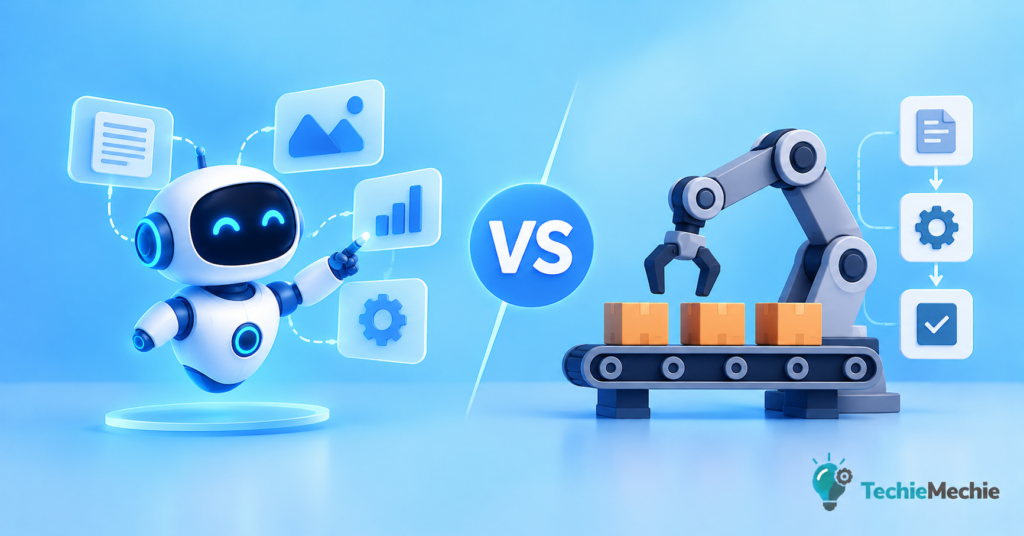
Unlike traditional automation systems that generally follow predefined rules, AI agents can interpret goals, reason through problems, use tools, make decisions, and execute multi-step tasks with varying degrees of human supervision.
Microsoft’s 2026 Work Trend Index describes a workplace where AI and agents increasingly take on execution while people spend more time directing work, making decisions, and owning outcomes. The research analyzed productivity signals and surveyed 20,000 AI-using workers across 10 countries.
This raises an important question:
Are AI agents going to replace traditional automation, or will both technologies work together?
The answer in 2026 appears to be more nuanced. Traditional automation remains highly useful for predictable, rules-based processes, while AI agents are opening the door to more flexible and adaptive workflows.
Let’s examine the differences and what they mean for the future of work.
What Is Traditional Automation?
Traditional automation refers to software systems that perform tasks according to predefined rules, instructions, triggers, and workflows.
A traditional automation process might look like this:
Trigger → Rule → Action → Result
For example:
- A customer submits an online form.
- The system checks the form.
- If the required fields are completed, it creates a record.
- An email is automatically sent.
- The request is assigned to an employee.
The system does not need to understand the customer’s intent. It simply follows the workflow created by the organization.
Traditional automation includes technologies such as:
- Robotic Process Automation (RPA)
- Business Process Automation (BPA)
- Workflow automation
- Scheduled scripts
- Database triggers
- Rule-based systems
- Macros
- Enterprise integration workflows
These technologies remain valuable because they are generally predictable, repeatable, and easier to control.
What Are AI Agents?
AI agents are software systems designed to pursue a goal by interpreting information, making decisions, using tools, and taking actions.
McKinsey describes AI agents as software components that have the agency to act on behalf of a user or system and perform tasks, including coordinating complex workflows.
IBM similarly describes AI agents as systems capable of autonomously performing tasks by designing workflows and using available tools for activities such as decision-making, problem-solving, and interaction with external systems.
A simplified agentic workflow looks more like:
Goal → Understand → Plan → Use Tools → Evaluate → Act → Adjust
For example, instead of telling an AI system:
“Send this email when a customer submits this form.”
A company could give an agent a broader objective:
“Review new customer inquiries, identify high-value opportunities, research the company, prepare a personalized response, update the CRM, and notify the sales representative when human involvement is required.”
The agent may need to perform several actions across different systems to accomplish that objective.
That is a major difference between traditional automation and agentic AI.
AI Agents vs. Traditional Automation: Key Differences
| Feature | Traditional Automation | AI Agents |
| Basic approach | Rule-based | Goal-based |
| Decision-making | Predefined rules | AI-driven reasoning |
| Workflow | Usually fixed | Can dynamically adapt |
| Input | Structured data | Structured and unstructured data |
| Adaptability | Limited | Higher |
| Multi-step tasks | Possible but predefined | Can dynamically plan |
| Human involvement | Usually setup/exception handling | Can operate with varying levels of supervision |
| Best for | Predictable repetitive tasks | Complex and variable workflows |
| Error behavior | Usually deterministic | Can produce unexpected outputs |
| Governance | Relatively straightforward | Requires stronger controls |
| Examples | RPA, scripts, workflow rules | Research agents, coding agents, sales agents |
The important point is that AI agents do not make traditional automation obsolete.
In many organizations, the two technologies will operate together.
How AI Agents Change Automation
Traditional automation primarily asks:
“What steps should the system follow?”
Agentic AI asks:
“What outcome are we trying to achieve, and what actions should be taken to reach it?”
This difference becomes especially important when a process contains ambiguity.
Imagine a customer support workflow.
A traditional system might:
- Receive a ticket.
- Identify the category.
- Assign the ticket.
- Send a predefined message.
An AI agent could:
- Read the customer’s message.
- Understand the problem.
- Review previous conversations.
- Search internal documentation.
- Determine possible solutions.
- Draft or send an appropriate response.
- Update the support system.
- Escalate unusual or high-risk cases to a human.
Microsoft’s description of AI agents similarly emphasizes their ability to perceive information, reason, plan, and take actions toward defined goals.
This makes agentic AI particularly interesting for knowledge-intensive work.
Where Traditional Automation Still Wins
It is easy to assume that AI agents will replace every automation technology.
That is unlikely.
Traditional automation has several advantages.
1. Predictability
If a business process follows a fixed set of rules, traditional automation can be extremely reliable.
For example:
- Generate an invoice when an order is completed.
- Move a file into a specific folder.
- Copy information from one database to another.
- Send a notification after a transaction.
- Calculate a predefined value.
There may be little reason to introduce an AI agent into such processes.
2. Lower Complexity
A simple workflow does not necessarily need an intelligent system.
Using AI where a deterministic rule is sufficient can introduce unnecessary complexity.
3. Easier Testing
Traditional workflows can generally be tested against predefined inputs and expected outputs.
This makes them useful for highly regulated or tightly controlled processes.
4. Cost Control
AI systems can require model inference and additional infrastructure. A simple automation rule may be cheaper and faster.
5. Compliance and Auditability
In some environments, organizations need to know exactly why a system performed a specific action.
Deterministic workflows can be easier to audit.
Where AI Agents Have an Advantage
AI agents become particularly useful when workflows involve ambiguity, unstructured information, and multiple decisions.
Research
An AI research agent can:
- Search multiple sources.
- Extract relevant information.
- Compare findings.
- Organize research.
- Produce a structured report.
Customer Service
Agents can understand natural-language questions and determine the appropriate next step instead of relying entirely on fixed decision trees.
Software Development
Coding agents can analyze requirements, inspect code, write or modify files, run tests, and iterate on solutions.
OpenAI’s 2026 research describes agentic AI as changing the unit of knowledge work from individual interactions toward delegated, longer-horizon tasks in which agents can orchestrate tool calls and iterate toward a result.
Sales
An AI sales agent could research prospects, summarize accounts, prepare outreach, update CRM records, and identify follow-up opportunities.
Marketing
Agents can potentially support:
- Market research
- Content research
- Campaign analysis
- Audience segmentation
- Competitive monitoring
- Reporting
IT Operations
AI agents can assist with:
- Incident investigation
- Log analysis
- Troubleshooting
- Ticket classification
- Documentation
- Routine remediation
AI Agents and RPA: Competitors or Partners?
One of the biggest questions in 2026 is whether AI agents will replace RPA.
Gartner published research in September 2026 specifically addressing whether AI agents will replace RPA and BPA, reflecting the growing concern among enterprise technology leaders about the future role of traditional automation.
Rather than viewing the technologies as mutually exclusive, organizations can combine them.
For example:
AI Agent → Understands request → Makes decision → RPA executes deterministic action
An AI agent might decide which customer record needs updating, while an RPA workflow performs the exact database operation.
This creates a hybrid architecture:
AI reasoning + Traditional automation + APIs + Human oversight
That combination could become an important enterprise pattern.
The Future of Work: Humans + AI Agents
One of the most important misconceptions about AI automation is that the future will necessarily be humans versus machines.
Current workplace research increasingly focuses on human-AI collaboration.
Microsoft’s 2025 Work Trend Index described a progression from AI assistants to digital colleagues and eventually toward agents capable of operating larger portions of business workflows under human direction.
Its 2026 Work Trend Index continues this theme, arguing that as agents take on more execution, people can spend more time directing work and owning outcomes.
This suggests that many jobs could change without disappearing completely.
For example, a marketing manager might spend less time:
- Collecting spreadsheets
- Creating repetitive reports
- Researching basic information
- Updating campaign data
And more time:
- Defining strategy
- Reviewing AI-generated insights
- Making business decisions
- Understanding customers
- Managing creative direction
The job changes because the task mix changes.
Will AI Agents Replace Jobs?
AI-driven automation will affect employment, but the impact will vary significantly by occupation, industry, task, and organization.
The World Economic Forum’s Future of Jobs Report 2025 estimates that by 2030, structural labor-market changes could create around 170 million jobs while displacing 92 million, resulting in a net increase of approximately 78 million jobs. These are projections based on employer expectations and broader labor-market trends, not guarantees.
The same research estimates that 39% of workers’ existing skill sets could be transformed or become outdated by 2030. AI and big data are among the fastest-growing skill areas, alongside cybersecurity and technological literacy.
This points toward an important distinction:
AI may automate tasks faster than it automates entire occupations.
A job might remain, while the way that job is performed changes substantially.
Skills That Will Matter in the AI-Agent Era
As AI agents become more capable, workers will increasingly need a combination of technical and human skills.
Important areas include:
AI Literacy
Workers should understand:
- How AI systems work at a high level
- How to use AI tools
- How to evaluate AI outputs
- Where AI systems can fail
Analytical Thinking
People will still need to interpret information and make decisions.
Problem Solving
AI can execute many tasks, but humans still need to define meaningful problems and objectives.
Communication
Clear communication becomes even more important when humans coordinate with AI systems and other teams.
Domain Expertise
AI becomes more useful when paired with people who understand the specific industry or business process.
Critical Thinking
AI-generated information needs to be reviewed rather than automatically accepted.
AI Workflow Design
A growing role may involve determining which tasks should be:
- Automated
- Agent-driven
- Human-controlled
- Hybrid
The World Economic Forum identifies analytical thinking, creative thinking, resilience, flexibility, technological literacy, and AI and big data among important skills in the changing labor market.
Risks of AI Agents
AI agents also introduce risks that organizations need to manage.
Hallucinations and Incorrect Decisions
An AI agent can misunderstand information or produce an incorrect conclusion.
Security Risks
Agents connected to business systems may have access to sensitive data or powerful tools.
Excessive Autonomy
Giving an agent too much authority can create operational risks.
Data Privacy
Organizations need clear rules around which information agents can access and process.
Cost
Large-scale agentic systems can generate substantial inference, infrastructure, integration, and monitoring costs.
Lack of Explainability
It can be harder to understand why an AI system reached a particular conclusion than why a traditional rule-based workflow triggered.
Workflow Complexity
Adding multiple agents can create complicated dependencies.
Therefore, organizations should not simply deploy an agent because a process can be automated.
The better question is:
Should this process be automated by an agent?
How Businesses Can Prepare for the Agentic Workplace
Organizations preparing for 2026 and beyond can take a structured approach.
Step 1: Identify Repetitive Work
Start by mapping repetitive processes.
Examples include:
- Data entry
- Reporting
- Document processing
- Ticket classification
- Scheduling
- Information retrieval
Step 2: Separate Rules From Judgment
Determine which parts of the workflow are deterministic and which require interpretation.
Step 3: Automate Simple Tasks First
Use traditional automation where predictable rules provide a good solution.
Step 4: Introduce AI Agents Where Complexity Justifies Them
Agents can be considered when processes require:
- Reasoning
- Unstructured data interpretation
- Multiple tools
- Dynamic planning
- Contextual decisions
Step 5: Add Human Approval
High-impact decisions should generally include appropriate human review.
Step 6: Monitor Performance
Track:
- Accuracy
- Cost
- Completion rate
- Escalation rate
- Error rate
- Time saved
- Business outcomes
Step 7: Train Employees
Technology adoption without workforce preparation can limit the value of automation.
The World Economic Forum reports that 59% of workers may require reskilling or upskilling by 2030 under its survey-based projections.
AI Agents vs. Traditional Automation: Which Should Businesses Use?
The answer depends on the process.
Use traditional automation when:
- The process is predictable.
- Rules are clearly defined.
- Inputs are structured.
- The same steps occur repeatedly.
- Deterministic behavior is important.
- The workflow requires little judgment.
Consider AI agents when:
- Inputs are unstructured.
- The process requires reasoning.
- Multiple systems must be coordinated.
- The workflow changes depending on context.
- The goal is clear but the exact path is not.
- Human employees spend significant time making repetitive knowledge-work decisions.
Use a hybrid approach when:
- Some steps are predictable and others are complex.
- AI needs to make decisions while conventional systems execute actions.
- Human approval is required for specific stages.
In many enterprise environments, the hybrid model may be particularly practical.
What Will the Future of Work Look Like in 2026 and Beyond?
The workplace of the future is unlikely to be powered by one technology.
Instead, organizations will use layers of automation.
A typical workflow could look like:
Human → AI Agent → Business Logic → RPA/API → Enterprise System → Human Approval
For example:
A manager defines a goal.
↓
An AI agent analyzes the available information.
↓
The agent creates a plan.
↓
Traditional automation and APIs execute deterministic tasks.
↓
The agent reviews the results.
↓
A human approves important decisions.
This model combines the strengths of different technologies.
AI Agents Will Change Management Too
AI agents aren’t only changing employee tasks.
They could also change how managers organize work.
Managers may increasingly become responsible for:
- Assigning work between humans and agents
- Setting AI performance targets
- Reviewing agent outputs
- Managing exceptions
- Creating AI-enabled workflows
- Monitoring risks
- Developing employee skills
Microsoft’s 2025 Work Trend Index identified the emergence of roles in which workers train and manage AI agents as organizations move toward human-agent teams.
This suggests that AI management could become an important workplace capability.
The Future Is Not “AI Agents vs. Automation”
The title of this debate can make the technologies appear to be competitors.
In practice, the future may be:
AI Agents + Traditional Automation + Humans
Traditional automation is good at executing predictable processes.
AI agents are useful for flexible, context-heavy tasks.
Humans remain essential for objectives, judgment, relationships, accountability, creativity, and high-impact decisions.
Google Cloud’s 2026 AI agent research similarly describes agents as systems that can understand goals, develop multi-step plans, and take actions while operating under human guidance and oversight.
The real transformation is therefore not simply about replacing one automation technology with another.
It is about redesigning work around the strengths of each.
Final Thoughts
AI Agents vs. Traditional Automation is not necessarily a winner-takes-all competition.
Traditional automation remains valuable because predictable processes benefit from deterministic execution, clear rules, and straightforward monitoring.
AI agents introduce a different capability: they can work toward goals, interpret unstructured information, plan multi-step activities, use tools, and adapt their actions to changing circumstances.
In 2026, businesses are increasingly experimenting with both.
The organizations that benefit from AI may not be those that automate everything. Instead, they may be the ones that understand which work should be automated, which work should be agent-driven, and where human judgment should remain in control.
The future of work is therefore likely to be less about humans versus machines and more about humans directing increasingly capable digital systems.
As Microsoft puts it in its 2026 Work Trend Index, the opportunity is not simply to automate execution but to expand human agency over work and outcomes.
The most important skill for businesses and workers may consequently be learning how to design this new relationship between people, AI agents, and automation.
Frequently Asked Questions (FAQs)
What is the difference between AI agents and traditional automation?
Traditional automation generally follows predefined rules and workflows. AI agents can interpret goals, reason about tasks, use tools, and dynamically determine steps needed to accomplish an objective.
Will AI agents replace RPA?
AI agents may replace some RPA use cases, particularly where workflows require more flexibility and contextual decision-making. However, RPA remains useful for predictable, deterministic processes. Gartner’s 2026 research specifically examines the continuing role of RPA and BPA alongside AI agents.
Are AI agents better than traditional automation?
Neither technology is universally better. Traditional automation can be highly effective for predictable workflows, while AI agents are more suitable for complex, variable tasks requiring interpretation and planning.
What are examples of AI agents at work?
Examples include research agents, coding agents, customer-service agents, sales agents, IT-support agents, financial-analysis agents, and workflow orchestration agents.
Will AI agents replace human workers?
AI agents are expected to automate and transform many tasks, but the effect on entire jobs will vary. The World Economic Forum’s 2025 projections show both job creation and job displacement through 2030, emphasizing that technological change can create new opportunities while changing existing roles.
What skills should workers learn for the AI-powered workplace?
Useful skills include AI literacy, analytical thinking, critical thinking, creativity, communication, problem-solving, domain expertise, technological literacy, and continuous learning.
What is agentic AI?
Agentic AI refers to AI systems that can pursue goals and perform actions with varying degrees of autonomy. Modern agentic systems can combine reasoning, planning, tool use, and workflow execution.
What is the future of automation in 2026?
The direction of automation is moving toward a combination of traditional deterministic automation, AI agents, APIs, enterprise software, and human oversight rather than a complete replacement of existing automation technologies.