


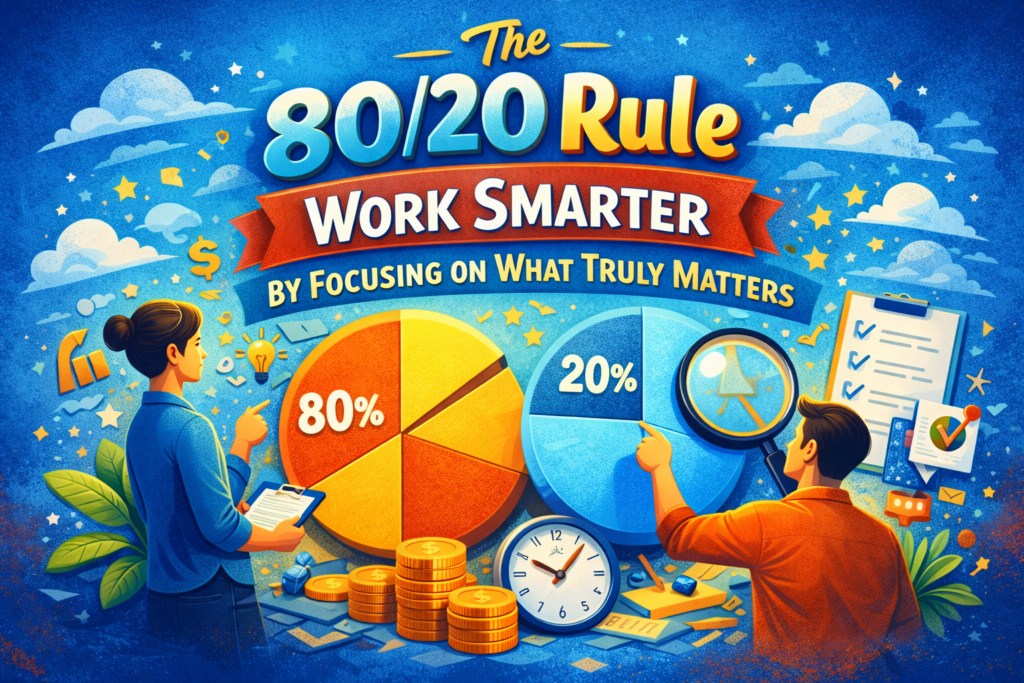
Have you ever felt like your to-do list has a life of its own? One task leads to another, emails pile up, deadlines chase you, and by the end of the day, it feels like you have been busy but not necessarily productive. As the saying goes, “Don’t work harder, work smarter.” One of the simplest ways to do that is by applying the 80/20 rule, also known as the Pareto Principle.
This powerful idea helps people focus on the tasks that create the biggest results. Instead of spreading your energy across dozens of activities, the 80/20 rule shows you how to concentrate on what actually moves the needle.
A Short Story About Sarah
Let me tell you a quick story.
Sarah was overwhelmed. Her day started with emails, continued with meetings, and ended with a growing pile of unfinished tasks. Her to-do list was so long that it felt like it had swallowed another to-do list.
One day, her mentor looked at the chaos on her desk and said,
“Not all tasks are equal.”
Sarah rolled her eyes and replied, “Yeah, obviously.”
But the mentor grabbed a marker and wrote “80/20” on the board.
Sarah frowned. “Math?”
“No,” the mentor said. “A shortcut.”
Curious, Sarah decided to track one full week of her work. The results surprised her.
- Most of her stress came from two demanding clients
- Most of her revenue came from three key projects
- Most of her progress came from a few important tasks she kept delaying
In other words, a small portion of her actions created most of her results.
Sarah realized something powerful. About 20% of her work was responsible for nearly 80% of her outcomes, both positive and negative.
So she made a simple change. She focused on the tasks that truly mattered and reduced the busy work that drained her energy.
Two weeks later, her workload looked similar. But her results had dramatically improved, and for the first time in a while, she felt in control.
That is the power of the 80/20 rule.
What Is the 80/20 Rule?
The 80/20 rule, or Pareto Principle, states that roughly 80% of results come from 20% of efforts. While the exact numbers may vary, the idea remains consistent: a small number of inputs usually drive the majority of outcomes.
This principle appears in many areas of life and business.
| Area | Example of the 80/20 Rule |
|---|---|
| Business | 80% of revenue comes from 20% of customers |
| Productivity | 80% of results come from 20% of tasks |
| Sales | 80% of sales come from 20% of products |
| Time Management | 20% of activities create 80% of progress |
Understanding this concept helps you focus on what truly matters rather than spreading yourself too thin.
Why the 80/20 Rule Matters for Productivity
Many people confuse being busy with being productive. However, productivity is not about doing more tasks. It is about doing the right tasks.
When you apply the 80/20 rule, you begin to:
- Identify high-impact activities
- Reduce unnecessary tasks
- Improve efficiency
- Achieve better results with less stress
Instead of constantly reacting to everything on your list, you start prioritizing work that creates meaningful outcomes.
How to Identify Your 20%
Finding your most impactful activities requires observation and reflection. Here are some simple steps to get started.
1. Track Your Work
Spend one week observing how you spend your time. Write down:
- Tasks you complete
- Time spent on each activity
- Results produced
Patterns will quickly start to appear.
2. Identify High-Impact Tasks
Ask yourself these questions:
- Which tasks generate the most results?
- Which activities lead to revenue, growth, or progress?
- Which tasks create the biggest difference in outcomes?
These are likely part of your 20%.
3. Remove or Reduce Low-Value Tasks
Not every task deserves equal attention. Consider reducing:
- Repetitive busy work
- Unnecessary meetings
- Tasks that do not produce meaningful results
Freeing up time allows you to invest more energy into high-impact work.
Practical Examples of the 80/20 Rule
You can apply the 80/20 principle to many parts of life.
Work and Career
Often, a small number of projects or responsibilities contribute the most to professional success.
Examples include:
- Key client relationships
- Strategic projects
- Skills that deliver the most value
Focusing on these areas can accelerate career growth.
Business and Marketing
In many businesses, a handful of customers drive the majority of revenue.
Businesses can benefit by:
- Strengthening relationships with top clients
- Investing more in high-performing marketing channels
- Improving their best-selling products
Personal Productivity
When managing your day, certain tasks contribute far more to progress than others.
For example:
- Planning your day effectively
- Completing one important project task
- Learning a skill that improves your expertise
These actions can create disproportionate results.
Common Mistakes When Applying the 80/20 Rule
While the concept is simple, people sometimes misuse it. Here are a few common mistakes.
- Ignoring important but infrequent tasks
Some responsibilities still need attention even if they are not part of your core 20%. - Trying to eliminate too much
The goal is optimization, not avoidance of necessary work. - Not reviewing priorities regularly
Your 20% can change over time as goals and responsibilities evolve.
A regular review ensures you stay focused on what truly matters.
A Simple Framework to Use Daily
You can apply the 80/20 rule to your daily routine with a simple method.
- List all tasks for the day
- Identify the two or three tasks with the highest impact
- Complete those tasks first
- Handle smaller tasks afterward
This approach ensures that even if the day becomes busy, the most valuable work still gets done.
Final Thoughts
The story of Sarah highlights an important truth. Not all tasks are equal.
A small number of actions often create the majority of results. Once you identify those actions, everything changes.
Instead of feeling overwhelmed by endless tasks, you begin focusing on work that truly matters. Your productivity increases, your stress decreases, and your progress becomes clearer.
The 80/20 rule is not about doing less work. It is about doing the right work.
So here is a question worth asking yourself today:
What is your 20%?